
Overview
Autonomous Vehicle Systems & Testing represents one of the most technically demanding disciplines within the automotive industry. Every prototype vehicle, autonomous driving controller, perception system, sensor fusion algorithm, and safety function must be validated through thousands of structured engineering activities before production deployment.
Unlike conventional vehicle testing, autonomous vehicle validation combines software engineering, electrical engineering, mechanical engineering, embedded systems, artificial intelligence, machine learning, simulation, cybersecurity, and functional safety into a continuous development lifecycle. Validation teams simultaneously evaluate perception performance, localization accuracy, path planning, actuator control, redundant safety systems, over-the-air software updates, V2X communications, digital twin models, and advanced driver assistance systems under thousands of operating scenarios.
Managing these activities requires far more than traditional asset management. Engineering organizations need continuous visibility into prototype vehicles, validation engineers, proving ground personnel, calibration equipment, engineering laboratories, software builds, prototype components, and controlled access zones while maintaining complete engineering traceability.
AVehicle AI delivers AI and IoT solutions specifically designed for these environments. By combining artificial intelligence with industrial identification technologies such as RFID, BLE, Ultra-Wideband (UWB), GNSS, GPS, digital credentials, and computer vision, engineering organizations gain accurate operational awareness without disrupting existing validation workflows.
Rather than focusing on environmental sensing, the solution emphasizes identification, positioning, authentication, engineering workflow visibility, and operational analytics throughout autonomous vehicle development.
Autonomous Vehicle Validation Campus Infographic | AI-Powered ADAS Testing, Digital Twin & IoT Engineering
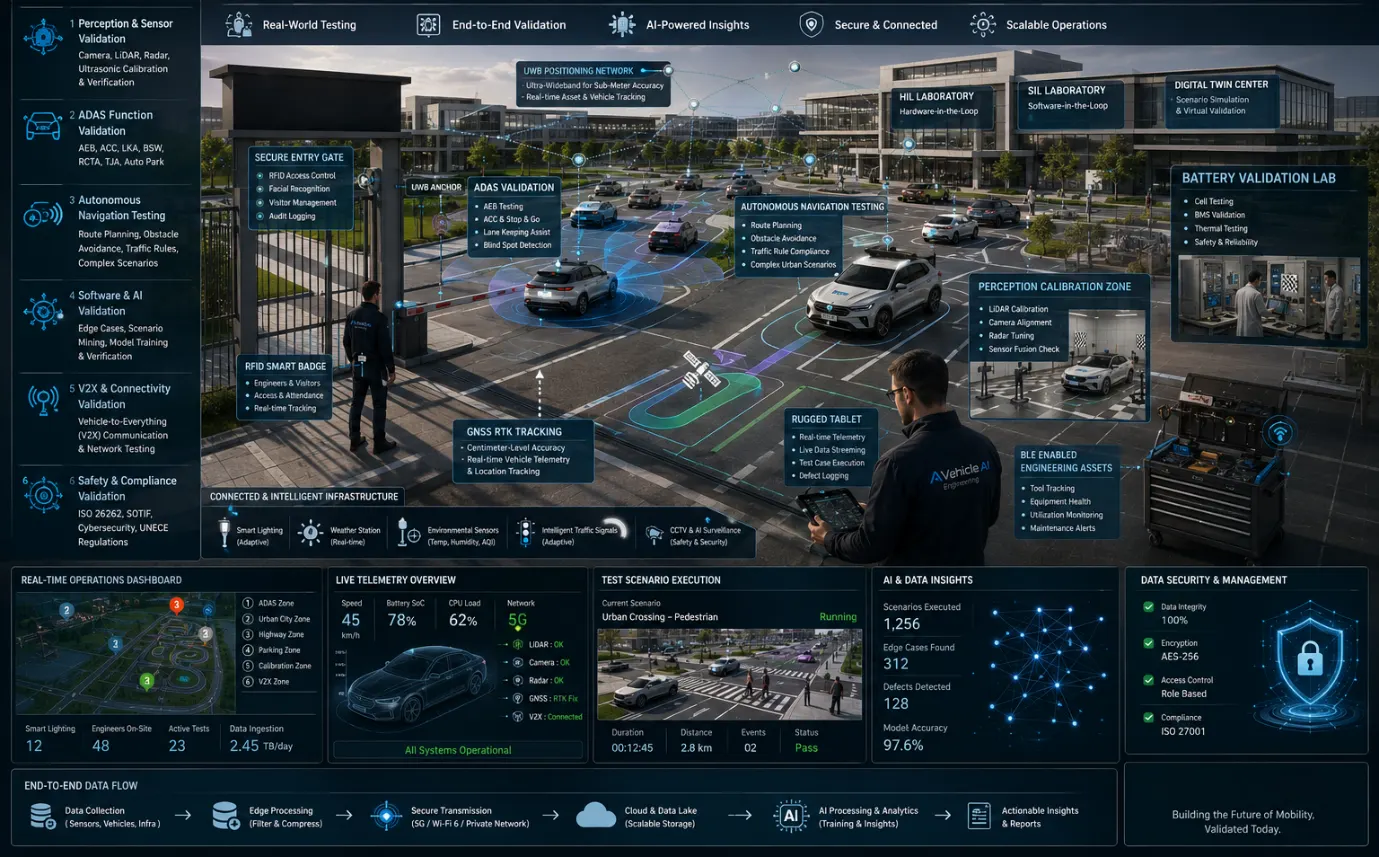
AI and IoT for Autonomous Vehicle Systems & Testing
Developing autonomous vehicles requires coordinated management of engineering personnel, prototype vehicles, validation laboratories, software releases, hardware revisions, calibration tools, engineering documentation, and secure testing facilities. Every engineering decision must be supported by reliable identification records that connect physical assets with validation evidence and software configuration history.
AI and IoT combines artificial intelligence with industrial identification technologies to transform operational events into actionable engineering insights. RFID, BLE, UWB, GNSS, GPS, Edge AI, and computer vision continuously identify personnel, vehicles, engineering equipment, and controlled assets. AI software analyzes these identification events to improve engineering coordination, optimize resource utilization, strengthen security, and support engineering decision-making.
Unlike production environments where repeatability is the primary objective, autonomous vehicle engineering focuses on iterative validation. Software builds change daily, electronic control units (ECUs) are repeatedly reconfigured, perception models are retrained, sensor calibration evolves throughout development, and engineering teams execute thousands of validation scenarios across multiple facilities.
AI and IoT supports this dynamic environment by providing:
The result is improved operational coordination without replacing existing engineering systems.
Engineering Challenges in Autonomous Vehicle Validation
Autonomous driving systems integrate cameras, radar, LiDAR, ultrasonic systems, inertial navigation, GNSS positioning, high-performance computing platforms, perception software, machine learning models, path planning algorithms, actuator controllers, cybersecurity functions, and functional safety mechanisms.
Validating these technologies requires extensive coordination across proving grounds, laboratories, engineering workshops, and remote validation facilities.
Organizations commonly encounter challenges such as:
As vehicle automation progresses toward SAE Level 3, Level 4, and Level 5 autonomy, operational complexity increases substantially. Development programs often involve millions of kilometers of proving ground testing, simulation, closed-course validation, public road evaluation where permitted, and continuous software iteration.
AI and IoT identification solutions provide reliable operational awareness by transforming location and identification events into engineering analytics that support planning, scheduling, security, and validation governance.
AI Function for AIoT-Enabled Autonomous Vehicle Testing
Autonomous vehicle validation programs involve thousands of engineering activities performed across proving grounds, ADAS validation laboratories, Hardware-in-the-Loop (HIL) facilities, Software-in-the-Loop (SIL) environments, Vehicle-in-the-Loop (VIL) test centers, battery validation laboratories, and connected vehicle development sites. AI and IoT transforms identification and location data into operational analytics that improve engineering coordination, resource utilization, security, and traceability while supporting functional safety and validation objectives.
Rather than focusing on generic workforce or asset management, AVehicle AI emphasizes engineering-specific operational visibility where prototype vehicles, validation equipment, engineering personnel, software builds, and configuration-controlled assets are continuously identified, authenticated, and analyzed throughout the development lifecycle.
Autonomous Test Workforce Analytics
Engineering personnel frequently move between validation facilities, calibration laboratories, proving grounds, crash test centers, battery laboratories, and software validation environments. Maintaining accurate awareness of workforce location supports operational efficiency, emergency response, engineering coordination, and controlled access to confidential development programs.
Capabilities include:
AI analyzes workforce movement patterns to identify congestion, underutilized engineering resources, scheduling conflicts, and operational bottlenecks while maintaining comprehensive historical records.
Autonomous Test Facility Access
Autonomous vehicle development facilities contain highly confidential software, prototype electronics, AI models, perception algorithms, calibration equipment, and intellectual property requiring strict access governance.
AI-assisted access management supports:
Identification events can be correlated with engineering schedules, project assignments, and laboratory reservations to help identify unauthorized activities and improve operational governance.
Prototype Vehicle Asset Analytics
Prototype vehicles represent significant engineering investments and frequently transition between workshops, calibration facilities, environmental chambers, proving grounds, charging infrastructure, and engineering laboratories.
AI and IoT improves visibility through:
Engineering managers can rapidly determine asset location, availability, assignment status, and utilization without interrupting ongoing validation programs.
Autonomous Test Inventory
Engineering validation depends upon immediate availability of prototype components, embedded controllers, validation hardware, calibration devices, and replacement assemblies.
AI-assisted inventory management supports:
Identification technologies reduce manual inventory reconciliation while improving engineering planning and prototype readiness.
Autonomous Validation Workflow
Validation campaigns include thousands of structured engineering activities involving software verification, perception evaluation, vehicle calibration, hardware validation, safety analysis, and engineering approvals.
AI supports workflow visibility by analyzing:
Operational analytics assist engineering leadership in identifying schedule risks, workflow bottlenecks, and resource constraints before they affect development timelines.
Autonomous Vehicle Traceability
Comprehensive traceability is fundamental throughout autonomous vehicle engineering.
Every software release, ECU revision, battery configuration, prototype vehicle, calibration procedure, engineering modification, validation report, and approval activity should be associated with accurate identification records.
Traceability capabilities include:
These records simplify engineering investigations while supporting quality assurance, functional safety documentation, and internal development governance.
IoT Software for Autonomous Vehicle Systems & Testing
AI and IoT software connects industrial identification technologies with engineering operations to provide centralized operational visibility across validation programs.
The software is designed to complement existing engineering systems while supporting secure, scalable deployment across proving grounds, laboratories, engineering centers, and distributed validation facilities.
Test Personnel Tracking Software
Personnel identification software improves operational awareness through:
Validation Access Software
Engineering access management software supports:
Prototype Asset Tracking Software
Engineering asset software manages:
Validation Inventory Software
Inventory software supports:
The software helps engineering organizations improve inventory accuracy, reduce asset search time, and support uninterrupted validation activities.
IoT Hardware Technologies for Autonomous Vehicle Systems & Testing
Reliable industrial identification depends upon robust hardware capable of operating within demanding automotive engineering environments.
AVehicle AI supports multiple wireless identification technologies selected according to positioning accuracy, operational range, environmental conditions, infrastructure requirements, and engineering objectives.
Engineering Identification Devices
Personnel identification technologies include:
These technologies improve workforce identification while supporting secure engineering operations.
Prototype Vehicle Identification
Vehicle identification solutions include:
Industrial Wireless Technologies
Different validation environments require different wireless technologies.
Supported technologies include:
Multiple technologies can operate together to provide the positioning accuracy and coverage required across large engineering campuses.
Validation Access Devices
Access hardware includes:
These systems maintain secure engineering facilities while supporting comprehensive audit records.
Prototype Asset Identification
Engineering assets can be uniquely identified using:
Consistent identification supports engineering lifecycle management, maintenance planning, utilization analysis, and long-term traceability.
AIoT Technical Block Diagram for Autonomous Vehicle Testing and Engineering Operations
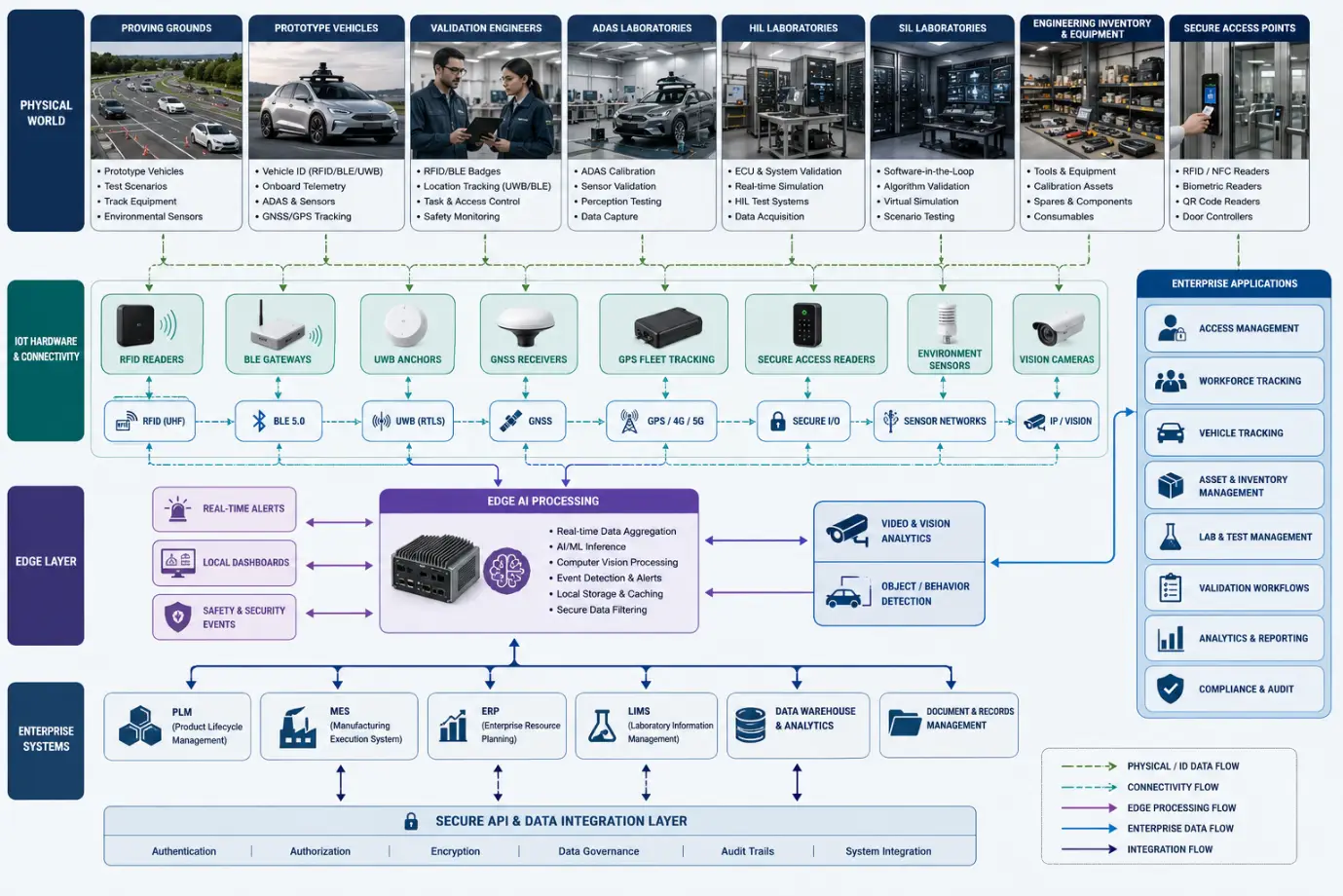
AIoT Integration for Autonomous Vehicle Systems & Testing
Autonomous vehicle engineering depends on continuous collaboration between product development, validation, quality assurance, fleet operations, laboratory management, and enterprise business systems. AI and IoT identification solutions deliver maximum value when engineering events, asset identification, workforce visibility, access records, and validation activities are securely exchanged with existing enterprise software.
AVehicle AI is designed to integrate with established engineering environments while preserving data integrity, cybersecurity, configuration management, and operational continuity throughout the autonomous vehicle development lifecycle.
Autonomous Engineering Connectivity
Engineering organizations frequently coordinate prototype development across mechanical engineering, electrical engineering, embedded software development, validation, quality assurance, manufacturing engineering, and supplier collaboration.
Common integration scenarios include:
These integrations improve consistency between engineering identification records and enterprise business processes while reducing duplicate manual data entry.
Edge Computing for Validation Operations
Remote proving grounds, environmental durability tracks, winter testing facilities, desert validation locations, and geographically distributed engineering centers may experience limited or intermittent network connectivity.
Edge AI enables local processing of identification events so validation activities continue without interruption. RFID, BLE, UWB, GNSS, GPS, access control, and computer vision events can be processed locally and synchronized with central engineering systems when communication becomes available.
Capabilities include:
This approach improves operational resilience while reducing unnecessary network traffic.
Validation Data Synchronization
Large validation programs often span multiple engineering campuses and international development centers. Consistent engineering records are essential for maintaining accurate prototype history and engineering traceability.
Synchronization capabilities include:
These capabilities help engineering organizations coordinate geographically distributed validation activities while maintaining consistent engineering documentation.
Flexible Deployment Models
Automotive organizations have diverse cybersecurity policies, IT governance requirements, and operational preferences.
AVehicle AI supports multiple deployment models including:
Flexible deployment options enable organizations to align AI and IoT implementations with internal IT policies and business continuity strategies.
Security and Identity Connectivity
Autonomous vehicle development programs involve confidential engineering information, prototype software, pre-production electronics, and intellectual property that require comprehensive protection.
Security capabilities include:
These capabilities support cybersecurity initiatives while maintaining engineering accountability throughout development.
Benefits of AI and IoT for Autonomous Vehicle Systems & Testing
Autonomous vehicle validation requires continuous coordination between engineering personnel, prototype vehicles, validation equipment, software development, laboratory operations, and engineering documentation.
AI and IoT identification technologies help organizations improve operational performance by enabling:
These improvements help engineering organizations focus more effectively on validation quality, safety verification, and development efficiency.
Supporting Advanced Automotive Engineering Programs
Autonomous vehicle development increasingly incorporates technologies such as software-defined vehicles, over-the-air software updates, connected mobility, V2X communications, high-performance domain controllers, AI perception models, and digital engineering workflows.
AI and IoT identification solutions support these initiatives by improving visibility of engineering operations without disrupting established validation methodologies. Accurate identification of personnel, assets, prototype vehicles, engineering inventory, and controlled facilities contributes to more consistent engineering execution across complex development programs.
Organizations working toward compliance with standards such as ISO 26262 Functional Safety, ISO/PAS 21448 SOTIF, Automotive SPICE (ASPICE), UNECE R155 Cybersecurity Management Systems, and UNECE R156 Software Update Management Systems can also benefit from comprehensive identification records that support engineering documentation and operational governance.
Experience Supporting Automotive Engineering Organizations
AVehicle AI was created within Aperture Venture Studio with support from GAO, building upon more than two decades of practical experience delivering industrial IoT identification and location solutions across advanced engineering environments.
Extensive investment in research and development, rigorous quality assurance processes, and experienced engineering support have contributed to solutions designed for demanding operational requirements. Technical leadership includes Ph.D. professionals from leading universities working alongside experienced industry specialists and strategic technology partners.
Over the years, experience gained from thousands of industrial IoT projects has supported Fortune 500 manufacturers, major research organizations, prestigious universities, and government agencies throughout the United States and Canada. These practical deployment experiences continue to influence the design of AI and IoT solutions for autonomous vehicle engineering and validation.
Contact AVehicle AI
Whether your organization manages an autonomous proving ground, an ADAS validation laboratory, a software verification center, a battery validation facility, or a distributed prototype fleet, AVehicle AI can help improve operational visibility through AI and IoT identification technologies.
Our engineering specialists evaluate existing validation workflows, recommend appropriate RFID, BLE, UWB, GNSS, GPS, computer vision, and digital identification technologies, and design solutions that integrate with current engineering software while supporting long-term operational objectives.
Contact AVehicle AI to discuss your autonomous vehicle validation requirements, engineering challenges, deployment preferences, and digital transformation initiatives.
Contact AVehicle AI