
AI Software for Autonomous Vehicle Validation, ADAS Verification, Prototype Vehicle Management, Engineering Traceability, and Proving Ground Operations
Autonomous vehicle validation is a multidisciplinary engineering process that combines mechanical engineering, embedded software, artificial intelligence, perception systems, functional safety, cybersecurity, and systems engineering. Successful validation requires continuous coordination among prototype vehicles, engineering personnel, validation equipment, software releases, engineering assets, and testing facilities distributed across multiple locations.
AI and IoT software transforms identification and location events into actionable operational insights by integrating RFID, Bluetooth® Low Energy (BLE), Ultra-Wideband (UWB), RTK GNSS, GPS, digital credentials, smart identification badges, QR-based identification, Edge AI, and enterprise engineering software. Rather than functioning as isolated tracking tools, these technologies work together to create a trusted operational picture of engineering activities throughout the validation lifecycle.
Unlike traditional vehicle manufacturing environments that focus primarily on production throughput, autonomous vehicle testing emphasizes repeatability, engineering accuracy, configuration control, and traceable validation evidence. AI software continuously analyzes operational information associated with personnel movement, prototype vehicle utilization, engineering equipment availability, laboratory access, inventory transactions, workflow progression, and engineering documentation to support informed technical decision-making.
Engineering teams responsible for validating perception algorithms, sensor fusion software, motion planning, localization, vehicle control systems, and autonomous driving stacks benefit from real-time operational visibility into:
- Validation engineer assignments across proving grounds and laboratories
- Autonomous test driver availability and workload distribution
- Prototype vehicle allocation and utilization
- ADAS calibration equipment availability
- Engineering asset movement between facilities
- High-value diagnostic tool utilization
- Restricted-area access authorization
- Validation inventory availability
- Prototype component identification
- Engineering workflow progress
- Test campaign execution status
- Configuration and software build associations
- Engineering change implementation
- Validation evidence organization
- Multi-site engineering coordination
AI models evaluate historical and real-time operational data to identify workflow bottlenecks, resource conflicts, underutilized assets, scheduling inefficiencies, and deviations from planned validation activities. These insights help engineering managers optimize laboratory utilization, reduce prototype downtime, improve proving ground scheduling, and coordinate multidisciplinary validation teams more effectively.
Edge AI extends these capabilities to remote proving grounds, outdoor validation tracks, environmental testing facilities, and distributed engineering campuses where low-latency decision support is important. Local processing enables identity verification, access authorization, and operational analytics even when connectivity to centralized systems is limited, with synchronized updates occurring once communication is restored.
Integration with Manufacturing Execution Systems (MES), Product Lifecycle Management (PLM) software, Enterprise Resource Planning (ERP) systems, Application Lifecycle Management (ALM) tools, engineering databases, fleet management software, digital twin environments, and validation documentation systems ensures that operational information remains consistent across the entire autonomous vehicle development lifecycle. This unified approach reduces duplicate data entry, strengthens engineering governance, and improves collaboration among software, hardware, validation, quality, and systems engineering teams.
Beyond day-to-day operational coordination, AI and IoT supports compliance-oriented engineering practices by helping organizations maintain structured records that align with ISO 26262 functional safety processes, ISO/PAS 21448 (SOTIF) validation activities, ASPICE engineering workflows, UNECE R155 cybersecurity management, UNECE R156 software update governance, and vehicle homologation preparation. While engineering expertise remains central to validation, AI software provides the operational transparency needed to execute complex development programs with greater confidence.
AVehicle AI was established within Aperture Venture Studio with support from GAO, drawing on more than two decades of industrial IoT experience. Backed by extensive research and development, rigorous quality assurance, and technical leadership from Ph.D.-level professionals, the company has supported thousands of IoT deployments across advanced engineering environments. This experience includes collaborations with Fortune 500 manufacturers, leading automotive R&D organizations, prestigious universities, and government agencies throughout the United States and Canada, providing practical expertise for complex autonomous vehicle systems and testing operations.
Autonomous Test Facility Access
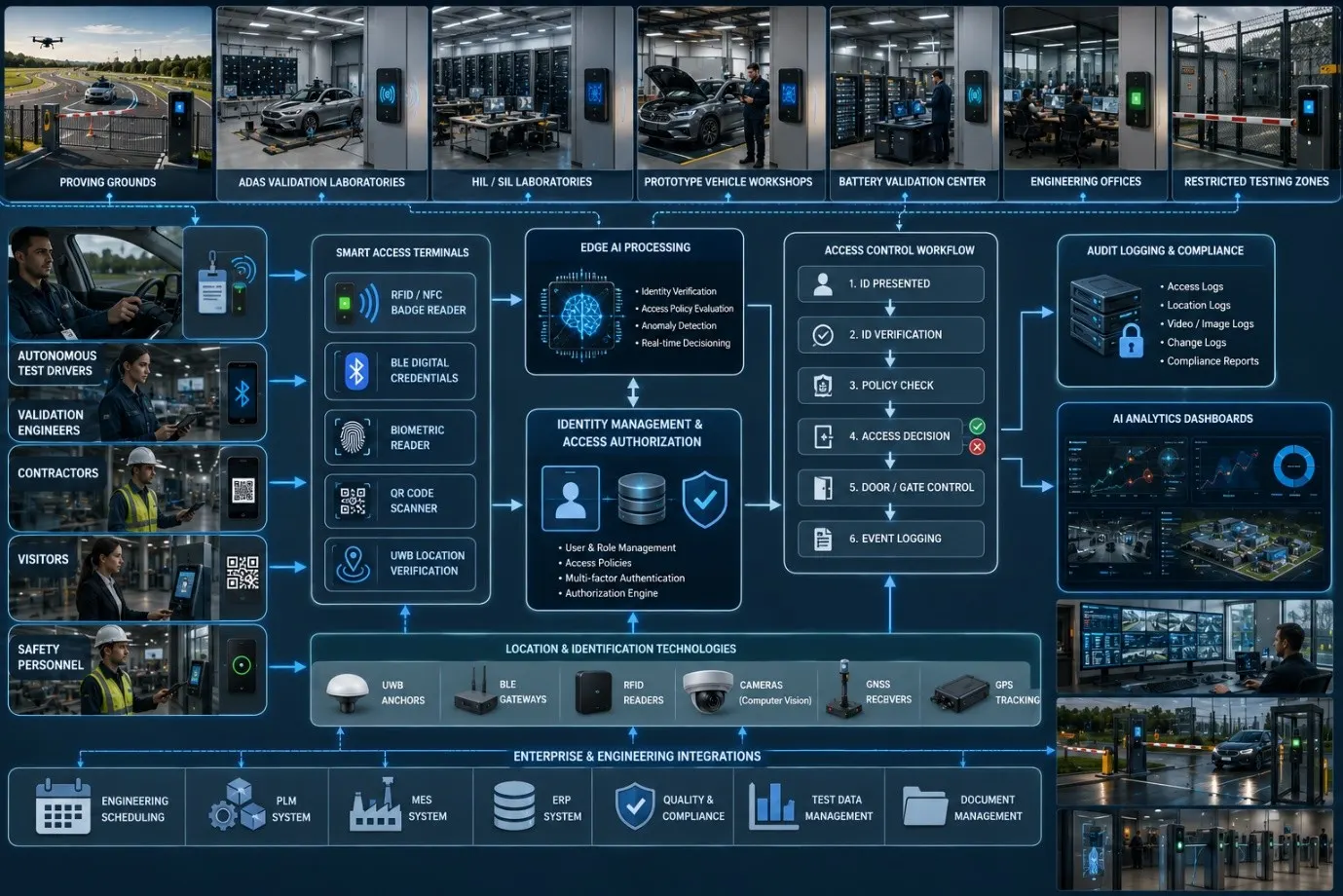
Autonomous vehicle validation facilities require strict access governance because they contain confidential vehicle prototypes, proprietary autonomous driving software, advanced ADAS development equipment, high-value engineering assets, and restricted testing environments. Proving grounds, autonomous driving laboratories, HIL/SIL facilities, battery validation centers, prototype workshops, and vehicle calibration laboratories must control access while enabling engineers to execute complex validation programs efficiently.
Traditional access control systems often record only entry and exit events. Autonomous vehicle testing requires a more comprehensive operational view that connects personnel identity, authorization status, engineering assignments, validation schedules, facility zones, and prototype activities.
AI and IoT access analytics combines RFID identification, BLE credentials, UWB location technologies, smart badges, QR-based visitor identification, biometric verification, computer vision where appropriate, and AI-driven analytics to improve secure access management across autonomous vehicle testing environments.
The objective is not only to restrict unauthorized entry. AI software helps engineering organizations understand how facilities are being used, whether authorized personnel are assigned correctly, whether restricted validation areas are protected, and whether engineering resources are available when required for scheduled testing.
AI-driven access analytics supports automotive organizations involved in:
- Advanced Driver Assistance Systems (ADAS) validation
- Autonomous driving software verification
- Vehicle perception testing
- Sensor fusion validation
- Autonomous fleet testing
- Prototype vehicle evaluation
- Functional safety verification
- Cybersecurity testing
- Connected vehicle development
- Vehicle-to-Everything (V2X) validation
By connecting access records with engineering operations, organizations gain improved visibility into validation activities while maintaining strong security controls around intellectual property and safety-critical development programs.
Proving Ground Access Analytics
Autonomous proving grounds are highly specialized testing environments containing multiple controlled zones designed for different validation scenarios. These may include highway simulation tracks, urban driving environments, pedestrian crossing areas, intersection testing zones, emergency braking areas, vehicle dynamics tracks, adverse weather facilities, and autonomous shuttle routes.
Each area may require different access permissions based on:
- Engineering role
- Validation program assignment
- Safety certification
- Test schedule
- Vehicle type
- Testing scenario
- Operational responsibility
AI and IoT access analytics helps proving ground operators verify that personnel entering specific test zones have appropriate authorization and are associated with approved validation activities.
Operational insights include:
- Personnel presence across active proving ground zones
- Authorized access verification
- Restricted-area entry analysis
- Workforce distribution during test campaigns
- Test zone utilization trends
- Historical access reporting
- Emergency personnel accountability
For large autonomous vehicle testing programs, this visibility improves coordination between test drivers, validation engineers, safety supervisors, and facility operators.
AI analytics can also help identify operational patterns such as frequently congested areas, underutilized validation zones, or scheduling conflicts between different engineering programs.
ADAS Validation Lab Access Analytics
ADAS validation laboratories contain highly specialized development resources, including perception test equipment, camera calibration systems, radar verification tools, LiDAR evaluation equipment, ECU programming stations, simulation environments, and vehicle communication testing systems.
Access control within these facilities must balance engineering collaboration with protection of confidential vehicle technologies and software development assets.
AI and IoT access analytics provides visibility into:
- Authorized engineering personnel entering validation laboratories
- Laboratory usage by project team
- Access frequency trends
- Validation resource utilization
- Restricted laboratory activity records
- Engineering shift coordination
Integration with engineering identity management systems allows organizations to align access permissions with project roles, development programs, and validation responsibilities.
This approach supports secure collaboration among:
- ADAS software engineers
- Embedded software developers
- Vehicle systems engineers
- Calibration specialists
- Verification and validation engineers
- Functional safety teams
- Cybersecurity engineers
By understanding how laboratories are used, organizations can improve facility planning and maximize utilization of expensive validation infrastructure.
Autonomous Test Zone Authorization
Autonomous vehicle testing often involves temporary or dynamic validation zones created for specific engineering objectives. Examples include autonomous driving scenarios, connected vehicle demonstrations, perception evaluation areas, and safety validation environments.
Access requirements may change depending on:
- Active test campaigns
- Prototype vehicle status
- Environmental conditions
- Safety procedures
- Engineering responsibilities
- Regulatory requirements
AI software supports dynamic authorization by connecting personnel identity, digital credentials, test schedules, and operational requirements.
Capabilities include:
- Temporary test zone authorization
- Role-based access verification
- Digital credential validation
- Engineering assignment matching
- Access exception monitoring
- Test area occupancy analytics
This enables engineering organizations to maintain flexible testing operations without compromising safety, confidentiality, or operational control.
Test Contractor Access Verification
Autonomous vehicle programs frequently involve external specialists supporting prototype development, calibration services, validation activities, infrastructure maintenance, and engineering integration.
Contractors may require access to:
- Proving grounds
- Prototype workshops
- Calibration laboratories
- Battery facilities
- Software validation environments
- Engineering support areas
AI and IoT contractor access verification ensures that external personnel receive appropriate access based on approved requirements.
AI software can support:
- Digital contractor credentials
- Time-limited authorization
- Project-based access permissions
- Contractor identity verification
- Training and qualification confirmation
- Access activity reporting
These capabilities help automotive organizations protect proprietary autonomous driving technologies while maintaining efficient collaboration with suppliers and engineering partners.
Validation Visitor Access Analytics
Autonomous vehicle testing facilities frequently host visitors including:
- Automotive suppliers
- Research partners
- Regulatory representatives
- University researchers
- Certification organizations
- Customer engineering teams
- Executive leadership
Visitor access must provide appropriate transparency while protecting confidential vehicle programs and intellectual property.
AI and IoT visitor management solutions support:
- Digital visitor registration
- Host approval workflows
- Temporary identification credentials
- Escort requirement management
- Facility access history
- Visitor activity reporting
AI analytics provides additional operational visibility by helping organizations understand visitor patterns, facility usage, and compliance with established access procedures.
Benefits of AI-Enabled Access Management for Autonomous Vehicle Testing
AI-driven facility access analytics helps transform access control from a security-only function into an operational resource supporting engineering performance.
Key benefits include:
- Improved protection of prototype vehicles and confidential autonomous driving technologies
- Faster authorization verification for engineering personnel
- Better coordination between proving grounds and validation laboratories
- Reduced administrative effort associated with contractor and visitor management
- Improved audit readiness for engineering compliance programs
- Enhanced visibility into facility utilization
- Better support for emergency response procedures
- More accurate workforce planning across distributed validation locations
For automotive organizations developing complex autonomous vehicle systems, secure access management is essential for maintaining reliable validation operations while accelerating innovation.
AI-Enabled Autonomous Vehicle Facility Access Control Workflow Diagram
Prototype Vehicle Asset Analytics
Prototype vehicles and engineering assets represent some of the most valuable resources within autonomous vehicle development programs. Unlike conventional production vehicles, autonomous prototypes are continuously modified with new ECUs, domain controllers, software releases, calibration configurations, perception systems, communication modules, and experimental hardware throughout the validation lifecycle.
Managing these assets requires accurate identification, location visibility, utilization analysis, and configuration awareness across multiple engineering environments, including autonomous proving grounds, ADAS laboratories, prototype workshops, battery validation centers, HIL/SIL laboratories, and supplier validation facilities.
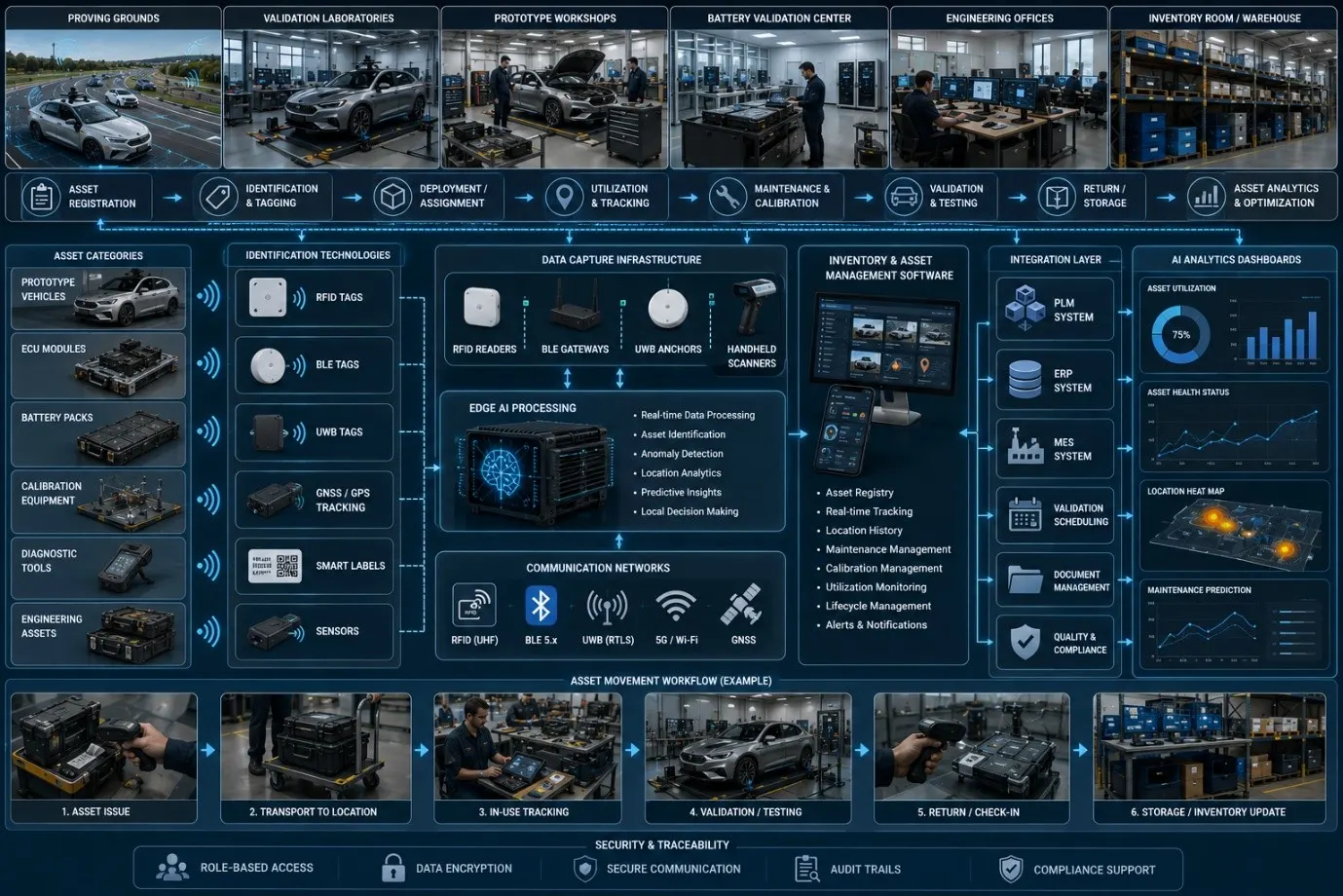
AI and IoT asset analytics combines RFID, BLE, UWB, GNSS, GPS, digital identification technologies, and AI-based analytics to provide engineering teams with operational visibility into prototype vehicle availability, equipment utilization, asset movement, and validation readiness.
The objective is not simply tracking where an asset is located. AI software analyzes asset movement patterns, engineering assignments, validation schedules, and utilization history to help organizations improve prototype availability, reduce downtime, and optimize expensive engineering resources.
Prototype Autonomous Vehicle Tracking
Autonomous vehicle prototypes frequently move between engineering facilities depending on development requirements. A single vehicle may transition from prototype assembly to ECU integration, ADAS calibration, proving ground testing, environmental validation, software verification, and fleet evaluation.
AI-enabled vehicle tracking supports operational visibility into:
- Prototype vehicle location
- Vehicle allocation by validation program
- Engineering ownership
- Test campaign assignment
- Movement history between facilities
- Vehicle utilization trends
- Prototype availability status
Using RFID identification, UWB positioning, GNSS/GPS tracking, and connected engineering software, organizations can maintain accurate awareness of prototype fleets throughout development.
This helps engineering teams reduce delays caused by unavailable vehicles, improve scheduling accuracy, and maximize the value of limited prototype resources.
For autonomous driving programs involving multiple vehicle platforms, AI analytics can identify:
- Underutilized prototype vehicles
- Excessive vehicle transfer between facilities
- Scheduling conflicts
- Validation resource constraints
- Fleet allocation opportunities
These insights support more efficient management of autonomous vehicle development programs.
ADAS Test Equipment Tracking
ADAS validation requires specialized equipment used for perception testing, calibration, communication verification, and system integration. Examples include:
- Camera calibration equipment
- Radar calibration tools
- LiDAR alignment equipment
- GNSS reference systems
- Vehicle communication analyzers
- Diagnostic instruments
- Data acquisition equipment
- Test computing systems
Many of these assets are shared between engineering teams and frequently transported between laboratories and proving grounds.
AI and IoT asset tracking software helps organizations maintain visibility into:
- Equipment location
- Asset assignment
- Usage frequency
- Laboratory availability
- Engineering ownership
- Movement history
- Validation project allocation
This reduces time spent searching for specialized equipment and helps ensure that critical validation resources are available when required.
Mobile Calibration Asset Analytics
Calibration assets play a critical role in autonomous vehicle verification because perception systems and vehicle control functions depend on accurate configuration and alignment.
Mobile calibration equipment often moves between:
- Prototype workshops
- ADAS laboratories
- Proving grounds
- Vehicle integration facilities
- Supplier engineering locations
AI analytics provides insights into:
- Calibration equipment utilization
- Asset movement patterns
- Engineering demand
- Location history
- Maintenance planning requirements
- Resource availability
By understanding how calibration assets are used across development programs, engineering organizations can improve scheduling, reduce idle time, and make better decisions regarding future equipment investments.
Autonomous Diagnostic Tool Tracking
Diagnostic tools are essential for analyzing vehicle behavior, debugging embedded systems, verifying ECU communication, and supporting software integration activities.
These tools may contain proprietary engineering configurations and require controlled access throughout validation programs.
AI and IoT tracking solutions provide visibility into:
- Diagnostic tool location
- Authorized user assignment
- Project allocation
- Usage history
- Storage verification
- Availability status
This improves accountability while helping engineering teams quickly locate required diagnostic resources during critical validation activities.
Validation Fleet Utilization Analytics
Autonomous vehicle testing programs often operate fleets of prototype vehicles supporting different engineering objectives, including:
- Autonomous driving validation
- ADAS feature verification
- Software release testing
- Vehicle dynamics evaluation
- Connected vehicle testing
- Regulatory preparation activities
AI fleet utilization analytics helps engineering managers understand how prototype vehicles are being used across development programs.
Operational insights include:
- Vehicle usage frequency
- Validation program allocation
- Idle prototype identification
- Testing resource distribution
- Facility demand patterns
- Fleet scheduling optimization
These insights help organizations increase prototype utilization while reducing unnecessary vehicle downtime.
Autonomous Test Inventory
Autonomous vehicle development requires careful management of prototype components, ECUs, battery packs, replacement assemblies, engineering tools, calibration equipment, and validation resources.
Unlike standard manufacturing inventory, autonomous testing inventory frequently includes experimental components, limited-production assemblies, multiple hardware revisions, and engineering samples associated with specific validation programs.
AI and IoT inventory software improves visibility by connecting identification technologies with inventory records, engineering assignments, and validation workflows.
This enables organizations to understand not only what inventory exists, but also where it is located, which project requires it, and whether it is available for upcoming validation activities.
Prototype Vehicle Parts Inventory
Prototype programs often require specialized components that may not exist in production supply chains. These include revised mechanical assemblies, electronic modules, prototype wiring systems, vehicle control components, and experimental hardware.
AI inventory analytics supports:
- Component identification
- Storage location visibility
- Prototype allocation
- Engineering ownership tracking
- Availability analysis
- Movement history
This improves coordination between engineering teams and reduces delays caused by unavailable prototype components.
Autonomous ECU Inventory Analytics
Modern autonomous vehicles depend on complex electronic systems, including:
- Vehicle domain controllers
- Autonomous driving computers
- Gateway modules
- Powertrain controllers
- Body control modules
- Communication units
Engineering organizations often evaluate multiple ECU revisions and software configurations simultaneously.
AI and IoT inventory analytics helps manage:
- ECU identification
- Hardware revision tracking
- Software build association
- Laboratory allocation
- Engineering project assignment
- Validation readiness
This improves configuration control and supports accurate testing of autonomous vehicle systems.
Battery Validation Inventory Analytics
Battery packs and high-voltage components require careful identification and management during autonomous vehicle development.
AI inventory solutions support visibility into:
- Prototype battery pack allocation
- Engineering storage locations
- Validation project assignment
- Availability status
- Movement history
- Utilization records
The focus is on identification, traceability, and operational coordination rather than battery performance monitoring.
Validation Equipment Inventory
Autonomous vehicle validation facilities contain extensive inventories of engineering resources, including:
- Calibration fixtures
- Test computers
- Communication devices
- Simulation equipment
- Diagnostic hardware
- Prototype accessories
- Engineering tools
AI inventory analytics helps organizations improve:
- Asset availability
- Equipment utilization
- Laboratory coordination
- Engineering resource planning
- Inventory accuracy
This reduces administrative overhead and improves engineering productivity.
Test Spare Components Availability
During autonomous vehicle testing, unexpected failures or prototype modifications may require immediate access to replacement components.
AI inventory software helps engineering teams maintain visibility into:
- Available spare components
- Reserved inventory
- Project-specific allocation
- Replenishment requirements
- Component usage history
This improves validation readiness and reduces downtime during critical testing campaigns.
Optimizing Prototype and Inventory Management for Autonomous Vehicle Testing
Effective asset and inventory management directly influences autonomous vehicle development timelines. When engineering teams can quickly identify prototype vehicles, calibration equipment, ECUs, battery packs, and validation resources, they can execute testing programs with fewer interruptions.
AI and IoT asset and inventory analytics enables organizations to:
- Improve prototype vehicle utilization
- Reduce engineering asset search time
- Increase laboratory efficiency
- Improve inventory accuracy
- Support faster validation scheduling
- Strengthen engineering traceability
- Coordinate distributed development locations
- Improve resource planning across vehicle programs
By combining AI analytics with RFID, BLE, UWB, GNSS, GPS, and enterprise engineering systems, automotive organizations gain operational visibility needed to manage increasingly complex autonomous vehicle development programs.
AIoT Asset Tracking and Inventory Management Workflow for Autonomous Vehicle Testing
Autonomous Validation Workflow
Autonomous vehicle validation requires coordination of thousands of engineering activities across prototype development, software verification, hardware integration, ADAS testing, autonomous driving evaluation, functional safety assessment, and regulatory preparation. Unlike conventional vehicle testing, autonomous systems require continuous verification of complex software-driven behaviors, including perception, localization, prediction, planning, vehicle control, and human-machine interaction.
Validation teams must coordinate prototype vehicles, engineering personnel, simulation environments, calibration equipment, test facilities, software builds, ECU configurations, and verification documentation across multiple locations. Any delay in one activity can impact downstream testing milestones, software releases, engineering approvals, and vehicle development schedules.
AI and IoT workflow analytics improves operational visibility by connecting identification and location information with validation activities. RFID, BLE, UWB, GNSS, GPS, digital identification technologies, Edge AI, and enterprise software integrations provide engineering organizations with actionable insights into validation progress, resource utilization, prototype readiness, and testing efficiency.
The goal is not to replace engineering validation processes. Instead, AI software helps engineering teams understand operational patterns, identify workflow constraints, and make data-supported decisions throughout the autonomous vehicle development lifecycle.
Autonomous Vehicle Test Progress Analytics
Autonomous vehicle validation programs involve extensive test execution across multiple engineering domains, including:
- ADAS feature verification
- Autonomous driving scenario testing
- Perception system validation
- Sensor fusion evaluation
- Localization accuracy testing
- Motion planning verification
- Vehicle control validation
- Highway and urban driving scenarios
- Parking assistance validation
- Connected vehicle testing
- Safety-critical scenario evaluation
Each test activity depends on coordinated availability of prototype vehicles, qualified personnel, engineering equipment, and approved testing environments.
AI-driven validation analytics analyzes operational information associated with testing activities to provide visibility into:
- Completed versus planned validation activities
- Prototype vehicle availability
- Test facility utilization
- Engineering resource allocation
- Validation schedule performance
- Testing bottlenecks
- Cross-site validation progress
These insights help engineering managers identify risks earlier and improve coordination between software, hardware, systems engineering, and validation teams.
For example, if a scheduled ADAS validation campaign requires a specific prototype vehicle configuration, calibration equipment, and specialized engineering personnel, AI workflow analytics can help identify whether all required resources are available before testing begins.
ADAS Calibration Workflow Analytics
ADAS calibration is a critical activity in autonomous vehicle development because camera systems, radar systems, LiDAR systems, GNSS positioning equipment, and vehicle control systems must operate according to validated engineering requirements.
Calibration workflows often involve:
- Prototype vehicle preparation
- Calibration equipment assignment
- Engineering specialist scheduling
- Laboratory or proving ground allocation
- Software configuration verification
- Validation documentation updates
AI and IoT workflow analytics improves coordination by associating identified assets, engineering personnel, facilities, and validation activities.
Operational insights may include:
- Calibration equipment readiness
- Laboratory availability
- Engineer assignment status
- Prototype vehicle preparation progress
- Calibration activity scheduling
- Workflow delays
- Resource conflicts
These capabilities help organizations reduce waiting periods between prototype preparation and validation execution while improving utilization of specialized calibration resources.
Validation Milestone Analytics
Autonomous vehicle programs are structured around engineering milestones that measure readiness for prototype testing, software deployment, system verification, and production planning.
Examples include:
- Prototype vehicle integration milestones
- ADAS feature validation milestones
- Autonomous driving software release milestones
- Functional safety verification milestones
- Cybersecurity validation milestones
- Vehicle system integration milestones
- Regulatory documentation milestones
AI analytics helps engineering leadership understand milestone progression by connecting workflow activities with operational information from personnel, assets, facilities, and engineering systems.
Capabilities include:
- Milestone completion tracking
- Validation resource analysis
- Engineering dependency identification
- Cross-team coordination visibility
- Schedule risk identification
- Historical milestone comparison
This enables organizations to focus resources on activities that directly affect vehicle development timelines.
Prototype Build Progress
Prototype vehicles continuously evolve throughout autonomous vehicle development. Engineering teams frequently update:
- Autonomous driving computers
- Vehicle domain controllers
- ECUs
- Communication modules
- Battery systems
- Mechanical assemblies
- Calibration configurations
- Software releases
- Vehicle integration components
Maintaining visibility into prototype build progress is essential because validation activities depend on accurate vehicle readiness information.
AI and IoT workflow analytics supports prototype build coordination by connecting:
- Vehicle identification records
- Component identification
- Engineering assignments
- Build activities
- Validation schedules
- Configuration history
Engineering teams gain improved visibility into:
- Prototype readiness status
- Component installation progress
- Vehicle allocation
- Engineering workload
- Validation availability
This helps reduce situations where test programs are delayed because prototype vehicles are not prepared according to planned schedules.
Test Campaign Analytics
Autonomous vehicle testing is typically organized into structured campaigns designed to evaluate specific engineering objectives.
Examples include:
- Highway autonomous driving validation
- Urban environment testing
- ADAS regression testing
- Vehicle perception evaluation
- Connected vehicle communication testing
- Extreme environment validation
- Battery system validation
- Functional safety verification
- Autonomous fleet evaluation
Each campaign requires coordination between:
- Prototype vehicles
- Test drivers
- Validation engineers
- Software teams
- Calibration specialists
- Proving ground operators
- Engineering documentation teams
AI software analyzes campaign execution data to provide insights into:
- Campaign progress
- Resource utilization
- Vehicle availability
- Engineering workload
- Facility usage
- Validation throughput
- Historical performance trends
These insights help organizations improve future testing strategies and increase efficiency across repeated validation programs.
AI and IoT Benefits for Autonomous Validation Operations
AI-enabled workflow analytics provides automotive engineering organizations with greater operational awareness throughout the autonomous vehicle validation lifecycle.
Key benefits include:
- Improved coordination between engineering disciplines
- Better utilization of prototype vehicles and validation facilities
- Faster identification of workflow delays
- More accurate validation scheduling
- Improved engineering resource planning
- Enhanced visibility across distributed testing locations
- Better support for functional safety documentation
- Improved readiness for regulatory reviews
- Stronger alignment between engineering activities and validation milestones
As autonomous vehicle programs become more complex, organizations require operational systems that support faster development cycles while maintaining engineering rigor, safety compliance, and traceability.
AI and IoT workflow analytics provides the operational foundation needed to manage large-scale autonomous vehicle validation programs involving multiple vehicle platforms, software releases, engineering locations, and testing environments.
Autonomous Vehicle Traceability
Autonomous vehicle development requires comprehensive traceability across hardware, software, engineering processes, and validation activities. Modern autonomous driving systems involve complex interactions among vehicle computers, ECUs, perception systems, communication modules, embedded software, machine learning models, calibration configurations, and engineering workflows.
Maintaining accurate traceability is essential for organizations developing ADAS and autonomous driving technologies because engineering teams must understand:
- Which prototype vehicle was tested
- Which hardware configuration was installed
- Which software build was evaluated
- Which engineering team performed the validation
- Which components were used during testing
- Which validation evidence supports engineering decisions
- Which changes were introduced between testing cycles
AI and IoT traceability solutions connect identification and location technologies with engineering software systems to create reliable operational records throughout the autonomous vehicle lifecycle.
By combining RFID identification, BLE tracking, UWB positioning, GNSS/GPS location technologies, digital credentials, Edge AI, and enterprise software integration, organizations can improve configuration visibility, engineering documentation accuracy, and validation readiness.
Traceability is especially important for safety-critical automotive development processes, including ISO 26262 functional safety activities, ISO/PAS 21448 SOTIF evaluation, ASPICE development practices, cybersecurity validation under UNECE R155, and software update management under UNECE R156.
Prototype Configuration Traceability
Autonomous vehicle prototypes frequently change during development as engineering teams refine vehicle hardware, software, and system behavior. A single prototype may undergo multiple modifications involving:
- ECU replacements
- Autonomous driving computer updates
- Wiring harness revisions
- Battery system changes
- Communication module updates
- Calibration adjustments
- Software configuration changes
- Vehicle integration improvements
AI-enabled traceability software helps maintain accurate records connecting prototype vehicles with their engineering configurations.
Capabilities include:
- Prototype vehicle identification
- Hardware configuration history
- Installed component records
- Engineering ownership tracking
- Validation campaign association
- Modification history
- Configuration comparison
This visibility helps engineering teams confirm that validation results correspond to the correct prototype configuration.
For autonomous driving programs where multiple prototype generations are tested simultaneously, configuration traceability reduces confusion and improves engineering confidence.
Autonomous Test Component Traceability
Autonomous vehicle testing relies on thousands of engineering components and specialized assets. These may include:
- ECU modules
- Vehicle computers
- Communication units
- Calibration equipment
- Prototype assemblies
- Test hardware
- Engineering tools
- Replacement components
Managing these resources requires accurate identification throughout their lifecycle.
AI and IoT component traceability supports:
- Component identification
- Engineering allocation
- Prototype installation history
- Validation usage records
- Location history
- Lifecycle tracking
- Engineering ownership records
By connecting component identity with validation activities, engineering organizations can quickly determine where components were used, which vehicles they supported, and which testing activities were affected.
This improves root-cause analysis when unexpected validation results occur.
ADAS Software Build Traceability
ADAS and autonomous driving systems rely heavily on software development, requiring continuous verification of software versions, configuration changes, and deployment history.
Multiple software builds may be evaluated across:
- Prototype vehicles
- Simulation environments
- HIL laboratories
- SIL environments
- Proving grounds
- Engineering test fleets
AI and IoT traceability solutions help associate software builds with:
- Specific prototype vehicles
- ECU configurations
- Validation activities
- Test campaigns
- Engineering approvals
- Deployment history
This improves software configuration control and supports more accurate validation reporting.
Engineering teams can better understand:
- Which software release produced specific test results
- Which prototype vehicles received updates
- Which validation campaigns evaluated specific builds
- Which engineering changes influenced performance
This information is critical for autonomous driving software development, where frequent updates and regression testing are required.
Validation Evidence Traceability
Autonomous vehicle validation generates extensive engineering evidence, including:
- Test results
- Simulation outputs
- Calibration records
- Verification reports
- Safety documentation
- Software validation records
- Engineering approvals
- Vehicle configuration information
AI-enabled traceability helps connect validation evidence with the correct operational context.
This includes relationships between:
- Prototype vehicle identity
- Engineering personnel
- Validation equipment
- Software configuration
- Test environment
- Engineering milestone
- Validation outcome
Benefits include:
- Faster engineering review
- Improved documentation accuracy
- Better audit preparation
- Reduced manual record reconciliation
- Improved confidence in validation results
This is particularly valuable for organizations preparing technical documentation for internal quality reviews, regulatory processes, and vehicle certification activities.
Engineering Change Traceability
Engineering changes are continuous throughout autonomous vehicle development. Changes may involve vehicle hardware, embedded software, autonomous driving algorithms, calibration settings, or validation procedures.
AI and IoT engineering change traceability helps organizations maintain visibility into:
- Change requests
- Modified components
- Prototype updates
- Software revisions
- Validation activities after changes
- Approval records
- Engineering impact analysis
By linking engineering changes with prototype vehicles, assets, and validation results, teams can better understand the effects of modifications before advancing development stages.
This supports more controlled engineering processes and reduces risks associated with undocumented changes.
Enterprise AIoT Expertise for Autonomous Vehicle Testing
AVehicle AI delivers AI and IoT software solutions designed to support complex autonomous vehicle validation environments through identification, location visibility, access management, asset analytics, workflow optimization, and engineering traceability.
The company was created within Aperture Venture Studio with support from GAO, leveraging more than two decades of industrial IoT experience. This foundation includes experience serving thousands of IoT customers and successfully completing thousands of IoT projects across demanding industrial environments.
AVehicle AI builds upon practical deployment knowledge, significant research and development investment, rigorous quality assurance processes, and expert technical support delivered remotely and onsite. Led by Ph.D. professionals from leading universities, the organization works with advanced engineering teams requiring reliable AI and IoT solutions for complex operational environments.
The company's experience includes supporting:
- Fortune 500 organizations
- Automotive research and development groups
- Engineering organizations
- Prestigious universities
- United States and Canadian government agencies
This experience enables AVehicle AI to address the operational challenges associated with autonomous vehicle systems and testing, including prototype fleet management, validation facility coordination, engineering asset utilization, secure access management, and technical traceability.
Supporting the Future of Autonomous Vehicle Validation
Autonomous vehicle development requires more than advanced driving algorithms and vehicle hardware. Successful validation depends on accurate operational visibility across engineering personnel, prototype vehicles, testing facilities, software configurations, equipment resources, and validation evidence.
AI and IoT solutions provide automotive organizations with the ability to connect identification and location information with engineering workflows. By using RFID, BLE, UWB, GNSS, GPS, Edge AI, computer vision where appropriate, and enterprise integration, organizations can improve coordination while maintaining engineering accuracy and traceability.
AVehicle AI helps autonomous vehicle development teams improve:
- Workforce visibility
- Facility access management
- Prototype vehicle utilization
- Engineering asset tracking
- Inventory availability
- Validation workflow coordination
- Engineering traceability
- Operational decision-making
These capabilities support autonomous vehicle programs ranging from early prototype development to advanced validation fleets and large-scale engineering operations.
Contact AVehicle AI
Organizations developing autonomous vehicles, ADAS systems, connected vehicles, and advanced validation programs require operational solutions that support engineering complexity while maintaining security, traceability, and efficiency.
AVehicle AI works with automotive engineering teams to identify opportunities for improving workforce visibility, prototype tracking, validation workflow coordination, engineering asset management, and traceability using AI and IoT technologies.
Contact AVehicle AI to explore how AI-enabled identification and location solutions can support autonomous proving grounds, ADAS validation centers, engineering laboratories, prototype fleets, and distributed autonomous vehicle testing operations.
Contact AVehicle AI