
Industrial IoT Identification Hardware for Autonomous Driving Validation Operations
Autonomous vehicle development requires precise identification, location visibility, and operational control across complex testing environments, including autonomous proving grounds, ADAS validation centers, vehicle calibration laboratories, hardware-in-the-loop (HIL) laboratories, software-in-the-loop (SIL) testing facilities, battery validation centers, and connected vehicle test fleets.
IoT hardware technologies provide the physical foundation for AIoT-enabled autonomous vehicle testing by connecting engineers, test drivers, prototype autonomous vehicles, validation equipment, engineering components, and test inventory with reliable identification and positioning technologies.
AVehicle AI provides AI and IoT solutions that combine industrial identification hardware, wireless communication technologies, AI-based data analysis, and enterprise software systems to improve visibility throughout autonomous vehicle validation programs. These solutions use RFID, Bluetooth Low Energy (BLE), Ultra-Wideband (UWB), GNSS, cellular connectivity, smart identification cards, digital credentials, and secure access devices to support automotive engineering teams managing increasingly complex autonomous driving test operations.
Autonomous vehicle testing involves far more than vehicle data collection. Validation organizations must control thousands of physical resources, including prototype vehicles, ADAS test equipment, autonomous driving components, electronic control units (ECUs), battery packs, calibration tools, engineering assets, and temporary test configurations.
AIoT-enabled identification hardware helps connect these physical resources with digital validation records, allowing engineering teams to improve asset visibility, support configuration management, verify access authorization, and maintain better operational control throughout vehicle development cycles.
AIoT, also called AI and IoT, combines artificial intelligence with IoT devices, connected equipment, identification technologies, and industrial systems. In autonomous vehicle testing applications, AIoT solutions may use Industrial AI, Edge AI, machine learning, computer vision, and Physical AI methods to analyze identification data and support engineering decision-making.
Autonomous Identification Devices for Vehicle Testing Operations
Autonomous vehicle testing programs require reliable identification of all personnel involved in engineering validation activities.
Test drivers, validation engineers, ADAS engineers, safety personnel, contractors, and visitors frequently move between:
- Autonomous proving grounds
- Vehicle integration facilities
- ADAS laboratories
- Prototype workshops
- Battery testing areas
- Restricted engineering zones
AIoT-enabled identification devices allow automotive organizations to associate personnel identities with authorized activities, testing locations, and operational workflows.
These devices provide the foundation for workforce visibility, safety procedures, and controlled access management during autonomous vehicle validation.
RFID Prototype Tags
RFID prototype tags provide automated identification for physical assets used throughout autonomous vehicle development programs.
Common applications include:
- Prototype component identification
- ADAS equipment tracking
- ECU identification
- Calibration tool management
- Engineering asset verification
- Validation inventory control
RFID tags are valuable in automotive engineering environments because they allow rapid identification of large numbers of components without requiring direct visual scanning.
For autonomous vehicle programs, RFID can help associate physical components with:
- Vehicle build records
- Engineering changes
- Validation activities
- Prototype configurations
- Test documentation
AI and RFID for Vehicle Testing combines RFID identification hardware with AI-enabled software analysis to improve control over prototype resources and validation workflows.
BLE Validation Tags
Bluetooth Low Energy (BLE) validation tags provide flexible identification capabilities for personnel and mobile assets across autonomous vehicle testing environments.
Typical applications include:
- Test engineer location visibility
- Validation equipment identification
- Mobile tool tracking
- Facility utilization analysis
- Engineering resource coordination
BLE technology is suitable for large automotive facilities because it provides low-power operation and scalable deployment options.
AI and BLE for Validation enables organizations to analyze movement patterns and resource utilization across proving grounds, laboratories, and engineering buildings while maintaining focus on identification and location visibility.
UWB Test Vehicle Tags
Ultra-Wideband (UWB) tags provide high-accuracy positioning capabilities for autonomous vehicle validation environments requiring precise location information.
Applications include:
- Prototype autonomous vehicle positioning
- ADAS scenario testing
- Vehicle movement analysis
- HIL laboratory positioning
- Controlled test zone tracking
UWB is especially useful in environments where vehicle position accuracy directly affects validation activities.
AI and UWB for Test Tracking combines precise vehicle positioning data with AI-based analysis to support autonomous driving test operations and engineering validation processes.
Smart Test ID Cards and Digital Validation Name Badges
Smart identification cards and digital validation badges provide secure identity verification for personnel involved in autonomous vehicle testing activities.
Autonomous vehicle validation programs frequently involve internal engineering teams, external suppliers, contractors, research partners, and temporary testing personnel. Accurate personnel identification helps organizations maintain controlled access and associate human activities with specific validation operations.
Common applications include:
- Test engineer identification
- Autonomous vehicle operator verification
- Contractor authorization
- Visitor management
- Emergency personnel accountability
- Restricted validation area access
Smart ID devices may combine RFID, BLE, QR-based identification, and secure digital credentials depending on facility requirements.
When integrated with AIoT software systems, these devices help automotive organizations improve workforce visibility while maintaining accurate records of personnel movement within proving grounds, ADAS laboratories, and prototype development areas.
Autonomous Vehicle Identification Technologies
Autonomous vehicle testing requires accurate identification of prototype vehicles, engineering vehicles, and autonomous test fleets throughout the vehicle development lifecycle.
Unlike conventional fleet management, autonomous vehicle validation involves continuous engineering changes, including:
- Autonomous driving software updates
- ADAS feature revisions
- ECU configuration changes
- Battery system modifications
- Prototype hardware replacements
- Test scenario changes
IoT hardware identification technologies allow engineering teams to connect physical vehicles with digital validation information, including vehicle configuration data, test campaigns, software builds, and engineering records.
AIoT-enabled vehicle identification solutions improve visibility across:
- Autonomous proving grounds
- ADAS validation facilities
- Vehicle integration centers
- Connected vehicle test routes
- Prototype development workshops
RFID Prototype Vehicle Tags
RFID prototype vehicle tags provide automated identification for autonomous vehicles used during engineering validation.
Applications include:
- Prototype autonomous vehicle identification
- Test vehicle assignment verification
- Vehicle configuration tracking
- Validation fleet management
- Engineering resource coordination
RFID vehicle identification helps engineers distinguish between multiple prototype vehicles that may appear similar but contain different:
- Autonomous driving software versions
- ECU configurations
- ADAS hardware packages
- Calibration settings
- Validation objectives
AI and RFID for Vehicle Testing connects vehicle identification events with validation software systems to improve prototype fleet management and engineering traceability.
BLE Test Vehicle Tags
BLE test vehicle tags provide wireless identification capabilities for autonomous vehicles operating within laboratories, workshops, and proving grounds.
Applications include:
- Prototype vehicle presence identification
- Vehicle movement analysis
- Test fleet utilization tracking
- Workshop vehicle management
- Engineering workflow coordination
BLE-based vehicle identification is useful when automotive organizations require scalable identification coverage across multiple facilities.
AI and BLE for Validation enables engineering teams to analyze vehicle usage patterns and improve coordination among autonomous vehicle testing groups.
Validation License Plate Recognition Cameras
License plate recognition cameras provide automated visual vehicle identification for controlled testing environments.
Applications include:
- Proving ground entry verification
- Test vehicle arrival tracking
- Validation fleet identification
- Vehicle access authorization
- Facility movement records
These systems support autonomous vehicle testing locations where vehicles frequently enter and exit controlled areas.
When combined with AI-based analysis, license plate recognition can help connect vehicle identity with authorized testing activities and facility records.
GNSS Test Vehicle Trackers
GNSS vehicle trackers provide outdoor location visibility for autonomous test fleets operating across large validation areas.
Applications include:
- Autonomous proving ground fleet tracking
- Public-road validation monitoring
- Test route verification
- Vehicle deployment analysis
- Remote validation operations
GNSS technology is especially valuable for autonomous vehicle programs that operate across large geographical areas where short-range identification technologies are insufficient.
AI and GPS for Test Fleets combines GNSS tracking information with AI-based analysis to support fleet utilization analysis, route evaluation, and autonomous testing coordination.
UWB Autonomous Vehicle Tags
UWB autonomous vehicle tags provide highly accurate positioning for controlled testing environments requiring precise vehicle location information.
Applications include:
- ADAS validation scenarios
- Vehicle-in-the-loop testing
- Indoor autonomous driving simulations
- Controlled test track positioning
- Laboratory vehicle movement analysis
UWB technology supports applications where accurate position data is critical for validating autonomous driving functions.
AI and UWB for Test Tracking allows engineering teams to associate vehicle position information with validation events, improving understanding of autonomous vehicle behavior during controlled testing.
Autonomous Vehicle Identification Workflow Using AIoT Technologies for Validation
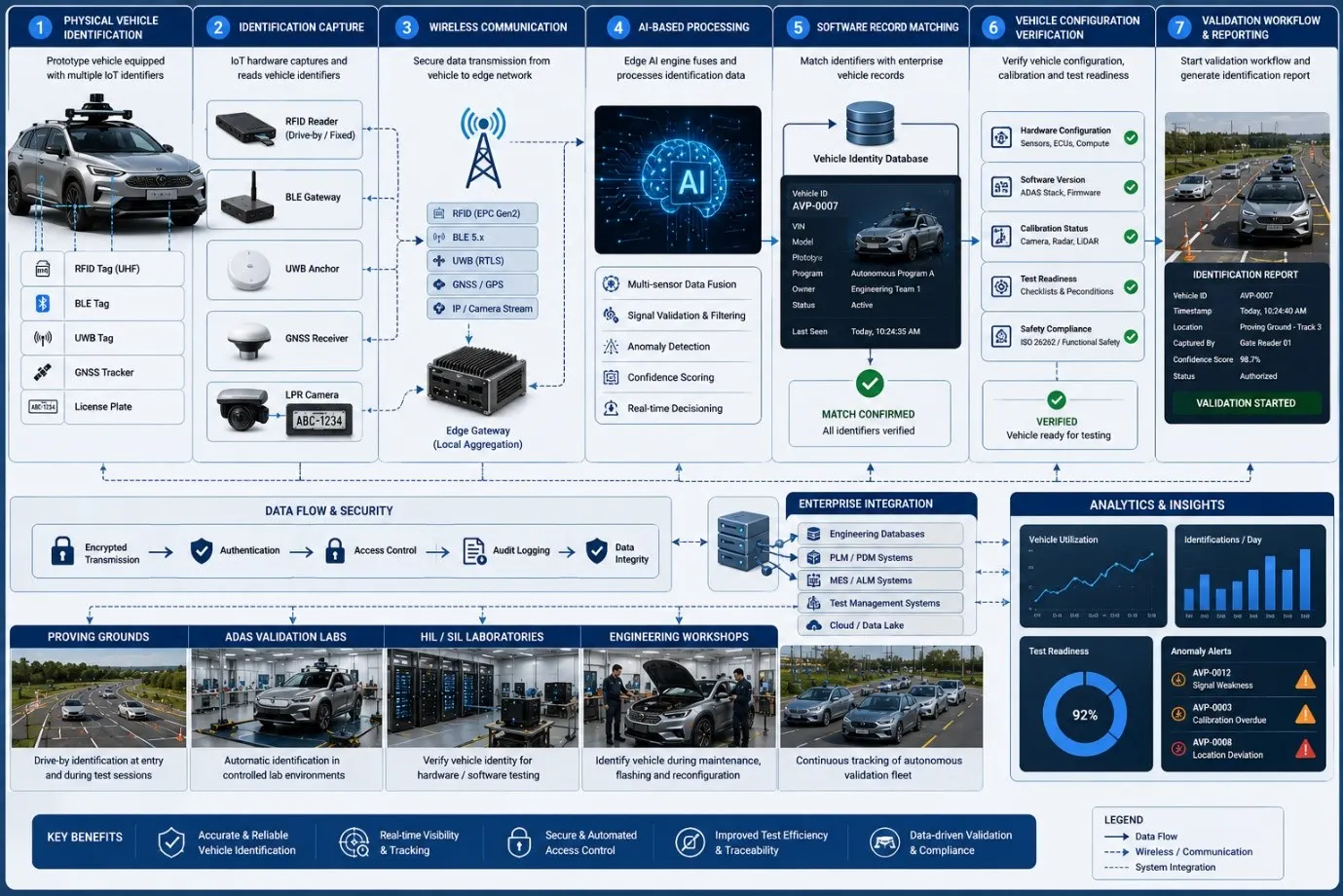
Autonomous Wireless Technologies for AIoT-Based Validation
Autonomous vehicle testing environments require different wireless technologies depending on operational conditions, location requirements, communication range, and validation objectives.
No single wireless technology supports every autonomous testing scenario. Automotive engineering organizations typically combine multiple identification technologies to achieve reliable visibility across vehicles, personnel, equipment, and facilities.
The selection of wireless technology depends on:
- Required identification accuracy
- Indoor or outdoor operating environment
- Vehicle mobility
- Infrastructure availability
- Testing scale
- Software integration requirements
AI and RFID for Vehicle Testing
RFID provides reliable identification for automotive engineering assets and prototype resources.
Key autonomous vehicle testing applications include:
- Prototype component identification
- ECU tracking
- Calibration equipment management
- Validation inventory control
- Engineering resource verification
RFID is particularly valuable during prototype development where thousands of components must be associated with vehicle builds and validation activities.
AI and BLE for Validation
BLE supports scalable identification of personnel and equipment across autonomous vehicle testing facilities.
Applications include:
- Validation workforce identification
- Mobile equipment tracking
- Engineering asset visibility
- Facility utilization analysis
BLE provides a practical option for large facilities requiring broad identification coverage with relatively low deployment complexity.
AI and UWB for Test Tracking
UWB provides precision positioning capabilities for environments requiring highly accurate location information.
Applications include:
- Autonomous vehicle positioning
- ADAS validation scenarios
- Laboratory equipment tracking
- Controlled testing environments
UWB is especially valuable for vehicle testing operations where location accuracy directly influences engineering analysis.
AI and GPS for Test Fleets
GPS and GNSS technologies support outdoor autonomous vehicle validation programs.
Applications include:
- Test fleet location tracking
- Road validation operations
- Proving ground vehicle management
- Route analysis
GNSS-based tracking provides broad-area visibility that complements RFID, BLE, and UWB identification technologies.
AI and Cellular for Validation
Cellular connectivity enables communication between mobile autonomous test vehicles, distributed facilities, and enterprise software systems.
Applications include:
- Remote validation vehicle identification
- Distributed test fleet visibility
- Multi-location engineering operations
- Connected vehicle testing support
Cellular technologies complement other identification methods by supporting communication beyond local facility boundaries.
Validation Access Devices for Autonomous Testing Facilities
Autonomous vehicle testing environments require strict control over access to prototype vehicles, confidential engineering areas, ADAS laboratories, battery validation facilities, and controlled proving ground zones.
Validation access devices provide automated identity verification and authorization capabilities for engineers, test drivers, contractors, suppliers, and visitors. These technologies help automotive organizations maintain secure operations while creating accurate records of facility access activities.
AIoT-enabled access solutions combine identification hardware with software systems to support:
- Authorized personnel verification
- Prototype vehicle area protection
- Restricted laboratory access management
- Contractor authorization tracking
- Validation activity records
Access control is especially important for autonomous vehicle programs because prototype vehicles and autonomous driving technologies often contain confidential engineering developments.
RFID Test Facility Readers
RFID test facility readers provide automated identification for personnel badges, equipment tags, and authorized credentials.
Applications include:
- ADAS laboratory access verification
- Prototype workshop entry control
- Engineering area authorization
- Test facility movement records
- Equipment identification checkpoints
RFID readers support fast identification processes while reducing dependence on manual verification procedures.
For autonomous vehicle validation facilities, RFID access systems can connect personnel identity with specific testing locations and authorized activities.
BLE Validation Gateways
BLE validation gateways support wireless identification coverage across large autonomous testing environments.
Applications include:
- Test workforce visibility
- Engineering equipment identification
- Validation zone monitoring
- Facility utilization analysis
BLE gateways are useful in proving grounds, engineering buildings, and laboratories where organizations require broader visibility of personnel and mobile resources.
Smart Test Access Terminals
Smart test access terminals combine multiple identification methods, including RFID, QR codes, digital credentials, and connected verification systems.
Applications include:
- Test engineer authentication
- Contractor access management
- Visitor registration
- Prototype vehicle area authorization
- Validation laboratory entry control
These devices provide flexible access options for complex automotive engineering environments.
Biometric Validation Readers
Biometric validation readers provide additional identity verification capabilities for highly restricted autonomous vehicle testing areas.
Applications include:
- Confidential prototype zones
- Advanced ADAS laboratories
- Restricted engineering facilities
- Secure validation environments
Biometric identification may be combined with other access methods where stronger identity confirmation is required.
Prototype Asset Identification Technologies for Autonomous Vehicle Testing
Autonomous vehicle development programs depend on thousands of physical engineering assets, including prototype components, calibration tools, battery packs, ECUs, diagnostic equipment, and validation resources.
Maintaining accurate identification of these assets is essential for:
- Vehicle configuration management
- Prototype build tracking
- Engineering workflow coordination
- Validation resource availability
- Test program efficiency
AIoT-enabled prototype asset identification solutions connect physical assets with digital records, helping automotive organizations improve visibility throughout autonomous vehicle development cycles.
RFID Calibration Tool Tags
RFID calibration tool tags provide automated identification for specialized equipment used in autonomous vehicle testing.
Applications include:
- ADAS calibration equipment tracking
- Vehicle alignment tool identification
- Test instrumentation management
- Engineering equipment verification
Calibration tools directly influence validation accuracy. RFID identification helps engineering teams confirm that the correct equipment is available for specific testing procedures.
BLE Test Equipment Tags
BLE test equipment tags provide wireless identification for mobile validation resources.
Applications include:
- ADAS test equipment tracking
- Portable diagnostic tool identification
- Shared engineering resource management
- Equipment movement analysis
BLE-based identification improves visibility when equipment is frequently moved between laboratories, workshops, and proving grounds.
Battery Pack Identification Tags
Battery pack identification technologies support electric and autonomous vehicle validation programs by maintaining accurate records of battery resources.
Applications include:
- Prototype battery identification
- Battery validation tracking
- Test assignment management
- Engineering configuration verification
Battery packs used in autonomous vehicle testing may undergo multiple validation cycles, requiring accurate identification throughout their operational lifecycle.
Calibration Asset Tags
Calibration asset tags support identification of precision equipment used during autonomous vehicle validation.
Applications include:
- Measurement equipment tracking
- Laboratory asset verification
- Test equipment assignment
- Engineering inventory accuracy
These identification technologies help ensure that critical validation resources are available when required.
Prototype Component Labels
Prototype component identification supports traceability of vehicle development resources.
Applications include:
- ECU identification
- ADAS component tracking
- Engineering change verification
- Prototype build management
AI and IoT identification solutions help connect physical prototype components with engineering records, improving configuration accuracy during autonomous vehicle validation.
AIoT Asset Identification System for Autonomous Vehicle Engineering and Prototype Testing
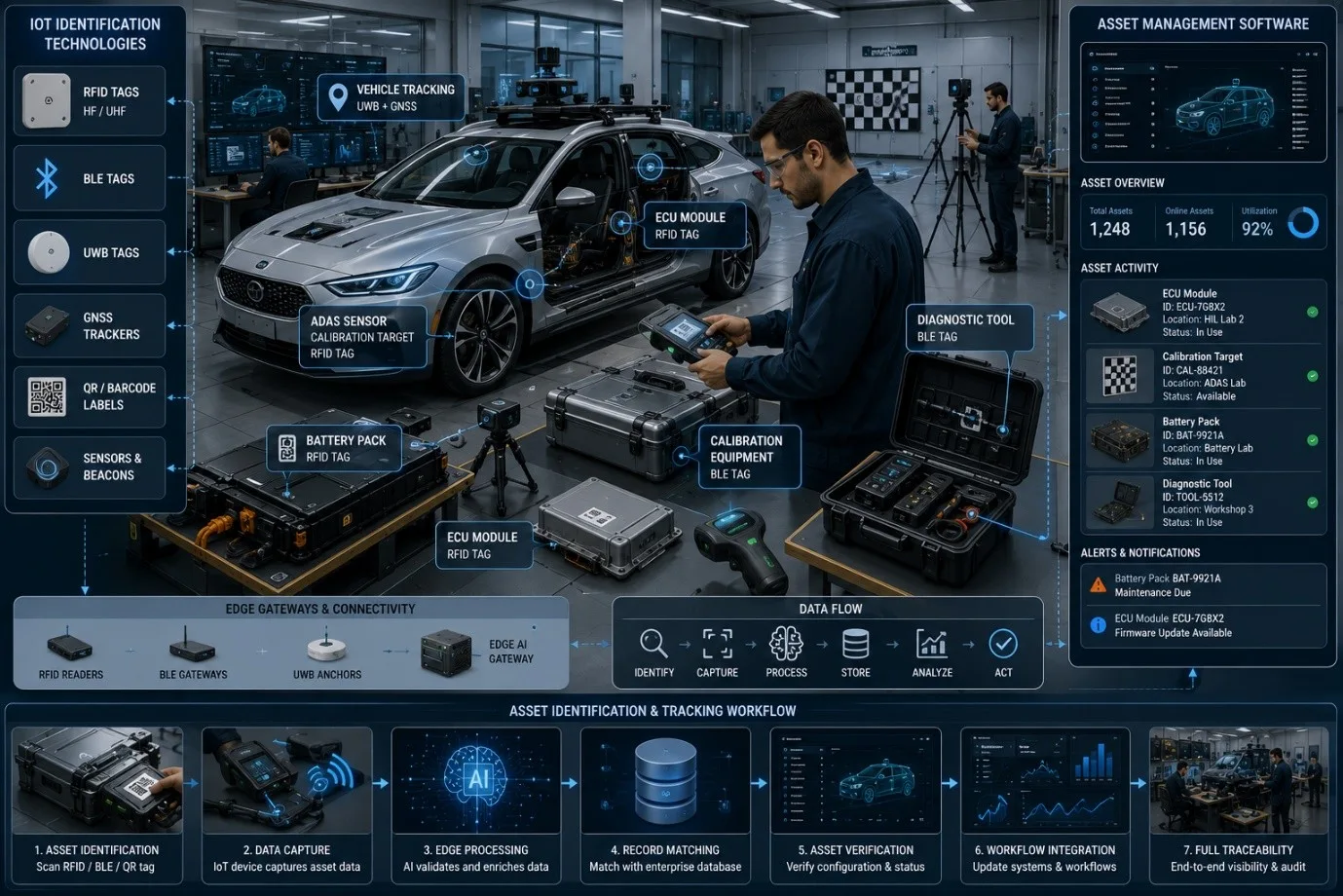
Hardware Deployment Considerations for Autonomous Vehicle Testing
Deploying IoT hardware technologies across autonomous vehicle testing operations requires careful planning based on facility characteristics, validation objectives, and operational requirements.
Different testing environments require different identification approaches.
Autonomous Proving Grounds
Large outdoor proving grounds typically require:
- GNSS autonomous vehicle trackers
- Cellular-connected fleet devices
- BLE workforce identification
- RFID asset identification
These technologies support vehicle fleet visibility across large testing areas.
ADAS Validation Centers
ADAS validation facilities commonly require:
- UWB positioning systems
- RFID identification
- Smart access terminals
- BLE equipment tracking
These technologies support precise vehicle, equipment, and personnel identification within controlled environments.
HIL and SIL Laboratories
Simulation and validation laboratories require:
- RFID component identification
- Equipment tracking
- Secure access devices
- Configuration management support
These solutions help engineering teams manage complex validation setups.
Battery Validation Centers
Battery testing environments require:
- Battery identification tags
- Asset tracking systems
- Controlled access devices
- Engineering resource management
AVehicle AI Experience in AIoT Hardware Solutions for Autonomous Vehicle Testing
AVehicle AI was created within Aperture Venture Studio, with support from GAO. Building on more than two decades of IoT experience, the company applies practical knowledge gained from thousands of IoT customers and thousands of IoT projects.
AVehicle AI develops AI and IoT solutions based on real-world industrial requirements, supporting organizations that need reliable identification, location visibility, access control, and asset management capabilities.
The company invests significantly in research and development, quality assurance processes, and technical expertise delivered remotely or onsite. Led by Ph.D. professionals from leading universities, AVehicle AI works with experienced specialists and strategic partners to support complex engineering environments.
Over the years, these capabilities have supported Fortune 500 companies, leading research and development organizations, prestigious universities, and U.S. and Canadian government agencies.
U.S. and Canadian Standards and Regulations Applicable to AIoT-Enabled Autonomous Vehicle Testing
The following standards and regulations are relevant to AI and IoT identification, location, access control, asset tracking, inventory management, workflow coordination, and traceability solutions used in autonomous vehicle systems and testing operations.
Automotive Functional Safety and Autonomous Vehicle Standards
- ISO 26262: Road vehicles functional safety
- ISO/PAS 8800: Road vehicles safety and artificial intelligence
- ISO 21448: Safety Of The Intended Functionality (SOTIF)
- ISO 34501: Road vehicles automated driving systems terminology
- ISO 34502: Road vehicles automated driving systems safety case framework
- ISO 34503: Road vehicles automated driving systems operational design domain specification
- ISO 34504: Road vehicles automated driving systems taxonomy and definitions
- ISO 34505: Road vehicles automated driving systems test scenarios
- SAE J3016: Taxonomy and definitions for terms related to driving automation systems
- SAE J1739: Potential failure mode and effects analysis (FMEA)
- SAE J2980: Considerations for ISO 26262 ASIL hazard analysis
- SAE J3061: Cybersecurity guidebook for cyber-physical vehicle systems
- SAE J3208: Connected vehicle cybersecurity considerations
Autonomous Vehicle Testing and Validation Standards
- SAE J2944: Operational definitions of driving performance measures and statistics
- SAE J3116: Automated driving system validation and verification
- SAE J3018: Safety considerations for automated driving systems
- SAE J3224: Scenario-based testing for automated driving systems
- SAE J3164: Taxonomy and definitions for automated driving system testing
- NHTSA Automated Driving Systems Framework
- NHTSA Automated Driving Systems: A Vision for Safety
- NHTSA Cybersecurity Best Practices for Modern Vehicles
- Federal Automated Vehicles Policy Guidelines
- Automated Vehicles Comprehensive Plan (USDOT)
- Federal Motor Vehicle Safety Standards (FMVSS)
- Transport Canada Safety Framework for Automated and Connected Vehicles
Automotive Cybersecurity and Data Protection Standards
- ISO/SAE 21434: Road vehicles cybersecurity engineering
- UNECE WP.29 R155: Cybersecurity management system
- UNECE WP.29 R156: Software update management system
- NIST Cybersecurity Framework (CSF)
- NIST SP 800-53: Security and privacy controls for information systems and organizations
- NIST SP 800-171: Protecting controlled unclassified information
- NIST AI Risk Management Framework (AI RMF)
- Cybersecurity Framework Profile for Connected Vehicles (NIST)
- Automotive Information Sharing and Analysis Center (Auto-ISAC) Best Practices
- TISAX: Trusted Information Security Assessment Exchange
AI and Machine Learning Governance Standards
- NIST AI Risk Management Framework (AI RMF)
- NIST AI 600-1: Generative AI Risk Management Profile
- ISO/IEC 23894: Artificial intelligence risk management
- ISO/IEC 42001: Artificial intelligence management system
- ISO/IEC 22989: Artificial intelligence concepts and terminology
- ISO/IEC 23053: Framework for artificial intelligence systems using machine learning
- IEEE 7000 Series: Ethical and responsible AI standards
Industrial IoT and Connected Device Standards
- ISO/IEC 30141: Internet of Things reference architecture
- ISO/IEC 20924: Internet of Things vocabulary
- IEC 62443 Series: Industrial communication networks cybersecurity
- IEEE 802.15.4: Low-rate wireless personal area networks
- IEEE 802.11: Wireless LAN standards
- Bluetooth Core Specification
- Bluetooth Low Energy (BLE) Specifications
- Ultra-Wideband (UWB) IEEE 802.15.4z
- ISO/IEC 18000 Series: RFID air interface standards
- EPCglobal RFID Standards
- GS1 Identification Standards
- GS1 EPC Information Services (EPCIS)
RFID, Asset Identification, and Traceability Standards
- ISO/IEC 18000-6: RFID air interface for UHF RFID
- ISO/IEC 18000-63: RFID UHF Type C
- ISO/IEC 15693: RFID vicinity cards
- ISO/IEC 14443: RFID proximity cards
- GS1 EPC Tag Data Standard
- GS1 Global Traceability Standard
- ANSI MH10.8.2: Data Identifier Standard
- ISO 17367: Supply chain applications of RFID for product tagging
- ISO 17366: Supply chain applications of RFID for returnable transport items
- ISO 17365: Supply chain applications of RFID for transport units
Wireless Location and Positioning Standards
- IEEE 802.15.4z: Enhanced Ultra-Wideband ranging
- FiRa Consortium UWB Specifications
- Bluetooth Direction Finding Specifications
- GPS Interface Standards
- National Marine Electronics Association (NMEA) GNSS Standards
- RTCM GNSS Correction Standards
Access Control and Identity Management Standards
- ISO/IEC 27001: Information security management systems
- ISO/IEC 27002: Information security controls
- ISO/IEC 24760: Entity authentication framework
- ISO/IEC 30107: Biometric presentation attack detection
- FIDO2 Authentication Standards
- ANSI INCITS 378: Finger Minutiae Format
- NIST Digital Identity Guidelines (SP 800-63)
- NIST Personal Identity Verification (PIV)
Automotive Manufacturing and Quality Management Standards
- IATF 16949: Automotive quality management systems
- ISO 9001: Quality management systems
- ISO 10007: Configuration management guidelines
- AIAG APQP: Advanced Product Quality Planning
- AIAG PPAP: Production Part Approval Process
- AIAG FMEA Handbook
- AIAG MSA: Measurement Systems Analysis
- AIAG SPC: Statistical Process Control
Engineering Asset, Inventory, and Enterprise Integration Standards
- ISA-95: Enterprise-control system integration
- ISA-88: Batch control systems
- ISO 10303 STEP: Product data representation and exchange
- ISO 14224: Collection and exchange of reliability and maintenance data
- ISO 55000: Asset management systems
- OAGIS: Open Applications Group Integration Specification
- OPC UA Industrial Interoperability Standard
Battery and Electric Vehicle Validation Standards
- SAE J1798: Recommended practice for electric vehicle battery systems
- SAE J2464: Electric and hybrid electric vehicle rechargeable energy storage system safety
- SAE J2929: Safety standard for electric and hybrid vehicle propulsion battery systems
- UL 2580: Batteries for use in electric vehicles
- UL 2271: Batteries for light electric vehicle applications
- UN 38.3: Transportation testing for lithium batteries
- IEC 62660: Secondary lithium-ion cells for electric road vehicles
U.S. Regulations
- National Highway Traffic Safety Administration (NHTSA) Automated Driving Systems Regulations and Guidance
- Federal Motor Vehicle Safety Standards (FMVSS)
- Federal Trade Commission (FTC) Data Security Requirements
- Federal Information Security Modernization Act (FISMA)
- Cybersecurity Information Sharing Act (CISA)
- California Consumer Privacy Act (CCPA)
- California Privacy Rights Act (CPRA)
- Occupational Safety and Health Administration (OSHA) Workplace Safety Regulations
- Federal Communications Commission (FCC) Part 15 Radio Frequency Device Rules
- FCC Part 96 Citizens Broadband Radio Service Rules
Canadian Standards and Regulations
- Transport Canada Motor Vehicle Safety Act
- Canadian Motor Vehicle Safety Standards (CMVSS)
- Innovation, Science and Economic Development Canada (ISED) Radio Standards Specifications
- Personal Information Protection and Electronic Documents Act (PIPEDA)
- Canadian Centre for Cyber Security Guidance
- CSA ISO/IEC 27001 Adoption Standards
- CSA Group Automotive Cybersecurity Standards
- CSA Group Functional Safety Standards
Top Players in AIoT-Enabled Autonomous Vehicle Testing Identification, Location, Access, Asset Tracking, and Inventory Solutions
Autonomous Vehicle Testing and Validation Technology Providers
NVIDIA
- Autonomous driving development systems
- AI computing solutions for vehicle validation
- Simulation and virtual testing environments
- ADAS and autonomous driving software development support
- Vehicle data processing solutions
Applied Intuition
- Autonomous vehicle simulation
- Scenario-based testing
- Validation workflow solutions
- ADAS and autonomous driving verification tools
- Vehicle development testing software
dSPACE
- Hardware-in-the-loop (HIL) testing
- Software-in-the-loop (SIL) validation
- Automotive ECU testing
- ADAS validation systems
- Vehicle development engineering tools
Vector Informatik
- Automotive communication systems
- ECU development tools
- Vehicle network testing
- Automotive diagnostics
- ADAS validation solutions
NI (National Instruments)
- Automated vehicle testing systems
- Hardware-in-the-loop validation
- Test instrumentation
- Automotive engineering measurement solutions
- Connected test environments
RFID, Asset Tracking, and Industrial Identification Providers
Zebra Technologies
- RFID identification systems
- Industrial asset tracking
- Barcode and RFID readers
- Mobile identification devices
- Enterprise inventory visibility solutions
Impinj
- RAIN RFID systems
- RFID readers
- RFID tags
- Item-level identification solutions
- Industrial tracking applications
Alien Technology
- UHF RFID readers
- RFID tags
- Industrial identification solutions
- Asset tracking technologies
- Inventory identification systems
Avery Dennison
- RFID labels
- Industrial identification solutions
- Product traceability technologies
- Automotive component identification
- Supply chain visibility solutions
BLE, UWB, and Real-Time Location System Providers
Quuppa
- BLE-based location systems
- Real-time location solutions
- Personnel tracking
- Asset location technologies
- Industrial positioning systems
Ubisense
- UWB positioning systems
- Automotive manufacturing location solutions
- Industrial asset tracking
- Vehicle positioning
- Production and engineering workflow tracking
Sewio Networks
- UWB positioning solutions
- Industrial vehicle tracking
- Asset location systems
- Real-time location technologies
- Manufacturing and logistics applications
Decawave
- UWB ranging technology
- High-accuracy positioning solutions
- Location-aware IoT applications
- Industrial positioning technologies
GNSS and Vehicle Tracking Technology Providers
Trimble
- High-accuracy GNSS positioning
- Vehicle tracking technologies
- Geospatial solutions
- Fleet location systems
- Precision positioning technologies
Hexagon
- GNSS positioning systems
- Autonomous vehicle testing technologies
- Industrial positioning solutions
- Automotive engineering applications
Topcon Positioning Systems
- GNSS positioning technologies
- Precision location solutions
- Vehicle positioning applications
- Industrial positioning systems
Access Control and Identity Management Providers
HID Global
- RFID access cards
- Digital identity solutions
- Secure authentication technologies
- Facility access systems
- Enterprise identity management
Johnson Controls
- Enterprise access control systems
- Security management solutions
- Facility protection systems
- Industrial access technologies
Honeywell
- Access control systems
- Industrial security technologies
- Connected facility solutions
- Identity verification systems
Cellular Connectivity and IoT Communication Providers
Ericsson
- Private cellular networks
- Industrial connectivity solutions
- IoT communication technologies
- Connected vehicle communication systems
Qualcomm Technologies
- Automotive connectivity solutions
- Vehicle communication technologies
- Edge AI computing
- Connected vehicle systems
Cisco
- Industrial networking
- IoT connectivity solutions
- Enterprise security
- Connected facility networking
Automotive OEMs and Autonomous Vehicle Development Organizations
Tesla
- Autonomous driving development
- Vehicle software validation
- Connected vehicle systems
- Large-scale vehicle data operations
Waymo
- Autonomous vehicle testing
- Driverless fleet operations
- Validation programs
- Autonomous driving development
General Motors
- Vehicle development programs
- Autonomous driving research
- Connected vehicle technologies
- ADAS validation activities
Toyota Motor Corporation
- Advanced vehicle research
- Autonomous driving development
- Vehicle validation programs
- Mobility technology research
Industrial Software and Enterprise Integration Providers
Siemens
- Digital engineering solutions
- Industrial automation
- Manufacturing software
- Automotive engineering integration
PTC
- Product lifecycle management
- Engineering collaboration software
- Digital product development
- Industrial IoT solutions
Dassault Systèmes
- Product lifecycle management
- Vehicle engineering software
- Simulation solutions
- Automotive development workflows
Case Studies
Autonomous Vehicle Testing AIoT Identification and Location Solutions
Case Study: Detroit, Michigan
Problem
An autonomous vehicle testing organization operating multiple validation areas required improved visibility of test personnel, engineering equipment, and prototype vehicle support resources across its proving ground and laboratory environments.
The organization managed complex autonomous vehicle validation activities involving:
- Autonomous driving test engineers
- Safety drivers
- Validation technicians
- ADAS calibration specialists
- Prototype vehicle support teams
- Mobile engineering equipment
Traditional manual tracking processes created operational challenges when coordinating personnel movement, locating shared validation equipment, and confirming the availability of resources before scheduled test activities.
The organization needed an AIoT-enabled identification and location solution that could support:
- Autonomous test workforce tracking
- Validation area visibility
- Engineering asset identification
- Test equipment availability
- Restricted area access verification
The primary requirement was to improve operational awareness without disrupting existing autonomous vehicle testing workflows.
Solution
AVehicle AI implemented an AI and IoT identification and location solution using BLE and RFID technologies to support autonomous vehicle testing operations.
The solution combined connected identification devices with software systems designed to process location and asset information for engineering operations.
The deployed solution included:
- BLE-based personnel identification for test workforce visibility
- RFID identification for engineering tools and validation assets
- Wireless gateways for collecting identification data across testing areas
- Software integration for location records and asset status information
The workforce location solution supported autonomous testing activities by allowing authorized personnel to be identified within designated operational areas.
Applications included:
- Proving ground personnel location analytics
- Validation engineer movement analysis
- Autonomous testing lone worker support
- Engineering area utilization analysis
- Emergency personnel accountability
The asset tracking solution supported identification of:
- ADAS calibration equipment
- Prototype vehicle diagnostic tools
- Validation instruments
- Mobile engineering resources
AI and RFID capabilities helped associate physical equipment with digital records, while AI and BLE capabilities supported wireless identification of personnel and mobile assets.
The combined AIoT solution helped create better visibility between physical testing operations and engineering software systems.
GAO / GAO Tek Inc / GAO RFID Inc Implementation Details
AVehicle AI utilized implementation experience from GAO, GAO Tek Inc, and GAO RFID Inc in deploying BLE, RFID, and IoT-based identification solutions for industrial environments.
The representative deployment applied hardware categories including:
- BLE Technologies
- BLE Gateways
- BLE Beacons
- UHF RFID Readers
- UHF RFID Tags
- RFID Accessories
- Edge Computing Solutions
BLE hardware was used for wireless identification of mobile personnel and equipment within validation areas.
BLE gateways collected identification information from BLE tags and transmitted data to software systems responsible for location processing and operational reporting.
RFID hardware supported identification of engineering resources requiring asset-level tracking.
UHF RFID readers and tags were applied for:
- Calibration equipment identification
- Prototype component tracking
- Engineering tool management
- Validation inventory verification
Edge computing capabilities were incorporated where local processing was required for faster operational responses and reduced dependency on continuous remote processing.
Hardware Categories Utilized
BLE Technologies
Selected BLE hardware capabilities included:
- BLE tags and beacons for personnel and equipment identification
- BLE gateways for wireless data collection
- Low-power operation suitable for mobile validation resources
- Flexible deployment across laboratories and outdoor testing areas
UHF RFID Technologies
Selected RFID hardware capabilities included:
- UHF RFID readers for automated identification
- UHF RFID tags for engineering assets
- RFID accessories for deployment flexibility
- Identification of tools, components, and validation resources
Edge Computing Solutions
Edge computing components supported:
- Local identification data processing
- Faster event handling
- Reduced communication delays
- Operation in areas with limited connectivity
Technical Deployment Details
The implementation followed a layered deployment approach.
Personnel identification devices were assigned to authorized test staff, including engineers and safety personnel.
BLE gateways were positioned across key operational zones:
- Autonomous vehicle preparation areas
- Validation workshops
- Engineering facilities
- Testing support areas
RFID readers were installed at designated equipment management locations to identify movement of tagged engineering resources.
The AIoT software system processed identification events to support:
- Workforce location analytics
- Asset availability records
- Equipment utilization reporting
- Validation resource coordination
The solution supported integration with existing engineering workflows while maintaining separation between operational identification data and vehicle development systems.
Result
The AIoT identification solution improved visibility across autonomous vehicle validation activities.
Key operational improvements included:
- Automated identification of test personnel and engineering assets
- Reduced time required to locate shared validation equipment
- Improved coordination between engineering teams and testing schedules
- Better documentation of asset movement activities
- Increased visibility of restricted validation areas
The most critical measurable operational metric was:
Reduced manual asset search and verification activities by approximately 30% through automated RFID and BLE identification workflows.
The implementation demonstrated how AI and IoT identification technologies can support autonomous vehicle testing environments where personnel coordination, prototype resource control, and engineering asset visibility are essential.
Real-World Lesson / Trade-Off
A major deployment consideration was balancing identification accuracy with installation complexity.
BLE provided flexible coverage for mobile personnel and equipment, while RFID delivered stronger item-level identification for tagged assets.
The practical lesson was that autonomous vehicle testing facilities often require a combination of identification technologies rather than a single wireless approach.
Case Study: Austin, Texas
Problem
An autonomous vehicle engineering organization operating an ADAS validation laboratory required improved control over access to confidential testing areas and better identification of prototype vehicle resources.
The laboratory environment included:
- Prototype autonomous vehicles
- ADAS development equipment
- Validation workstations
- Calibration resources
- Engineering test areas
The organization needed stronger visibility into:
- Who accessed restricted validation zones
- Which prototype vehicles were assigned to testing activities
- Where engineering resources were located
- Whether authorized personnel accessed controlled areas
Existing access procedures depended heavily on manual verification and disconnected records.
The organization required an AIoT-enabled solution supporting:
- Validation access management
- Prototype vehicle identification
- Engineering asset tracking
- Secure test environment operations
Solution
AVehicle AI implemented an AI and IoT access control and identification solution combining RFID, BLE, biometric verification, and connected software systems.
The solution focused on protecting sensitive autonomous vehicle testing environments while improving operational efficiency.
Implemented capabilities included:
- RFID-based employee and contractor identification
- Smart access terminals for validation areas
- Prototype vehicle RFID identification
- BLE tracking for mobile engineering equipment
- Digital access records for validation activities
The access control system supported:
- ADAS laboratory entry authorization
- Prototype vehicle area access control
- Contractor verification
- Visitor access management
AI and RFID technologies enabled automated identification of authorized personnel and prototype resources.
AI and BLE capabilities supported identification of mobile engineering equipment used during autonomous vehicle validation.
The system helped connect access events with operational records, creating better visibility across laboratory activities.
GAO / GAO Tek Inc / GAO RFID Inc Implementation Details
AVehicle AI applied GAO, GAO Tek Inc, and GAO RFID Inc experience in RFID, BLE, and IoT identification deployments.
The representative implementation utilized:
- NFC and HF RFID Readers
- NFC Tags
- UHF RFID Readers
- UHF RFID Tags
- BLE Gateways
- BLE Accessories
- Biometric Devices
- IoT and M2M Hardware Products
RFID access devices supported controlled entry points within validation areas.
NFC and HF RFID technologies were applied for personnel credential identification where short-range secure authentication was appropriate.
UHF RFID technologies supported prototype vehicle and engineering asset identification.
BLE hardware supported location visibility for:
- Mobile diagnostic equipment
- Calibration tools
- Portable validation resources
Biometric devices were integrated for higher-security areas requiring additional identity verification.
Hardware Categories Utilized
RFID Identification Technologies
Capabilities included:
- RFID access credentials
- Prototype vehicle tags
- Engineering asset identification
- Automated verification records
BLE Technologies
Capabilities included:
- BLE equipment identification
- Wireless gateway communication
- Mobile asset location support
Biometric Devices
Capabilities included:
- Additional identity confirmation
- Restricted laboratory access support
- Secure personnel authentication
Technical Deployment Details
The deployment integrated identification hardware throughout the validation facility.
Access points were equipped with RFID readers and smart authentication devices.
Authorized personnel received identification credentials connected with access software.
Prototype vehicles and critical engineering resources were assigned RFID identification tags.
BLE devices were attached to mobile equipment requiring location visibility.
The AIoT software system processed:
- Access events
- Asset identification records
- Equipment movement information
- Validation area activity data
The solution supported secure autonomous vehicle testing operations while maintaining accurate operational records.
Result
The AIoT access and identification solution improved control over autonomous vehicle validation operations.
Key improvements included:
- Automated validation facility access records
- Improved prototype vehicle identification accuracy
- Reduced manual access verification activities
- Better tracking of engineering resources
- Enhanced visibility of restricted testing areas
The most critical measurable operational metric was:
Achieved approximately 95% automated identification coverage for tagged prototype resources and authorized access points.
The implementation demonstrated how AI and IoT access control and identification solutions can support secure autonomous vehicle testing environments.
Real-World Lesson / Trade-Off
Higher-security validation environments often require multiple identification methods.
RFID provided efficient credential and asset identification, while biometric verification increased security for sensitive areas.
The practical trade-off involved balancing security requirements, user convenience, and deployment complexity.
Case Study: Phoenix, Arizona
Problem
An autonomous vehicle testing organization operating a distributed validation fleet required improved visibility into prototype vehicles, engineering components, and test inventory resources across multiple operational locations.
The organization managed autonomous vehicle validation programs involving:
- Prototype autonomous vehicles
- ADAS development vehicles
- Engineering spare components
- Battery validation resources
- Diagnostic equipment
- Calibration materials
The growing number of prototype configurations created challenges related to:
- Vehicle identification accuracy
- Test vehicle assignment tracking
- Engineering inventory availability
- Component location visibility
- Validation workflow coordination
Manual records and disconnected inventory processes made it difficult for engineering teams to quickly determine:
- Which prototype vehicle was assigned to a specific validation activity
- Where critical test components were located
- Whether required spare parts were available
- Which engineering assets were ready for deployment
The organization required an AIoT-enabled identification solution focused on autonomous vehicle tracking, prototype asset management, and validation inventory control.
Solution
AVehicle AI implemented an AI and IoT asset tracking and inventory management solution using RFID, BLE, GPS IoT tracking, and edge computing technologies.
The solution connected physical prototype resources with software records to improve identification accuracy throughout autonomous vehicle testing operations.
Implemented capabilities included:
- RFID prototype vehicle identification
- BLE engineering asset tracking
- GPS IoT fleet location tracking
- Validation inventory identification
- Edge-based data processing
- Digital asset records
The prototype vehicle identification system supported:
- Autonomous test vehicle assignment
- Fleet location visibility
- Vehicle configuration tracking
- Validation resource coordination
RFID tags were applied to selected prototype assets, components, and engineering resources to establish automated identification.
BLE tracking technologies supported mobile validation resources, including:
- Diagnostic equipment
- Calibration tools
- Portable engineering devices
- Shared test resources
GPS IoT tracking devices supported outdoor validation fleet visibility, especially for vehicles operating across large proving ground areas.
AI and IoT inventory management capabilities helped engineering teams improve availability tracking for:
- Prototype components
- Replacement parts
- Validation equipment
- Test preparation materials
GAO / GAO Tek Inc / GAO RFID Inc Implementation Details
AVehicle AI leveraged GAO, GAO Tek Inc, and GAO RFID Inc experience in BLE, RFID, GPS IoT, and industrial identification solutions.
The representative implementation incorporated hardware categories including:
- BLE Technologies
- BLE Gateways
- BLE Beacons
- UHF RFID Readers
- UHF RFID Tags
- GPS IoT Trackers/Devices
- GPS IoT Tracking Accessories
- Cellular IoT Devices
- Edge Computing Solutions
UHF RFID hardware supported identification of prototype vehicle components and validation resources.
Selected RFID capabilities included:
- Long-range asset identification
- Automated inventory verification
- Component-level identification
- Engineering resource tracking
BLE technologies supported indoor and controlled-area tracking where engineering teams required visibility of mobile resources.
GPS IoT trackers supported outdoor vehicle location applications by providing:
- Vehicle position information
- Fleet movement records
- Validation route tracking support
- Remote operational visibility
Cellular IoT connectivity enabled communication for mobile resources operating outside fixed facility networks.
Edge computing solutions supported local processing where autonomous testing environments required rapid data handling.
Hardware Categories Utilized
UHF RFID Technologies
Capabilities included:
- Prototype component identification
- Engineering inventory tracking
- Validation resource verification
- Automated asset records
BLE Technologies
Capabilities included:
- Equipment identification
- Mobile asset location support
- Wireless communication across testing facilities
GPS IoT Tracking Technologies
Capabilities included:
- Autonomous test fleet location tracking
- Outdoor vehicle movement visibility
- Distributed validation support
Cellular IoT Devices
Capabilities included:
- Remote vehicle communication
- Wide-area connectivity
- Mobile asset data transmission
Edge Computing Solutions
Capabilities included:
- Local processing of identification events
- Faster operational decisions
- Support for distributed testing environments
Technical Deployment Details
The deployment combined multiple identification technologies based on operational requirements.
RFID identification was applied to assets requiring precise inventory records.
BLE devices were deployed for mobile engineering resources requiring frequent movement tracking.
GPS IoT tracking devices were installed on selected validation vehicles operating across outdoor testing areas.
The AIoT software system processed identification information to support:
- Prototype vehicle tracking
- Test fleet utilization analysis
- Engineering inventory management
- Asset availability reporting
- Validation preparation workflows
The system was designed to support integration with existing automotive engineering processes while maintaining accurate physical resource identification.
Result
The AIoT asset tracking and inventory solution improved visibility across autonomous vehicle validation operations.
Key operational improvements included:
- Increased accuracy of prototype vehicle identification
- Improved engineering inventory availability records
- Reduced manual reconciliation activities
- Faster identification of validation resources
- Improved coordination between vehicle testing and engineering teams
The most critical measurable operational metric was:
Reduced prototype asset reconciliation time by approximately 40% through automated RFID, BLE, and GPS-based identification workflows.
The implementation demonstrated how AI and IoT asset tracking solutions can support autonomous test fleets where accurate identification and location visibility directly affect validation efficiency.
Real-World Lesson / Trade-Off
Different autonomous vehicle testing environments require different location technologies.
GPS IoT tracking provides broad outdoor vehicle visibility, while RFID and BLE provide more detailed identification within facilities.
The practical trade-off was selecting the appropriate technology combination based on required location accuracy, operating environment, and deployment cost.
Case Study: Waterloo, Ontario, Canada
Problem
A Canadian autonomous vehicle engineering organization required improved workforce coordination and secure access management across its vehicle validation laboratories and engineering facilities.
The organization supported autonomous vehicle development activities involving:
- Validation engineers
- Software testing teams
- Prototype vehicle specialists
- Engineering contractors
- Laboratory personnel
The operational environment required better visibility into:
- Personnel movement within controlled areas
- Authorized access to validation zones
- Emergency workforce accountability
- Engineering facility usage
Existing processes relied on manual records and separate access systems, creating challenges when coordinating multiple engineering groups working on autonomous vehicle validation programs.
The organization required an AIoT-enabled workforce location and access management solution supporting:
- Test personnel tracking
- Validation facility access control
- Engineering area authorization
- Personnel accountability
Solution
AVehicle AI implemented an AI and IoT workforce tracking and secure access solution using BLE identification, RFID credentials, biometric verification, and connected software systems.
The solution focused on improving operational visibility while supporting secure autonomous vehicle engineering environments.
Implemented capabilities included:
- BLE personnel identification
- RFID employee credential management
- Validation zone access verification
- Emergency personnel location support
- Engineering workforce activity records
The workforce tracking solution supported:
- Validation engineer location analytics
- Test workforce movement analysis
- Lone worker support
- Facility utilization analysis
The access control solution supported:
- Restricted laboratory access
- Contractor authorization
- Engineering visitor management
- Prototype area protection
AI and BLE technologies provided flexible personnel identification across laboratory and engineering spaces.
AI and RFID capabilities supported credential-based access verification and personnel records.
GAO / GAO Tek Inc / GAO RFID Inc Implementation Details
AVehicle AI applied GAO, GAO Tek Inc, and GAO RFID Inc experience in BLE, RFID, biometric, and IoT-based identification solutions.
The representative implementation used hardware categories including:
- BLE Products
- BLE Gateways
- BLE Beacons
- HF RFID Readers
- NFC Readers
- NFC Tags
- RFID Accessories
- Biometric Devices
- IoT and M2M Hardware Products
BLE hardware supported workforce location visibility throughout engineering facilities.
BLE gateways collected identification information from personnel devices and transmitted records to the workforce management software.
HF RFID and NFC technologies supported secure personnel credential identification.
Biometric devices were used for selected restricted areas requiring stronger identity verification.
Hardware Categories Utilized
BLE Identification Technologies
Capabilities included:
- Personnel location identification
- Workforce movement analysis
- Wireless facility coverage
HF RFID and NFC Technologies
Capabilities included:
- Employee credential verification
- Secure access authentication
- Personnel identification records
Biometric Technologies
Capabilities included:
- Additional identity confirmation
- Restricted area protection
- Enhanced access verification
Technical Deployment Details
The implementation deployed BLE identification devices across engineering work areas and validation facilities.
Access points incorporated RFID and biometric verification devices based on security requirements.
Authorized personnel received identification credentials connected with access software.
The AIoT software system integrated identification information to support:
- Workforce location records
- Access authorization
- Personnel accountability
- Facility utilization reporting
The solution was designed to support autonomous vehicle engineering environments where confidentiality, safety, and operational coordination are important.
Result
The AIoT workforce tracking and access management solution improved visibility and control across autonomous vehicle engineering operations.
Key operational improvements included:
- Automated workforce identification
- Improved validation area access records
- Better engineering personnel coordination
- Faster personnel accountability processes
- Reduced manual access documentation
The most critical measurable operational metric was:
Achieved approximately 90% automated workforce identification coverage across designated engineering and validation areas.
The implementation demonstrated the value of AI and IoT workforce location and access solutions for autonomous vehicle testing environments requiring secure and coordinated operations.
Real-World Lesson / Trade-Off
Workforce tracking solutions require careful consideration of privacy, operational requirements, and location accuracy.
BLE provides practical facility-level visibility with flexible deployment, while RFID and biometric technologies support stronger identity verification.
The deployment lesson was that successful autonomous vehicle validation tracking requires balancing employee privacy, security controls, and operational visibility.
Future of AIoT Hardware for Autonomous Vehicle Validation
Autonomous vehicle testing continues to become more complex as automotive organizations manage larger prototype fleets, advanced ADAS systems, increasing software releases, and distributed validation operations.
IoT hardware technologies provide the identification foundation required to connect physical testing environments with AI-enabled software systems.
RFID, BLE, UWB, GNSS, cellular connectivity, smart identification devices, and secure access technologies enable better visibility across:
- Prototype autonomous vehicles
- Validation personnel
- Engineering equipment
- Testing facilities
- Vehicle components
- Inventory resources
AVehicle AI helps automotive organizations implement AIoT-enabled hardware solutions designed specifically for autonomous vehicle testing and validation operations.
Request an AIoT Hardware Assessment for Autonomous Vehicle Testing
Automotive engineering organizations require reliable identification technologies that match their validation environment, operational requirements, and engineering workflows.
AVehicle AI helps evaluate and implement:
- RFID prototype vehicle identification systems
- BLE validation tracking solutions
- UWB autonomous vehicle positioning systems
- GNSS autonomous fleet tracking technologies
- Smart validation access devices
- Prototype asset identification solutions
Contact AVehicle AI to explore AIoT hardware technologies for autonomous vehicle testing, ADAS validation, and advanced vehicle development operations.
Contact AVehicle AI