
Advancing AIoT for Autonomous Vehicle Systems & Testing
Company Overview
AVehicle AI specializes in AIoT solutions developed for the automotive industry, with a focused emphasis on autonomous vehicle systems and testing operations.
The development and validation of autonomous vehicles require complex coordination among vehicle manufacturers, autonomous driving software teams, ADAS engineers, validation engineers, test drivers, calibration specialists, and manufacturing engineering groups.
Modern autonomous vehicle programs involve thousands of activities, including:
- Prototype vehicle development
- ADAS feature validation
- Autonomous driving software testing
- Electronic control unit (ECU) verification
- Vehicle calibration activities
- Sensor and perception system validation
- Hardware-in-the-loop testing
- Software-in-the-loop testing
- Proving ground evaluation
- Fleet-based validation testing
Managing these activities requires accurate identification, location visibility, and traceability of physical resources throughout the engineering lifecycle.
AVehicle AI develops AI and IoT software solutions that help automotive organizations connect physical testing environments with engineering workflows. The company's solutions support the identification and management of:
- Prototype autonomous vehicles
- Validation fleet vehicles
- Engineering personnel
- Test contractors
- ADAS test equipment
- Calibration tools
- Prototype components
- Battery validation resources
- Engineering inventory
Rather than focusing on general-purpose tracking applications, AVehicle AI addresses the specific operational requirements of autonomous vehicle validation environments where accurate identification, secure access, and engineering traceability are essential.
The company combines AI software with industrial identification and location technologies, including RFID, BLE, UWB, GNSS, and computer vision, to support enterprise automotive testing operations.
AVehicle AI is created within Aperture Venture Studio, with support from GAO. Building on two decades of IoT experience, GAO has served thousands of IoT customers and successfully delivered thousands of IoT projects across industrial applications.
AVehicle AI is based on practical experience gained through real-world IoT implementations and customer requirements. The company has made significant investments in research and development, supported by structured quality assurance processes and technical expertise provided remotely and onsite.
Led by Ph.D. professionals from leading universities, AVehicle AI benefits from experienced engineering specialists, strategic partnerships, and technical resources focused on developing reliable AIoT solutions.
Over the years, the supporting organizations behind AVehicle AI have worked with:
- Fortune 500 companies
- Leading research and development organizations
- Prestigious universities
- United States and Canadian government agencies
This experience contributes to AVehicle AI's ability to understand enterprise requirements related to reliability, security, system integration, and operational scalability.
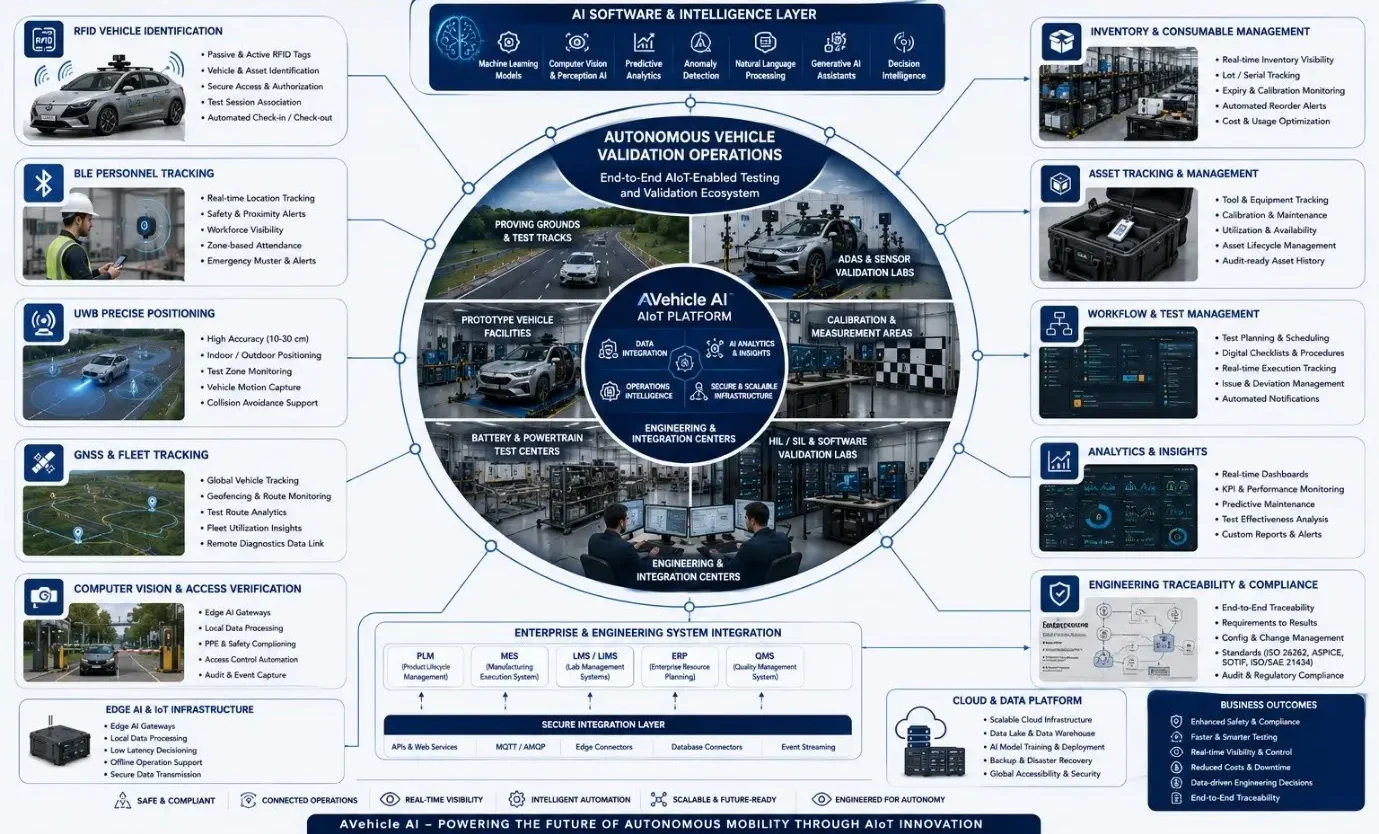
Enterprise AIoT Capabilities for Autonomous Vehicle Systems and Testing
Our Mission
AVehicle AI's mission is to improve autonomous vehicle development and validation operations through practical AIoT solutions that increase visibility, traceability, and operational reliability.
Autonomous vehicle engineering programs depend on accurate information throughout the entire validation lifecycle. Engineering teams must know where prototype vehicles are located, which personnel are authorized for specific testing areas, which equipment is available, and how vehicle configurations change during testing.
The company's mission is to help automotive organizations create stronger connections between physical validation activities and digital engineering workflows.
AVehicle AI focuses on three fundamental objectives:
- Improving visibility across autonomous vehicle testing operations
- Strengthening identification and traceability of engineering resources
- Supporting efficient coordination of validation activities
AIoT enables these capabilities by combining artificial intelligence with IoT devices, connected equipment, identification technologies, and industrial software systems.
For autonomous vehicle applications, AIoT may incorporate:
- Industrial AI for operational analysis
- Edge AI for localized data processing
- Machine learning for workflow analysis
- Computer vision for identification and verification
- Physical AI concepts supporting autonomous systems
AVehicle AI applies these technologies where they provide practical value for automotive validation teams.
The company's approach emphasizes accurate identification and location solutions that help engineering organizations better understand the status and movement of vehicles, personnel, tools, and components involved in autonomous vehicle testing.
Autonomous Vehicle Systems & Testing Industry Focus
Autonomous vehicle systems and testing represent one of the most technically demanding areas within the automotive industry.
Vehicle manufacturers and technology developers must validate increasingly complex systems involving:
- Advanced Driver Assistance Systems (ADAS)
- Autonomous driving software
- Vehicle perception systems
- Electronic control units
- Vehicle communication systems
- Automated driving functions
- Connected vehicle technologies
- Safety-critical automotive software
Validation organizations operate across multiple environments where engineering accuracy and operational visibility are critical.
These environments include:
- Autonomous proving grounds
- ADAS validation centers
- Vehicle calibration laboratories
- Hardware-in-the-loop laboratories
- Software-in-the-loop laboratories
- Battery validation centers
- Environmental vehicle test chambers
- Crash test facilities
- Autonomous validation fleets
- Connected vehicle testing locations
Each environment introduces unique operational challenges.
For example, proving grounds may require location visibility for test drivers, engineers, prototype vehicles, and contractors operating across large areas. ADAS laboratories may require controlled access management and precise identification of test equipment. Prototype vehicle programs may require configuration traceability across multiple hardware and software revisions.
AVehicle AI develops AIoT solutions that address these operational requirements by connecting identification technologies, location technologies, and engineering software systems.
The company's focus areas include:
- Prototype vehicle identification and tracking
- Validation workforce visibility
- Secure testing facility access
- Engineering asset management
- Validation inventory control
- Autonomous testing workflow visibility
- Vehicle configuration traceability
By focusing on autonomous vehicle validation requirements, AVehicle AI helps automotive engineering organizations improve operational awareness throughout prototype development and testing processes.
AI and AIoT Expertise
AVehicle AI combines artificial intelligence, industrial IoT, and automotive engineering knowledge to develop solutions supporting autonomous vehicle systems and testing operations.
AIoT, also referred to as AI and IoT, combines artificial intelligence with IoT devices, connected equipment, identification technologies, and industrial software systems. For automotive validation applications, AIoT solutions can incorporate Industrial AI, Edge AI, machine learning, computer vision, and Physical AI concepts when appropriate.
AVehicle AI focuses primarily on identification and location solutions that help engineering organizations understand the status, location, and utilization of critical resources involved in autonomous vehicle testing.
The company applies AIoT technologies to support visibility of:
- Autonomous prototype vehicles
- Validation fleet vehicles
- Test drivers and engineering personnel
- ADAS validation equipment
- Calibration tools
- Prototype components
- Engineering inventory
- Testing resources
Accurate identification and location information supports better engineering decisions throughout the validation lifecycle.
For example:
- RFID identification can help associate prototype vehicles, components, and engineering tools with specific validation activities.
- BLE tracking can support workforce and mobile asset visibility across proving grounds and engineering facilities.
- UWB positioning can provide high-accuracy location information for vehicles and equipment in controlled testing environments.
- GNSS tracking can support outdoor autonomous validation fleet operations.
- Computer vision solutions can assist with vehicle identification, access verification, and operational documentation.
These technologies are combined with AI software and engineering workflows to provide automotive organizations with improved visibility into physical testing operations.
Technology Approach
AVehicle AI follows an engineering-focused approach that connects physical autonomous vehicle testing activities with software-based operational processes.
Autonomous vehicle validation involves thousands of interactions between vehicles, components, software releases, engineering teams, and test environments. Maintaining accurate information across these activities requires reliable identification, location, and traceability capabilities.
The AVehicle AI technology approach focuses on four primary areas:
- Identification of vehicles, equipment, components, and personnel
- Location visibility across testing environments
- Integration with automotive engineering software systems
- Traceability throughout validation workflows
RFID Identification for Prototype Vehicles and Validation Assets
Radio Frequency Identification (RFID) technology provides automated identification capabilities for automotive testing operations.
Within autonomous vehicle validation environments, RFID solutions can support:
- Prototype autonomous vehicle identification
- ADAS test equipment identification
- Calibration tool tracking
- Prototype component identification
- Battery validation asset tracking
- Engineering inventory management
RFID technology is particularly valuable when engineering organizations manage large volumes of physical resources across multiple validation locations.
For example, during prototype vehicle development, engineering teams may need to verify the relationship between:
- Vehicle identification numbers
- Prototype configurations
- Installed components
- Validation campaigns
- Engineering change records
RFID-based identification helps improve accuracy by reducing manual data entry and providing a consistent connection between physical assets and digital records.
BLE Tracking for Test Workforce and Mobile Asset Visibility
Bluetooth Low Energy (BLE) technology supports location visibility for people and mobile assets involved in autonomous vehicle testing.
Large proving grounds and validation facilities often involve:
- Multiple testing zones
- Restricted operating areas
- Mobile engineering teams
- Temporary contractors
- Specialized equipment movement
BLE tracking solutions can support:
- Autonomous test driver location analytics
- Validation engineer location analytics
- Proving ground personnel visibility
- Lone worker safety applications
- Mobile equipment tracking
By improving awareness of personnel movement and asset locations, BLE-based solutions can help engineering teams coordinate testing activities more effectively.
BLE technology provides a practical approach for organizations requiring scalable location visibility across large automotive testing environments.
UWB Positioning for Precision Autonomous Vehicle Testing
Ultra-Wideband (UWB) positioning provides high-accuracy location capabilities for applications requiring precise positioning information.
Autonomous vehicle testing environments often require accurate location data for:
- Prototype vehicle movement analysis
- Indoor validation facilities
- Vehicle calibration areas
- ADAS laboratory equipment
- High-value engineering assets
UWB positioning can support environments where traditional location technologies may not provide sufficient accuracy.
For example, engineering teams performing controlled testing inside facilities may require precise location awareness of vehicles, equipment, or test resources.
UWB solutions can complement RFID, BLE, and GNSS technologies by providing additional location accuracy for specific automotive validation scenarios.
GNSS Tracking for Autonomous Validation Fleets
Global Navigation Satellite System (GNSS) tracking supports outdoor vehicle testing operations where prototype vehicles operate across proving grounds, test routes, and distributed validation locations.
GNSS-based solutions can support:
- Autonomous test vehicle location tracking
- Validation fleet utilization analysis
- Vehicle route documentation
- Outdoor prototype vehicle visibility
- Fleet testing coordination
For autonomous driving development, maintaining visibility of test vehicles during extensive validation programs is essential.
GNSS tracking provides automotive engineering teams with location information that can support fleet operations, test management, and validation reporting.
Computer Vision and AI Software for Validation Operations
Computer vision and AI software can enhance identification and verification processes within autonomous vehicle testing environments.
Potential applications include:
- Vehicle identification at testing facilities
- Access verification at controlled areas
- Visual validation documentation
- Automated operational reporting
- Test process analysis
When combined with identification technologies such as RFID, BLE, UWB, and GNSS, AI software can provide additional context for engineering operations.
AVehicle AI focuses on applying these technologies where they improve practical automotive workflows rather than introducing unnecessary complexity.
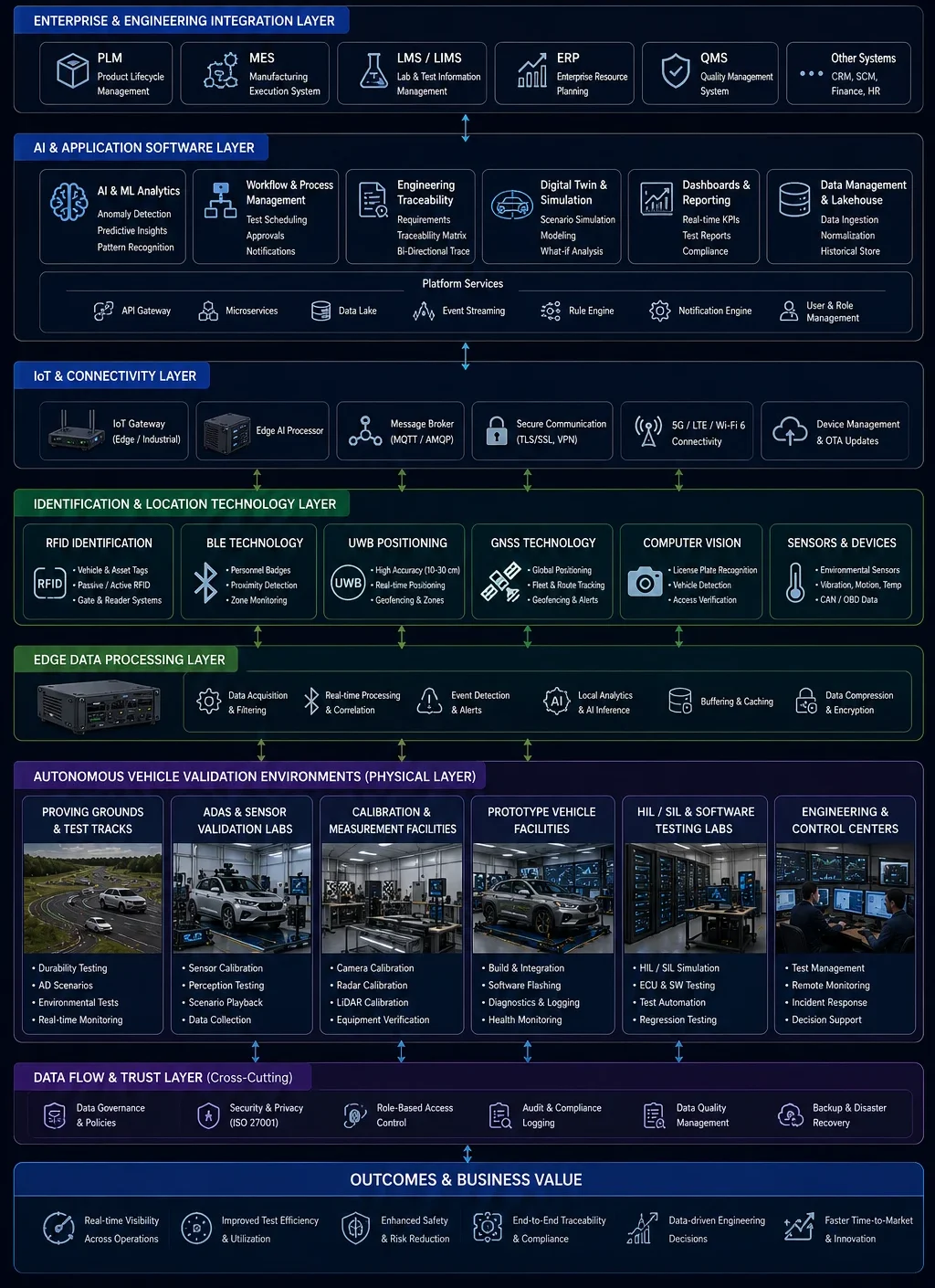
AIoT Technology Stack for Autonomous Vehicle Testing and Engineering Integration
Engineering Experience and Industry Knowledge
AVehicle AI combines AIoT engineering expertise with practical knowledge of automotive validation requirements.
Autonomous vehicle development requires solutions that operate reliably across different environments, including outdoor proving grounds, controlled laboratories, engineering facilities, and distributed testing locations.
The company understands that automotive validation teams require more than basic tracking capabilities. They need solutions that support engineering processes such as:
- Prototype vehicle management
- Validation resource allocation
- Configuration control
- Test campaign coordination
- Equipment availability
- Component traceability
- Access authorization
AVehicle AI applies experience from industrial IoT implementations to develop solutions that support these engineering requirements.
The company's engineering approach emphasizes:
- Technical accuracy
- Reliable system integration
- Enterprise security considerations
- Automotive workflow alignment
- Practical deployment requirements
This approach enables organizations to improve visibility into complex testing operations while maintaining compatibility with existing engineering processes.
Industry Applications Supported by AVehicle AI
AVehicle AI supports a wide range of automotive validation applications where identification, location, and traceability are important.
Key application environments include:
- Autonomous proving grounds
- ADAS validation centers
- Vehicle calibration laboratories
- Hardware-in-the-loop laboratories
- Software-in-the-loop laboratories
- Battery validation facilities
- Environmental testing chambers
- Crash testing facilities
- Autonomous vehicle fleets
- Connected vehicle testing environments
Each environment has different operational requirements.
For example:
- Proving grounds require workforce visibility, vehicle location tracking, and controlled access.
- ADAS laboratories require equipment identification and configuration traceability.
- Calibration facilities require accurate management of specialized tools.
- Validation fleets require vehicle location visibility and utilization analysis.
AVehicle AI develops AIoT solutions that align with these automotive engineering environments and operational requirements.
Why Choose AVehicle AI
Automotive organizations developing autonomous vehicles require technology solutions that support complex validation environments, engineering collaboration, and long-term operational reliability.
AVehicle AI focuses on AIoT solutions specifically designed for autonomous vehicle systems and testing applications, combining automotive domain knowledge with identification, location, and software expertise.
Key strengths include:
Specialized focus on autonomous vehicle validation
AVehicle AI develops solutions around the operational requirements of autonomous driving development, ADAS testing, prototype vehicle programs, and engineering validation activities.
Expertise in identification and location technologies
The company applies RFID, BLE, UWB, GNSS, computer vision, and AI software technologies to improve visibility of vehicles, personnel, equipment, and engineering resources.
Industrial IoT implementation experience
AVehicle AI benefits from extensive IoT experience developed through thousands of industrial IoT projects and customer deployments.
Engineering-oriented software solutions
Solutions are designed to support automotive workflows including prototype vehicle tracking, asset management, validation inventory control, access authorization, and engineering traceability.
Integration with existing automotive systems
AIoT solutions can connect with engineering systems such as manufacturing execution systems (MES), product lifecycle management (PLM) systems, enterprise resource planning (ERP) systems, autonomous fleet management systems, and laboratory software.
Enterprise-quality development practices
AVehicle AI emphasizes research and development, quality assurance processes, technical expertise, and reliable implementation support.
Autonomous vehicle testing requires accurate information throughout every stage of development. AVehicle AI helps organizations improve operational visibility by connecting physical testing activities with digital engineering processes.
Supporting Autonomous Vehicle Validation Through AIoT Solutions
Autonomous vehicle validation continues to become more complex as automotive organizations develop advanced driver assistance systems, autonomous driving software, connected vehicle technologies, and software-defined vehicle capabilities.
Engineering teams must manage:
- Increasing numbers of prototype vehicles
- Multiple software releases
- Complex vehicle configurations
- Large validation teams
- Distributed testing locations
- Extensive engineering documentation requirements
Traditional manual processes may create challenges when organizations need accurate information about vehicles, equipment, personnel, and validation activities.
AIoT solutions provide a connection between physical automotive operations and digital engineering workflows.
AVehicle AI supports this connection through solutions that improve:
- Vehicle identification
- Engineering asset visibility
- Personnel location awareness
- Validation facility access control
- Inventory availability
- Test workflow tracking
- Configuration traceability
By combining AI software with IoT identification and location technologies, organizations can develop stronger visibility into their autonomous vehicle testing operations.
The goal is not simply to track assets, but to provide meaningful engineering information that supports better validation decisions.
AVehicle AI Solution Areas
AVehicle AI provides AIoT software solutions supporting multiple operational areas within autonomous vehicle systems and testing.
Autonomous Test Workforce Analytics
Autonomous vehicle validation requires coordination among test drivers, validation engineers, software engineers, contractors, and facility personnel.
Workforce analytics solutions support visibility across proving grounds and testing facilities.
Applications include:
- Autonomous test driver location analytics
- Validation engineer location analytics
- Proving ground personnel analytics
- Autonomous testing lone worker analytics
- Test workforce movement analytics
These capabilities help organizations improve workforce coordination, emergency response readiness, and operational awareness in complex testing environments.
Autonomous Test Facility Access Management
Autonomous vehicle testing facilities often contain confidential prototypes, advanced vehicle software, and restricted engineering areas.
Access management solutions support:
- Proving ground access analytics
- ADAS validation laboratory access
- Autonomous test zone authorization
- Test contractor access verification
- Validation visitor access analytics
These capabilities help organizations maintain better control over who enters specific testing areas and support improved operational records.
Prototype Vehicle and Validation Asset Analytics
Prototype vehicles and engineering assets represent significant investments during autonomous vehicle development.
AIoT asset analytics solutions support:
- Prototype autonomous vehicle tracking
- ADAS test equipment tracking
- Mobile calibration asset analytics
- Autonomous diagnostic tool tracking
- Validation fleet utilization analytics
These solutions help engineering teams improve asset availability, reduce search time, and maintain better records of testing resources.
Autonomous Test Inventory Management
Autonomous vehicle programs require accurate management of specialized components and validation resources.
Inventory solutions support:
- Prototype vehicle parts inventory
- Autonomous ECU inventory analytics
- Battery validation inventory management
- Validation equipment inventory
- Test spare component availability
Improved inventory visibility helps engineering teams reduce delays caused by unavailable or unidentified resources.
Autonomous Validation Workflow Analytics
Autonomous vehicle testing involves multiple validation stages, engineering approvals, and test campaigns.
Workflow analytics solutions support:
- Autonomous vehicle test progress analytics
- ADAS calibration workflow analytics
- Validation milestone analytics
- Prototype build progress tracking
- Test campaign analytics
These capabilities provide engineering teams with improved awareness of validation status and resource utilization.
Autonomous Vehicle Traceability
Traceability is a critical requirement for autonomous vehicle development because engineering teams must understand relationships between vehicles, components, software versions, and validation results.
Traceability solutions support:
- Prototype configuration traceability
- Autonomous test component traceability
- ADAS software build traceability
- Validation evidence traceability
- Engineering change traceability
These capabilities help organizations maintain accurate validation records throughout the vehicle development lifecycle.
Commitment to Automotive Engineering Innovation
AVehicle AI supports automotive organizations as autonomous vehicle development continues to advance toward more connected, automated, and software-driven mobility solutions.
The company recognizes that successful autonomous vehicle validation depends on accurate engineering information, reliable operational processes, and effective coordination between physical testing environments and digital systems.
AVehicle AI remains focused on developing AIoT solutions that support:
- Autonomous vehicle testing operations
- ADAS validation programs
- Prototype vehicle management
- Engineering asset visibility
- Secure validation access
- Industrial IoT integration
- Automotive traceability requirements
Through continued investment in research and development, technical expertise, and customer-focused engineering practices, AVehicle AI helps organizations improve the management of complex autonomous vehicle validation activities.
Contact AVehicle AI
Automotive organizations developing autonomous vehicles require reliable AIoT solutions that connect engineering operations, physical resources, and digital workflows.
AVehicle AI works with automotive engineering teams to support:
- Autonomous vehicle validation operations
- ADAS testing environments
- Prototype vehicle tracking
- RFID vehicle identification
- BLE and UWB positioning solutions
- GNSS-based validation fleet tracking
- Engineering traceability software
- Industrial IoT applications
Contact AVehicle AI to discuss how AIoT identification, location, and traceability solutions can support autonomous vehicle systems and testing requirements.
Contact AVehicle AI