
Connected AI and IoT Integration for Autonomous Vehicle Validation, ADAS Testing, and Engineering Systems
AVehicle AI provides AI and IoT integration solutions that connect autonomous vehicle testing operations with engineering software, prototype vehicle programs, validation laboratories, proving grounds, and enterprise systems. AIoT integration enables automotive engineering organizations to unify identification, location, workflow, and operational data across autonomous vehicle development environments.
Autonomous Vehicle Systems & Testing requires coordination between prototype vehicles, ADAS validation equipment, test engineers, calibration teams, software builds, engineering documentation, and enterprise applications. AIoT solutions help connect these physical testing activities with digital systems such as Manufacturing Execution Systems (MES), Product Lifecycle Management (PLM), Enterprise Resource Planning (ERP), laboratory management software, fleet management systems, and engineering data applications.
Artificial Intelligence of Things, commonly called AIoT or AI and IoT, combines artificial intelligence with IoT devices, connected equipment, identification technologies, and industrial systems. AIoT solutions may include Industrial AI, Edge AI, machine learning, computer vision, and Physical AI capabilities for autonomous applications. Within autonomous vehicle testing, AIoT integration enables connected identification and location solutions that improve prototype vehicle traceability, validation workflow coordination, engineering collaboration, and test facility operations.
Autonomous vehicle development programs involve thousands of validation activities across proving grounds, ADAS laboratories, hardware-in-the-loop (HIL) facilities, software-in-the-loop (SIL) environments, battery testing centers, and environmental test facilities. AIoT integration connects these environments by linking vehicle identification, engineering workflows, test resources, and enterprise software systems.
AVehicle AI was created within Aperture Venture Studio with support from GAO and builds upon two decades of IoT experience serving thousands of IoT customers and successfully executing thousands of IoT projects. The company applies practical experience from real-world deployments, research and development investments, stringent quality assurance processes, and technical expertise from Ph.D. professionals from leading universities. AVehicle AI has supported Fortune 500 companies, leading R&D organizations, prestigious universities, and U.S. and Canadian government agencies through advanced IoT and connected technology solutions.
AIoT Integration Architecture for Autonomous Vehicle Testing and Enterprise Engineering
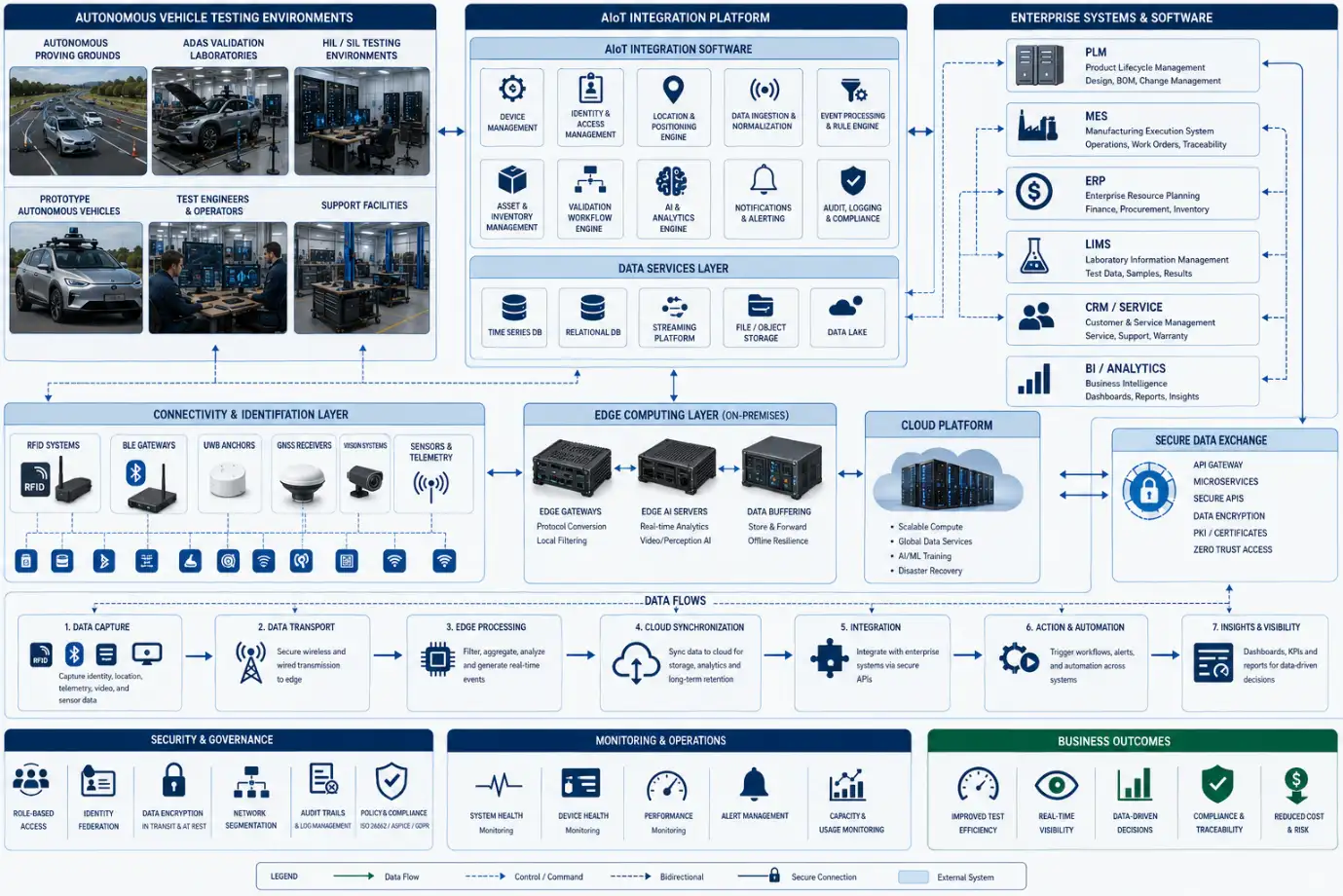
AIoT Integration for Autonomous Vehicle Testing Overview
Autonomous vehicle testing requires accurate coordination between physical assets and digital engineering systems. Prototype vehicles, ADAS components, validation tools, calibration equipment, and engineering personnel must be correctly identified and connected with software systems throughout the vehicle development lifecycle.
AIoT integration provides a structured approach for connecting identification technologies, enterprise software, and validation workflows. Instead of managing isolated systems for vehicle tracking, test equipment management, engineering documentation, and operational records, organizations can create connected workflows that improve validation accuracy and operational visibility.
Key AIoT integration applications for autonomous vehicle systems and testing include:
- Connecting prototype autonomous vehicle identification systems with validation software
- Linking ADAS test equipment location information with engineering workflows
- Synchronizing RFID, BLE, UWB, and GNSS identification technologies with enterprise applications
- Connecting autonomous vehicle telemetry with validation management systems
- Integrating test personnel identification with access control and safety processes
- Supporting edge computing for proving grounds and laboratory environments
- Synchronizing prototype configurations, software builds, and validation records
- Connecting digital twin environments with physical testing activities
AIoT integration is especially important for autonomous vehicle programs because testing involves rapidly changing vehicle configurations, software releases, hardware revisions, and validation requirements. Accurate identification and connectivity help engineering teams associate the correct vehicle, component, software version, and test activity throughout the validation lifecycle.
Autonomous Engineering Connectivity
Autonomous vehicle engineering requires connectivity between physical testing operations and enterprise software systems. AIoT integration enables communication between validation environments and applications used for vehicle development, manufacturing preparation, inventory management, and engineering collaboration.
MES Integration for Autonomous Vehicle Validation Operations
Manufacturing Execution System (MES) integration connects AIoT identification solutions with production engineering and validation workflows. Although autonomous vehicle testing often occurs before full-scale production, MES connectivity helps organizations maintain consistency between prototype development, manufacturing processes, and engineering validation activities.
AIoT-enabled MES integration supports:
- Prototype vehicle build status identification
- Test component tracking
- Engineering process synchronization
- Validation workflow updates
- Prototype assembly traceability
- Manufacturing readiness verification
RFID, BLE, UWB, and other identification technologies can associate physical prototype components and vehicles with digital MES records. This improves visibility into prototype configurations and supports engineering teams during vehicle validation cycles.
For example, a prototype autonomous vehicle entering a validation facility can be automatically associated with its build configuration, software version, assigned test program, and engineering documentation.
PLM Integration for Autonomous Vehicle Prototype Development
Product Lifecycle Management (PLM) integration connects AIoT operational information with vehicle design and engineering lifecycle records. Autonomous vehicle programs rely heavily on PLM systems to manage hardware revisions, software configurations, engineering changes, and validation requirements.
AIoT integration with PLM systems supports:
- Prototype vehicle configuration traceability
- ADAS software build association
- Engineering change tracking
- Component identification throughout development
- Validation evidence connection
- Vehicle revision management
Autonomous vehicles frequently undergo continuous hardware and software modifications during development. AIoT integration helps engineering teams confirm that validation activities are performed on the correct vehicle configuration and associated components.
Connected identification solutions can provide accurate relationships between physical prototype vehicles and digital engineering records, reducing manual verification requirements during complex validation programs.
ERP Integration for Autonomous Testing Resources
Enterprise Resource Planning (ERP) integration connects AIoT systems with inventory, procurement, asset management, and resource planning processes required for autonomous vehicle testing.
Validation programs require management of:
- Prototype vehicle components
- Autonomous driving computers
- Electronic control units (ECUs)
- Battery packs
- Calibration equipment
- Specialized testing tools
- Replacement components
AIoT-enabled ERP integration supports:
- Real-time inventory identification
- Validation equipment availability tracking
- Prototype component allocation
- Spare part management
- Engineering resource coordination
By connecting physical identification data with ERP software, automotive engineering organizations can improve resource availability and reduce delays caused by misplaced equipment or unavailable validation components.
ADAS Validation Laboratory Systems Integration
ADAS validation laboratories require precise coordination between vehicles, simulation systems, calibration tools, engineering applications, and test personnel. AIoT integration connects laboratory operations with enterprise systems to improve visibility and workflow coordination.
ADAS laboratory integration applications include:
- ADAS test equipment identification
- Calibration tool location tracking
- Validation workstation association
- Laboratory access workflow integration
- Test procedure coordination
- Engineering data exchange
Hardware-in-the-loop and software-in-the-loop testing environments can benefit from AIoT connectivity by linking physical test resources with digital validation workflows.
For example, a calibration device used during ADAS testing can be identified, associated with a validation activity, and connected with engineering records to improve test documentation accuracy.
Autonomous Fleet Systems Integration
Autonomous validation fleets require coordination among prototype vehicles, fleet management software, engineering teams, and testing applications. AIoT integration enables fleet systems to exchange operational information with enterprise validation software.
Autonomous fleet integration supports:
- Prototype vehicle identification
- Test vehicle assignment tracking
- Fleet utilization analysis
- Vehicle location data exchange
- Validation campaign coordination
- Test route management
For large autonomous vehicle programs, AIoT integration helps engineering teams maintain visibility across multiple test vehicles operating across proving grounds, public-road validation routes, and research facilities.
Edge Computing for Autonomous Vehicle Validation
Autonomous vehicle testing environments require rapid processing of operational information generated during prototype validation, ADAS testing, vehicle calibration, and engineering verification activities. AIoT-enabled edge computing brings processing capabilities closer to proving grounds, laboratories, and test facilities, enabling faster operational responses and more reliable connectivity between physical testing activities and enterprise software systems.
Edge computing is especially valuable for autonomous vehicle systems and testing because validation activities often occur in environments with large operational areas, moving prototype vehicles, distributed test equipment, and variable network conditions. Processing identification and location information closer to testing locations helps reduce communication delays and supports continuous validation operations.
AIoT edge computing solutions for autonomous vehicle testing support:
- Local processing of prototype vehicle identification data
- Real-time test equipment location verification
- Edge-based validation workflow updates
- Local data filtering before enterprise synchronization
- Connectivity support for remote proving grounds
- Distributed processing across multiple validation facilities
Edge AI software can analyze operational events locally and determine which information should be synchronized with MES, PLM, ERP, fleet management systems, and engineering applications.
Edge AI Validation Workflow for Autonomous Vehicle Testing Operations
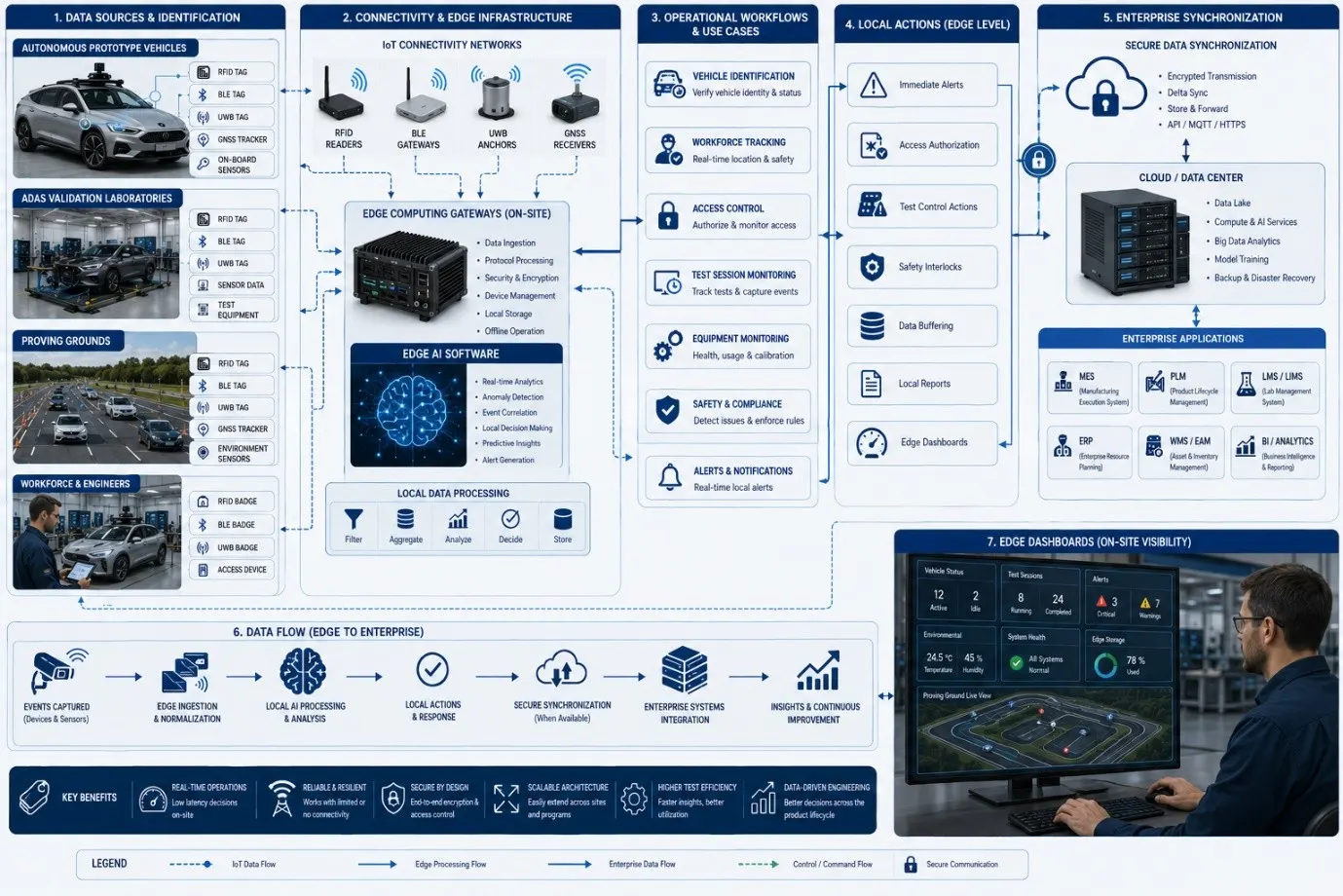
Edge AI Validation Software
Edge AI validation software supports autonomous vehicle testing applications where operational decisions must occur close to the testing environment. Instead of transferring every operational event to centralized systems, edge software processes relevant information locally and forwards important records to enterprise applications.
Applications include:
- Prototype vehicle identification verification
- Test vehicle assignment confirmation
- Validation equipment location processing
- ADAS laboratory workflow coordination
- Engineering event synchronization
- Test facility operational updates
For autonomous proving grounds, edge AI software can connect vehicle identification technologies with local computing systems to verify that the correct prototype vehicle is assigned to the correct validation activity.
For example, an autonomous test vehicle entering a designated validation zone can be identified through RFID, UWB, GNSS, or BLE technologies. The edge system can validate the vehicle assignment, associate the event with a test campaign, and synchronize information with enterprise software.
Local Test Data Processing
Autonomous vehicle validation requires processing information from multiple sources, including prototype vehicles, engineering resources, test equipment, and laboratory systems.
Local processing improves:
- Validation response time
- Operational reliability
- Data synchronization efficiency
- Test workflow automation
- Engineering visibility
Hardware-in-the-loop (HIL) and software-in-the-loop (SIL) testing environments benefit from local AIoT processing because they require coordination between simulation systems, physical equipment, and engineering applications.
Local processing can help associate physical validation activities with digital engineering records while reducing unnecessary communication between remote systems.
Edge Event Filtering
Autonomous testing facilities generate numerous operational events throughout the validation lifecycle. Edge event filtering allows AIoT systems to identify important events locally before transmitting information to enterprise applications.
Examples include:
- Prototype vehicle entry into authorized testing zones
- Unauthorized movement of validation equipment
- Test personnel access events
- Calibration asset relocation
- Completion of validation activities
- Equipment availability changes
By filtering events locally, AIoT systems improve communication efficiency while ensuring important information reaches MES, PLM, ERP, and validation management applications.
Distributed Validation Computing
Autonomous vehicle development programs often operate across multiple engineering locations, including:
- Vehicle research centers
- Autonomous proving grounds
- ADAS validation laboratories
- Supplier testing locations
- Battery testing facilities
Distributed validation computing allows AIoT software to operate across multiple locations while maintaining consistent workflows and data exchange.
Capabilities include:
- Multi-site validation coordination
- Distributed edge processing
- Centralized engineering visibility
- Consistent identification workflows
- Remote facility connectivity
This approach supports automotive organizations conducting autonomous vehicle testing across geographically distributed environments.
Offline Autonomous Testing Operations
Autonomous vehicle testing may occur in remote locations where network availability is limited. AIoT solutions with offline operation capabilities allow testing activities to continue while maintaining local operational records.
Offline testing support includes:
- Local identification data storage
- Continued vehicle and asset identification
- Local validation workflow execution
- Delayed synchronization after connectivity restoration
- Operational continuity during network interruptions
This capability is important for outdoor proving grounds and remote vehicle testing locations where uninterrupted validation activities are required.
Validation Data Synchronization for Autonomous Vehicle Testing
Autonomous vehicle engineering requires accurate synchronization between physical testing activities and digital engineering records. AIoT integration connects identification systems, prototype vehicles, test equipment, personnel activities, and enterprise software applications.
Validation data synchronization helps organizations maintain relationships between:
- Prototype vehicle configurations
- ADAS software versions
- Test campaigns
- Engineering changes
- Calibration activities
- Validation evidence
- Vehicle telemetry records
AIoT-enabled synchronization supports consistent information exchange between autonomous testing operations and enterprise systems.
Real-Time Validation Data Exchange
Real-time data exchange allows autonomous vehicle testing teams to connect operational activities with engineering applications.
Applications include:
- Linking test vehicles with validation programs
- Updating prototype status records
- Connecting equipment usage with engineering tasks
- Synchronizing laboratory activities
- Sharing validation progress information
Real-time exchange reduces manual data entry and improves accuracy during complex autonomous vehicle validation programs.
RFID Integration for Autonomous Vehicle Testing
RFID integration provides reliable identification capabilities for prototype vehicles, components, calibration equipment, and validation resources.
RFID-enabled AIoT solutions support:
- Prototype component identification
- ECU identification
- Calibration equipment tracking
- Battery pack identification
- Test inventory management
- Validation workflow association
Connecting RFID identification data with MES, PLM, and ERP systems improves traceability throughout autonomous vehicle development.
For example, an RFID-tagged prototype component can be associated with a specific vehicle build, engineering revision, and validation process.
BLE Integration for Validation Operations
Bluetooth Low Energy (BLE) integration supports flexible identification and location solutions across autonomous vehicle testing environments.
BLE-based AIoT applications include:
- Test engineer location identification
- Validation equipment movement tracking
- Laboratory asset identification
- Proving ground operational visibility
- Workforce coordination
BLE solutions are particularly useful for large testing environments where personnel and equipment frequently move between validation zones.
UWB Vehicle Positioning Integration
Ultra-Wideband (UWB) technology provides high-accuracy location capabilities for autonomous vehicle testing environments requiring precise positioning.
UWB integration supports:
- Prototype vehicle positioning
- ADAS test zone identification
- High-precision validation workflows
- Indoor laboratory positioning
- Vehicle movement verification
UWB-based positioning is valuable for environments where precise vehicle location information is required, such as autonomous testing facilities, calibration laboratories, and controlled validation zones.
GNSS and Cellular Integration for Autonomous Test Fleets
GNSS and cellular connectivity support large-area autonomous vehicle testing applications, especially for proving grounds and outdoor validation routes.
Applications include:
- Prototype fleet location tracking
- Test vehicle movement records
- Remote validation coordination
- Vehicle route documentation
- Fleet activity synchronization
GNSS and cellular integration can connect autonomous test fleets with enterprise validation software while supporting geographically distributed testing operations.
Digital Twin Synchronization for Autonomous Validation
Digital twin synchronization connects physical autonomous vehicle testing activities with digital representations used by engineering teams.
AIoT integration supports digital twin synchronization through:
- Prototype vehicle identification
- Component configuration records
- Test activity association
- Engineering change tracking
- Validation history updates
Digital twin synchronization helps engineering teams understand the relationship between physical prototype vehicles and their corresponding digital engineering records.
For autonomous vehicle programs, this connection improves visibility into vehicle configurations, software versions, and validation progress.
Autonomous AIoT Deployment Models for Vehicle Testing Operations
Autonomous vehicle testing organizations require flexible AIoT deployment models because validation environments differ significantly between proving grounds, engineering laboratories, research facilities, and enterprise development centers. AIoT integration solutions must support different operational requirements, data management policies, cybersecurity requirements, and engineering workflows.
AVehicle AI supports cloud, server, hybrid, and multi-site deployment approaches for autonomous vehicle systems and testing applications. These deployment models enable organizations to connect prototype vehicles, ADAS validation equipment, engineering systems, and enterprise applications while maintaining operational control.
Cloud Deployment for Autonomous Vehicle Validation Software
Cloud deployment enables centralized management of AIoT integration software across distributed autonomous vehicle testing locations. This approach is suitable for automotive organizations operating multiple proving grounds, engineering centers, validation laboratories, or global testing programs.
Cloud-based AIoT deployment supports:
- Centralized validation information management
- Remote engineering collaboration
- Multi-location testing visibility
- Enterprise application connectivity
- Scalable software deployment
- Controlled access management
Cloud deployment allows engineering teams to access connected validation information across multiple facilities while maintaining consistent software configurations and operational workflows.
For example, a global automotive organization can connect prototype vehicle identification, validation equipment tracking, and test workflow information from different proving grounds through a centralized AIoT software environment.
Server Deployment for Controlled Engineering Environments
Server deployment allows organizations to host AIoT integration software within their own computing environments. This model is commonly used by automotive manufacturers, research organizations, and engineering laboratories requiring greater control over operational data and software management.
Server-based deployment supports:
- Internal data management
- Enterprise-controlled computing environments
- Local application hosting
- Customized integration requirements
- Existing engineering software connectivity
Server deployment can support autonomous vehicle testing facilities where prototype information, ADAS validation records, and engineering data require management within controlled environments.
Hybrid AIoT Deployment for Autonomous Testing Programs
Hybrid deployment combines cloud and server environments to support complex autonomous vehicle testing requirements.
Hybrid AIoT deployment enables organizations to connect:
- Local validation systems
- Edge computing environments
- Enterprise servers
- Cloud applications
- Engineering databases
This approach allows critical operational processing to occur locally while selected information is synchronized with centralized systems.
Hybrid deployment is valuable for autonomous vehicle programs where proving grounds, laboratories, and engineering centers operate under different connectivity, security, and data management requirements.
Multi-Site Validation Deployment
Large autonomous vehicle programs often involve multiple testing environments, including:
- Autonomous proving grounds
- ADAS validation centers
- Vehicle calibration laboratories
- Hardware-in-the-loop testing facilities
- Software-in-the-loop testing environments
- Battery validation centers
- Environmental test facilities
Multi-site AIoT deployment allows organizations to maintain consistent validation processes across different locations.
Capabilities include:
- Centralized configuration management
- Distributed identification solutions
- Cross-location operational visibility
- Shared validation workflows
- Coordinated engineering activities
Multi-site deployment helps automotive organizations maintain consistent autonomous testing processes while supporting regional testing requirements.
Validation Security Connectivity for Autonomous Vehicle Systems
Autonomous vehicle testing involves sensitive engineering information, including prototype configurations, ADAS software versions, vehicle calibration parameters, test procedures, and validation results. Secure AIoT connectivity helps protect information exchange between physical testing environments and enterprise software systems.
AIoT security connectivity supports:
- Controlled access to validation systems
- Protected communication between connected applications
- Secure API integration
- Identity verification
- Operational audit tracking
- Enterprise cybersecurity alignment
Security considerations are essential for autonomous vehicle testing because development programs involve confidential vehicle designs, software development activities, and safety validation processes.
Test Identity Management
Test identity management connects personnel identification solutions with autonomous vehicle validation workflows.
Autonomous testing environments involve:
- Test drivers
- Validation engineers
- Calibration specialists
- Software engineers
- Contractors
- Research personnel
- Visitors
AIoT-enabled identity management supports:
- Digital validation credentials
- RFID test badges
- BLE identification devices
- Smart access cards
- Personnel authorization workflows
- Test participation records
Connecting personnel identification with validation systems helps organizations verify authorized participation in restricted testing areas.
Engineering Single Sign-On Integration
Engineering single sign-on connects AIoT validation applications with enterprise authentication systems.
Benefits include:
- Simplified user authentication
- Centralized access management
- Reduced credential duplication
- Controlled application permissions
- Improved engineering workflow efficiency
Single sign-on integration allows engineering teams to access authorized validation applications while maintaining enterprise security requirements.
Validation API Connectivity
API integration enables communication between AIoT software and existing autonomous vehicle engineering systems.
AIoT API connectivity supports integration with:
- MES software
- PLM systems
- ERP applications
- Laboratory management systems
- Fleet management software
- Vehicle telemetry applications
- Digital twin systems
Secure APIs allow organizations to connect AIoT identification and location solutions with existing engineering applications without replacing established software systems.
Test Data Encryption and Secure Communication
Autonomous vehicle testing generates valuable engineering information that requires protection during transmission and storage.
AIoT security solutions support:
- Encrypted data communication
- Protected software connections
- Secure validation records
- Controlled information access
- Enterprise security compliance
Encryption helps protect prototype vehicle information, ADAS development data, software validation records, and engineering workflows.
Validation Audit Logging
Audit logging provides visibility into activities performed within autonomous vehicle testing systems.
AIoT-enabled audit records can capture:
- Personnel access events
- Prototype vehicle identification activities
- Equipment movement records
- Software system interactions
- Configuration changes
- Validation workflow updates
Audit logging improves accountability and supports engineering organizations requiring traceable validation processes.
Why AVehicle AI for Autonomous Vehicle AIoT Integration
AVehicle AI delivers AI and IoT integration solutions based on extensive IoT engineering experience and enterprise deployment knowledge. The company was created within Aperture Venture Studio with support from GAO and builds upon two decades of experience serving thousands of IoT customers.
AVehicle AI combines practical deployment experience with research and development investment, quality assurance processes, and technical expertise to support demanding autonomous vehicle testing environments.
The company provides:
- AIoT integration solutions for autonomous vehicle validation operations
- Identification and location solutions using RFID, BLE, UWB, GNSS, and cellular technologies
- Enterprise software integration with MES, PLM, ERP, and engineering applications
- Edge AI and distributed processing solutions
- Cloud, server, hybrid, and multi-site deployment options
- Remote and onsite technical support
AVehicle AI is supported by Ph.D. professionals from leading universities and has attracted experienced technical experts and strategic partners. Over the years, the company has supported Fortune 500 companies, leading R&D organizations, prestigious universities, and U.S. and Canadian government agencies.
Connect Autonomous Vehicle Testing Systems with AIoT Integration Solutions
Autonomous vehicle development requires reliable connections between prototype vehicles, validation facilities, engineering teams, and enterprise software systems. AIoT integration enables automotive organizations to connect identification technologies, edge computing systems, enterprise applications, and validation workflows.
AVehicle AI helps organizations implement AI and IoT integration solutions for:
- Autonomous vehicle prototype tracking
- ADAS validation workflows
- Engineering system connectivity
- Test facility access management
- Validation data synchronization
- Enterprise software integration
Contact AVehicle AI to explore AIoT integration solutions for autonomous vehicle systems and testing operations.
Contact AVehicle AI