
Technical Resources for AIoT-Enabled Autonomous Vehicle Systems & Testing
The AVehicle AI Resource Center provides technical knowledge and engineering references for AIoT-enabled autonomous vehicle systems and testing operations within the automotive industry. The resource center supports professionals involved in autonomous driving development, advanced driver assistance systems (ADAS), vehicle validation, prototype fleet management, and automotive safety engineering.
Autonomous vehicle testing requires coordination among multiple engineering disciplines, including vehicle systems engineering, embedded software development, perception and decision software validation, electronic control unit (ECU) verification, calibration engineering, and test operations management.
Modern autonomous vehicle programs rely on extensive physical testing across proving grounds, closed-course facilities, hardware-in-the-loop (HIL) laboratories, software-in-the-loop (SIL) environments, vehicle calibration centers, environmental test facilities, and autonomous validation fleets.
These environments require accurate identification, location awareness, and traceability of:
- Prototype autonomous vehicles
- ADAS development vehicles
- Validation engineers and test operators
- Calibration equipment
- Test instruments
- Prototype components
- Engineering assets
- Validation records
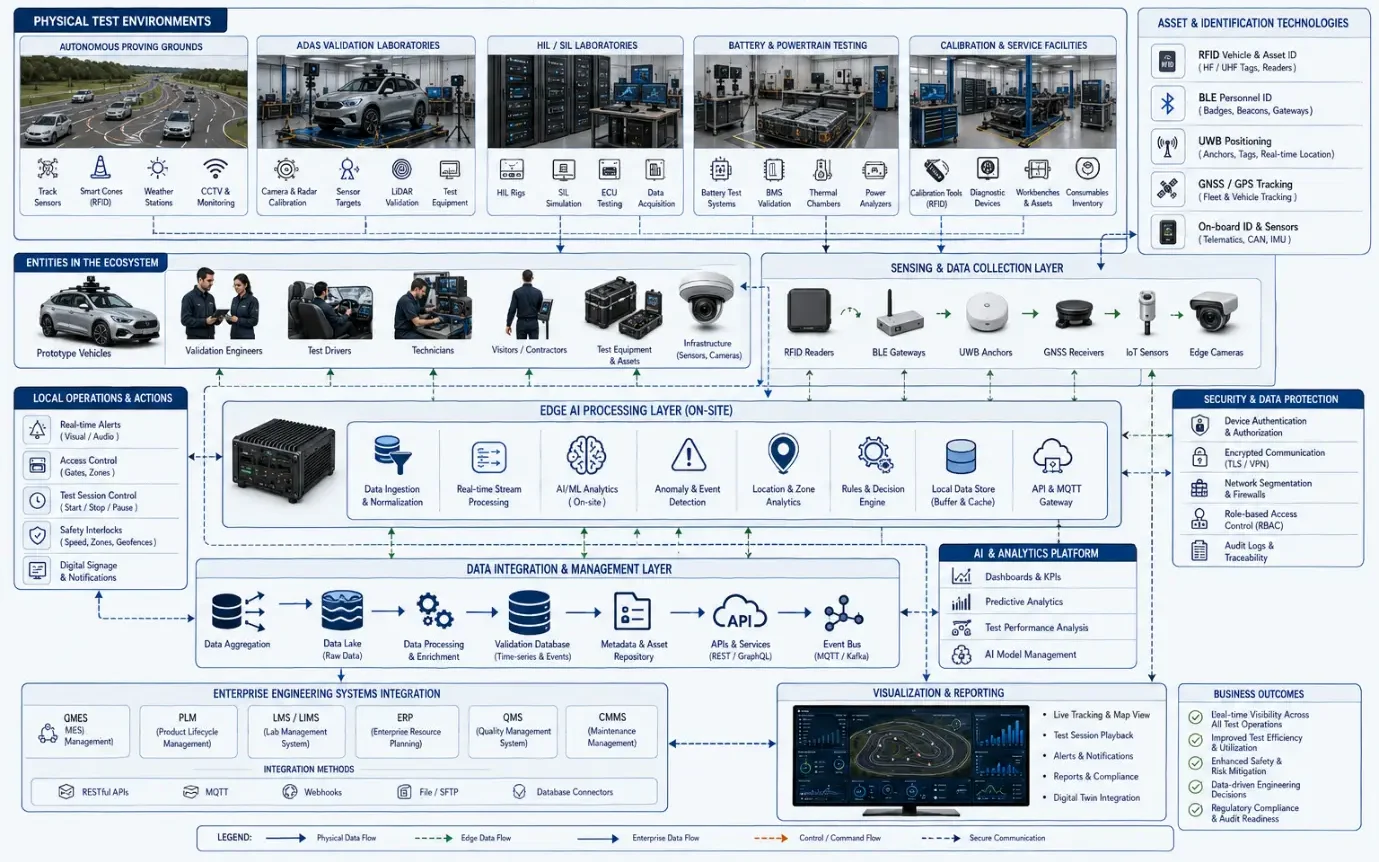
AIoT, also known as AI and IoT, combines artificial intelligence with connected identification technologies, IoT devices, software systems, and industrial workflows. In autonomous vehicle testing, AIoT solutions may combine RFID identification, Bluetooth Low Energy (BLE) tracking, Ultra-Wideband (UWB) positioning, GNSS vehicle tracking, Edge AI processing, machine learning analytics, and engineering software integration.
Unlike traditional manual tracking methods, AIoT-enabled identification and location solutions allow automotive engineering teams to connect physical testing activities with digital validation records. This improves prototype vehicle traceability, test resource coordination, validation documentation accuracy, and engineering decision-making.
The AVehicle AI resource center focuses on practical technical knowledge for deploying AIoT solutions across autonomous vehicle development environments, including:
- Autonomous vehicle proving grounds
- ADAS validation centers
- Vehicle calibration laboratories
- Hardware-in-the-loop testing facilities
- Software-in-the-loop validation environments
- Connected vehicle testing programs
- Autonomous fleet validation operations
AVehicle AI was created within Aperture Venture Studio, with support from GAO. Building on more than two decades of IoT experience, GAO has served thousands of IoT customers and successfully executed thousands of IoT projects across industrial applications. AVehicle AI applies this experience through dedicated research and development investment, stringent quality assurance processes, and expert technical support provided remotely or onsite.
Supported by Ph.D. professionals from leading universities, AVehicle AI combines technical expertise with practical deployment experience. Over the years, related IoT solutions have supported Fortune 500 companies, leading research and development organizations, prestigious universities, and U.S. and Canadian government agencies.
AIoT System Architecture for Autonomous Vehicle Testing and Engineering Integration
Autonomous Vehicle Validation Documentation
Autonomous vehicle validation documentation provides structured technical guidance for planning, executing, recording, and improving autonomous driving verification programs.
Validation documentation is essential because autonomous vehicle development involves thousands of engineering activities across vehicle hardware, embedded systems, autonomous driving software, ADAS functions, and safety verification processes.
Engineering teams use documentation to establish repeatable procedures for:
- Prototype vehicle testing
- ADAS feature verification
- Autonomous driving scenario evaluation
- Vehicle configuration management
- Software build validation
- Test evidence collection
- Engineering change tracking
- Functional safety verification
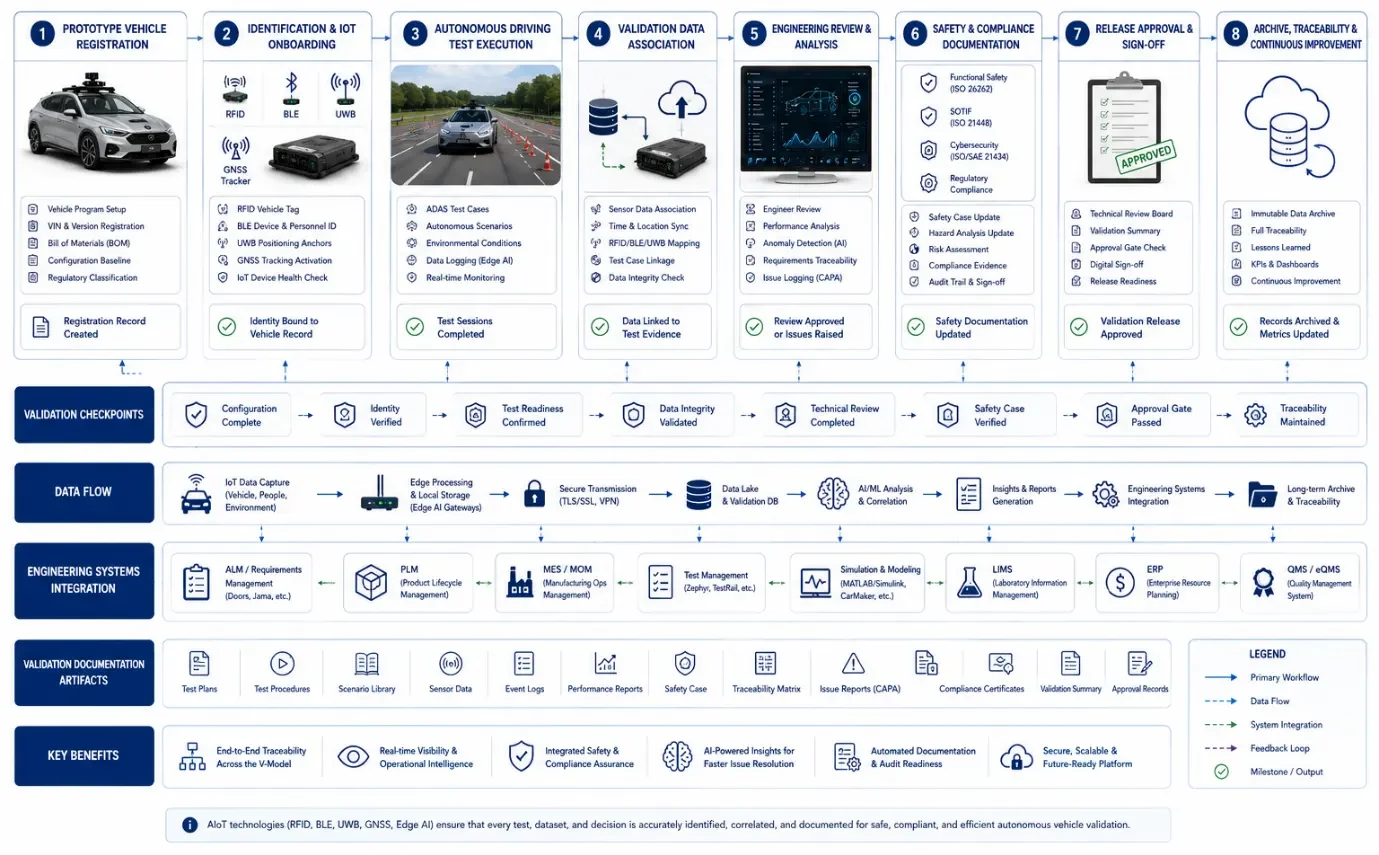
AIoT deployment documentation extends traditional validation records by connecting physical assets and operational activities with digital engineering information.
For example, a prototype autonomous vehicle equipped with an RFID identification tag can be associated with:
- Vehicle program information
- Hardware configuration
- Software release version
- Assigned validation campaign
- Test engineer responsibility
- Verification status
Similarly, BLE and UWB-based identification solutions can support location-related validation records by associating personnel, vehicles, and equipment with specific testing activities.
AIoT Documentation for Autonomous Driving Test Programs
AIoT implementation guides for autonomous vehicle systems and testing explain how connected identification and location technologies can be deployed within automotive validation environments.
Key documentation areas include:
- RFID identification methods for prototype vehicles and test equipment
- BLE workforce tracking methods for proving grounds
- UWB positioning approaches for high-accuracy vehicle location
- GNSS tracking methods for autonomous validation fleets
- AI-based analysis of identification and location data
- Integration with engineering software systems
- Data security and access control considerations
Autonomous vehicle testing programs often involve multiple prototype vehicles with different configurations. A vehicle used for perception testing may have different software, hardware, and calibration requirements compared with a vehicle used for highway automation validation.
Accurate identification helps engineering teams prevent configuration confusion and maintain reliable test documentation.
AIoT-based identification systems can support:
- Vehicle-to-test-case association
- Prototype configuration traceability
- Validation milestone tracking
- Engineering workflow coordination
- Test campaign documentation
Autonomous Vehicle Validation Knowledge Areas
Technical resource documentation for autonomous vehicle testing commonly covers several engineering areas:
- ADAS verification procedures
- Autonomous driving validation workflows
- Prototype vehicle identification methods
- Test facility deployment practices
- Vehicle positioning technologies
- Safety engineering documentation
- Engineering change management
- Validation evidence management
These resources help automotive engineering organizations improve consistency across development programs and support collaboration between vehicle engineering, software teams, safety specialists, and validation personnel.
AIoT-Supported Autonomous Vehicle Validation Workflow and Documentation Lifecycle
Prototype Vehicle RFID Identification Guides
Prototype vehicle identification is a fundamental requirement in autonomous vehicle development because engineering organizations often operate multiple test vehicles with different hardware configurations, software releases, calibration parameters, and validation objectives.
Autonomous vehicle programs may include prototype vehicles dedicated to:
- ADAS feature validation
- Autonomous driving software testing
- Sensor and perception system evaluation
- Vehicle dynamics testing
- Powertrain and battery validation
- Connected vehicle verification
- Functional safety assessments
Accurate identification ensures that engineering teams can associate each physical vehicle with the correct development records, test campaign, configuration data, and validation history.
RFID identification technology provides a reliable method for managing prototype vehicle identity throughout the vehicle development lifecycle. RFID tags, readers, and software systems allow engineering teams to automatically identify vehicles without relying on manual documentation processes.
AIoT-enabled RFID vehicle identification solutions can connect:
- Prototype vehicle identifiers
- Vehicle configuration records
- Software build information
- ADAS feature versions
- Test campaign assignments
- Validation results
This connection improves prototype vehicle traceability and reduces errors when multiple autonomous vehicles operate across different testing locations.
RFID Applications in Autonomous Vehicle Testing
RFID identification guides for autonomous vehicle testing may cover deployment practices for:
- Prototype autonomous vehicle identification
- ADAS development vehicle tracking
- Calibration equipment identification
- Validation tool management
- Prototype component traceability
- Test inventory association
For example, an autonomous vehicle entering a proving ground can be identified through RFID technology and associated with its approved testing configuration. Engineering teams can verify whether the vehicle is assigned to a specific autonomous driving scenario, software release, or validation activity.
RFID identification also supports engineering change traceability. During autonomous vehicle development, prototype vehicles frequently receive updated:
- Electronic control units (ECUs)
- Computing modules
- Communication components
- Battery systems
- Software versions
- Calibration parameters
Maintaining accurate identification records helps ensure that validation results are connected to the correct vehicle configuration.
RFID Deployment Considerations for Prototype Vehicles
Successful RFID implementation requires consideration of automotive testing requirements, operating conditions, and information management processes.
Important considerations include:
- Selecting RFID tags appropriate for prototype vehicle environments
- Defining vehicle registration procedures
- Linking RFID identifiers with engineering databases
- Maintaining configuration history
- Managing access permissions for validation information
- Supporting multi-site vehicle testing programs
RFID identification is especially valuable for automotive organizations managing large prototype fleets where manual vehicle tracking becomes difficult.
By combining RFID identification with AI-based software analysis, organizations can gain improved visibility into vehicle utilization, validation activity, and development progress.
BLE Proving Ground Tracking Guides
Autonomous proving grounds are large-scale testing environments where multiple engineering teams, prototype vehicles, contractors, and support personnel operate simultaneously.
Managing personnel identification and movement across these environments is important for:
- Operational coordination
- Workforce accountability
- Safety procedures
- Test activity documentation
- Facility utilization analysis
Bluetooth Low Energy (BLE) identification solutions provide a practical method for tracking authorized personnel and mobile assets within autonomous testing facilities.
BLE-based identification devices such as smart badges and tracking tags allow engineering organizations to associate individuals with testing activities while supporting location analytics.
AIoT-enabled BLE solutions can support:
- Autonomous test driver identification
- Validation engineer location analytics
- Proving ground personnel analytics
- Contractor activity management
- Emergency mustering procedures
- Test workforce movement analysis
BLE Applications in Autonomous Testing Facilities
BLE proving ground tracking guides help engineering teams understand how BLE technology can support different operational scenarios.
Applications include:
Autonomous Test Workforce Location Analytics
Engineering teams can analyze workforce movement patterns to understand:
- Personnel presence within testing zones
- Engineering resource allocation
- Test activity coordination
- Operational workflow improvements
Validation Access Coordination
BLE identification can support controlled access workflows by helping verify authorized personnel within:
- Autonomous driving test zones
- ADAS validation areas
- Calibration laboratories
- Vehicle preparation facilities
Emergency Workforce Accountability
Large proving grounds require effective emergency response procedures.
BLE identification can support:
- Personnel location awareness
- Emergency assembly verification
- Faster workforce accountability
- Incident documentation
BLE Deployment Practices for Proving Grounds
BLE deployment planning typically considers:
- Facility size and testing zones
- Identification requirements
- Data processing requirements
- Workforce privacy considerations
- Integration with access management systems
BLE technology can complement other AIoT identification methods. For example:
- RFID can identify vehicles and equipment
- BLE can identify personnel and mobile assets
- UWB can provide high-accuracy vehicle positioning
- GNSS can support fleet-level vehicle tracking
Together, these technologies support comprehensive autonomous testing operations.
UWB Vehicle Positioning Guides
Ultra-Wideband (UWB) positioning provides high-accuracy location capability for autonomous vehicle testing environments where precise vehicle position information is required.
Autonomous driving validation often requires accurate understanding of vehicle movement within controlled environments. Traditional location technologies may not provide sufficient precision for applications such as:
- Closed-course autonomous testing
- Vehicle trajectory analysis
- ADAS scenario validation
- Test event verification
- Prototype vehicle positioning
UWB technology enables accurate location determination by using wide-spectrum radio communication between UWB tags and positioning infrastructure.
UWB Applications for Autonomous Vehicle Validation
UWB vehicle positioning guides support engineering teams deploying high-accuracy location solutions for:
- Autonomous proving grounds
- Vehicle calibration facilities
- Controlled testing areas
- HIL validation environments
- Prototype vehicle development sites
Potential applications include:
- Tracking autonomous vehicle movement paths
- Confirming vehicle position during test scenarios
- Associating vehicle location with validation events
- Supporting repeatable testing procedures
- Improving engineering analysis
AIoT systems can combine UWB location information with AI-based analytics to identify patterns in autonomous vehicle testing activities.
For example, engineering teams can analyze whether prototype vehicles followed expected routes during automated driving scenarios or whether test procedures were executed within defined validation zones.
UWB Positioning Integration Considerations
UWB deployment considerations include:
- Required positioning accuracy
- Testing environment layout
- Vehicle tag installation
- Positioning infrastructure placement
- Software integration requirements
- Data synchronization methods
UWB is particularly valuable when autonomous vehicle testing requires precise location information beyond basic fleet tracking.
ISO 26262 & SOTIF Compliance Resources
Autonomous vehicle development requires rigorous safety engineering processes to address risks associated with vehicle electronics, autonomous driving functions, and advanced driver assistance systems.
ISO 26262 and SOTIF provide important engineering references for organizations developing and validating automated driving technologies.
ISO 26262 Functional Safety Resources
ISO 26262 addresses functional safety requirements for automotive electrical and electronic systems.
The standard provides guidance related to:
- Safety lifecycle management
- Hazard analysis and risk assessment
- System development processes
- Hardware and software safety requirements
- Verification and validation activities
- Safety documentation
Autonomous vehicle testing programs rely on accurate validation records to demonstrate that safety-related requirements have been evaluated.
AIoT-enabled identification solutions can support these processes by improving traceability between:
- Prototype vehicles
- Test configurations
- Validation procedures
- Engineering evidence
- Development milestones
SOTIF Resources for Autonomous Driving Systems
Safety Of The Intended Functionality (SOTIF) addresses situations where autonomous vehicle functions may behave unexpectedly due to limitations in perception, decision-making, or environmental understanding.
SOTIF considerations are especially relevant for:
- Autonomous driving systems
- ADAS perception functions
- Machine learning-based vehicle functions
- Automated decision systems
Testing documentation should maintain clear relationships between:
- Test scenarios
- Vehicle configurations
- Software versions
- Validation results
- Engineering decisions
AIoT identification and location solutions help support these processes by improving physical asset traceability and validation workflow documentation.
Autonomous Vehicle Testing FAQs
Autonomous vehicle systems and testing programs require coordination between vehicle hardware, autonomous driving software, ADAS functions, validation procedures, safety requirements, and engineering operations. The following frequently asked questions address common technical considerations related to AIoT-enabled identification, location, traceability, and validation documentation.
Autonomous vehicle testing resources are technical documents, engineering references, deployment guides, and operational materials that support the development, verification, and validation of autonomous driving systems.
These resources help automotive engineering teams manage complex testing activities involving:
- Prototype autonomous vehicles
- ADAS development programs
- Vehicle calibration processes
- Autonomous driving software validation
- Hardware-in-the-loop (HIL) testing
- Software-in-the-loop (SIL) testing
- Proving ground operations
- Functional safety verification
Typical autonomous vehicle testing resources include:
- Autonomous vehicle validation documentation
- ADAS test deployment guides
- RFID vehicle identification references
- BLE proving ground tracking guides
- UWB vehicle positioning documentation
- GNSS fleet tracking references
- ISO 26262 functional safety resources
- SOTIF engineering guidelines
- AIoT implementation documentation
These resources help engineering teams establish repeatable testing processes, improve traceability, and maintain consistent validation practices throughout autonomous vehicle development.
AIoT combines artificial intelligence with IoT identification technologies, connected equipment, software systems, and industrial workflows.
Within autonomous vehicle testing environments, AIoT solutions support the connection between physical testing activities and digital engineering records.
AIoT applications may include:
- Prototype vehicle identification
- Test workforce location analytics
- Validation equipment identification
- Vehicle configuration traceability
- Test workflow documentation
- Engineering data association
For example, an RFID-identified prototype vehicle can be linked with its software version, hardware configuration, assigned validation program, and testing history.
Similarly, BLE and UWB technologies can provide identification and location information that helps engineering teams understand personnel movement, vehicle positioning, and validation activities.
AIoT does not replace engineering validation processes. Instead, it supports those processes by improving visibility, documentation accuracy, and operational coordination.
RFID plays an important role in prototype vehicle identification and asset traceability within autonomous vehicle development environments.
RFID solutions can support:
- Prototype autonomous vehicle identification
- ADAS test vehicle management
- Calibration equipment identification
- Validation asset tracking
- Component traceability
- Inventory association
A prototype vehicle may undergo frequent changes during development. Hardware components, software releases, and calibration parameters can change between testing phases.
RFID identification helps ensure that engineering teams can accurately associate test results with the correct vehicle configuration.
This improves:
- Validation record accuracy
- Engineering change tracking
- Prototype fleet management
- Safety documentation quality
BLE identification solutions are commonly used for personnel and mobile asset identification within large autonomous testing facilities.
Applications include:
- Validation engineer location analytics
- Autonomous test driver identification
- Contractor identification
- Workforce movement analysis
- Emergency mustering support
Autonomous proving grounds may contain multiple testing areas operating simultaneously. BLE-based identification helps organizations understand personnel presence and improve operational coordination.
When integrated with AIoT software, BLE information can support analysis of:
- Workforce distribution
- Test zone utilization
- Operational workflows
- Emergency response activities
UWB is important for autonomous vehicle testing because it provides high-accuracy positioning capabilities in controlled environments.
Autonomous driving validation often requires precise location information for:
- Vehicle trajectory analysis
- Test scenario verification
- Closed-course testing
- ADAS feature validation
- Autonomous driving demonstrations
Compared with broad-area tracking technologies, UWB is suitable for applications requiring more precise vehicle positioning within proving grounds, laboratories, and controlled testing zones.
AIoT software can combine UWB positioning information with engineering analytics to support validation reviews and testing documentation.
ISO 26262 and SOTIF provide important guidance for automotive safety engineering.
ISO 26262 focuses on functional safety processes for electrical and electronic vehicle systems, including:
- Safety lifecycle management
- Hazard analysis
- Risk assessment
- Verification and validation
SOTIF addresses risks related to limitations of intended functionality, particularly for advanced systems involving perception, decision-making, and automated driving functions.
Autonomous vehicle testing documentation should maintain traceability between:
- Test scenarios
- Prototype vehicle configurations
- Software versions
- Validation results
- Safety assessments
AIoT identification solutions can support these activities by improving the connection between physical test assets and digital engineering records.
AIoT Implementation Guide for Autonomous Vehicle Testing
Deploying AIoT solutions within autonomous vehicle testing environments requires alignment between technology selection, engineering workflows, and operational objectives.
A structured implementation process typically includes:
- Identifying vehicle, personnel, and equipment tracking requirements
- Mapping validation workflows
- Selecting suitable identification technologies
- Integrating AIoT software with engineering systems
- Establishing data management procedures
- Defining security and access requirements
- Evaluating deployment performance
Different autonomous testing environments require different technical approaches.
AIoT Deployment Applications by Testing Environment
Autonomous Proving Grounds
AIoT solutions can support:
- Prototype vehicle identification
- Test workforce location analytics
- Validation zone coordination
- Vehicle movement analysis
- Emergency workforce accountability
Proving grounds benefit from combining multiple identification technologies. Examples include:
- RFID for vehicle identification
- BLE for personnel identification
- UWB for precise vehicle positioning
- GNSS for fleet-level tracking
ADAS Validation Centers
ADAS validation facilities require accurate management of vehicles, equipment, and testing procedures.
AIoT applications may include:
- ADAS test vehicle identification
- ECU and component association
- Calibration equipment identification
- Validation workflow documentation
Hardware-In-The-Loop Laboratories
HIL laboratories simulate vehicle conditions and test electronic systems before physical vehicle deployment.
AIoT solutions can support:
- Test equipment identification
- Component traceability
- Configuration management
- Validation record association
Software-In-The-Loop Testing Environments
SIL testing focuses on validating autonomous driving software behavior through simulation and software-based testing.
AIoT-related documentation can support:
- Software build association
- Validation workflow tracking
- Engineering record management
Autonomous Validation Fleets
Autonomous validation fleets require management of multiple vehicles operating across different locations.
AIoT solutions can support:
- Vehicle identification
- Fleet assignment tracking
- Validation campaign management
- Development record association
Autonomous Vehicle Testing Best Practices
Successful autonomous vehicle validation programs require disciplined engineering processes, accurate documentation, and reliable identification methods.
Recommended practices include:
- Maintaining accurate prototype vehicle identification records
- Connecting vehicle configurations with validation results
- Documenting software and hardware changes
- Standardizing testing procedures
- Managing engineering access requirements
- Maintaining safety-related validation evidence
- Integrating physical asset identification with digital records
AIoT-enabled identification and location solutions provide additional visibility into complex testing environments by connecting vehicles, personnel, equipment, and workflows.
This improves the ability of engineering teams to understand testing progress, maintain traceability, and support continuous validation improvement.
AVehicle AI Autonomous Vehicle Testing Resource Library
The AVehicle AI Resource Center provides technical references for professionals involved in autonomous vehicle systems development, ADAS validation, and AIoT deployment.
The resource library includes:
- Autonomous vehicle validation documentation
- ADAS test deployment guides
- Prototype vehicle RFID identification guides
- BLE proving ground tracking guides
- UWB vehicle positioning guides
- GNSS autonomous fleet tracking references
- ISO 26262 functional safety resources
- SOTIF engineering documentation
- AIoT implementation guides
- Autonomous vehicle testing FAQs
These resources are designed for:
- Automotive engineering teams
- Autonomous driving developers
- Validation engineers
- Test facility managers
- Research organizations
- System integration specialists
Technical Knowledge for AIoT-Enabled Autonomous Vehicle Systems & Testing
Autonomous vehicle development requires reliable engineering methods for managing prototype vehicles, validation workflows, safety requirements, and testing operations.
AVehicle AI provides technical resources focused on AI and IoT identification and location solutions supporting autonomous vehicle systems and testing applications.
By combining RFID identification, BLE tracking, UWB positioning, GNSS vehicle tracking, AI-based analysis, and engineering software integration, AIoT solutions help organizations improve traceability and operational visibility throughout autonomous vehicle validation programs.
The AVehicle AI Resource Center helps engineering professionals understand practical deployment approaches for autonomous vehicle testing environments while supporting accurate documentation, safety processes, and validation workflows.
Explore Autonomous Vehicle Testing Resources
Access technical guides and engineering references supporting AIoT-enabled autonomous vehicle validation.
Resources include:
- Autonomous vehicle validation documentation
- ADAS verification resources
- RFID prototype vehicle identification guides
- BLE proving ground tracking references
- UWB autonomous vehicle positioning guides
- GNSS fleet tracking resources
- ISO 26262 and SOTIF documentation
- AIoT deployment guidance
Contact AVehicle AI
Explore AVehicle AI technical resources to understand how AI and IoT identification and location solutions support autonomous vehicle testing, ADAS validation, and prototype vehicle traceability.
Contact AVehicle AI