
IoT Software for Connected Autonomous Vehicle Testing Operations
Autonomous vehicle testing involves complex validation activities across multiple environments, including outdoor proving grounds, ADAS laboratories, hardware-in-the-loop facilities, software-in-the-loop environments, battery test centers, and connected vehicle validation sites.
Traditional tracking methods based on manual records or disconnected systems often create challenges when engineering teams need real-time visibility into prototype vehicles, test equipment, personnel movement, and validation resources.
IoT software provides a digital foundation for managing identification and location information from connected automotive testing resources. By integrating RFID identification software, BLE location solutions, UWB positioning software, and GPS fleet tracking capabilities, organizations can improve coordination across large-scale autonomous testing programs.
Key capabilities include:
- RFID-based identification of prototype vehicles, engineering components, and validation equipment
- BLE-based location visibility for test personnel and mobile engineering assets
- UWB high-accuracy positioning for indoor validation environments and controlled testing zones
- GPS tracking software for autonomous validation fleets and outdoor proving grounds
- Digital access management for ADAS laboratories and restricted testing areas
- Inventory visibility for prototype parts, ECUs, battery packs, and validation equipment
The software supports automotive engineering teams working on:
- Autonomous driving system validation
- Advanced Driver Assistance Systems (ADAS) testing
- Vehicle perception and control system verification
- Autonomous fleet testing programs
- Prototype vehicle development
- Connected vehicle validation
- Engineering test campaigns
AIoT solutions in autonomous vehicle testing are not limited to data collection. They help transform identification and location information into operational insights that support safer testing procedures, improved resource coordination, and better engineering decision-making.
AVehicle AI is created within Aperture Venture Studio, with support from GAO. Based on more than two decades of IoT experience, GAO has supported thousands of IoT customers and successfully delivered thousands of IoT projects across industrial applications. AVehicle AI applies this practical experience to autonomous vehicle testing solutions through research and development investment, quality assurance processes, and technical expertise provided remotely or onsite.
Test Personnel Tracking Software for Autonomous Vehicle Validation Operations
Autonomous vehicle testing requires coordinated activities from multiple engineering groups, including autonomous test drivers, validation engineers, safety operators, calibration specialists, software engineers, and external testing contractors.
Managing personnel location and accountability is critical because autonomous vehicle testing facilities often include large proving grounds, restricted validation zones, high-speed testing areas, prototype preparation facilities, and specialized laboratories.
Test personnel tracking software enables automotive organizations to identify personnel, understand workforce movement, and maintain operational accountability using RFID badges, BLE tracking devices, UWB positioning systems, and connected identification technologies.
The software supports:
- Autonomous test driver location analytics
- Validation engineer location analytics
- Proving ground workforce visibility
- Restricted test zone personnel verification
- Emergency personnel mustering
- Workforce movement analysis
These capabilities help engineering organizations improve coordination while supporting safety procedures required for complex autonomous vehicle validation programs.
Test Badge Tracking Software
Test badge tracking software connects employee identities with autonomous vehicle testing activities through RFID-enabled badges, BLE identification badges, and digital credentials.
The software enables validation organizations to:
- Identify personnel working within autonomous testing areas
- Associate engineers with validation activities
- Maintain digital records of personnel presence
- Support restricted testing zone verification
- Improve workforce accountability
RFID test badge systems are commonly used in automotive engineering environments because they provide reliable personnel identification across laboratories, prototype facilities, and controlled validation areas.
BLE Test Workforce Tracking Software
BLE workforce tracking software provides scalable location visibility for autonomous vehicle testing personnel.
Bluetooth Low Energy identification solutions are suitable for environments requiring continuous workforce awareness across:
- Autonomous proving grounds
- ADAS validation centers
- Vehicle calibration laboratories
- Prototype preparation areas
- Engineering workshops
Applications include:
- Validation engineer movement analysis
- Autonomous test driver location visibility
- Workforce utilization analysis
- Personnel presence verification
- Engineering team coordination
BLE technology provides a practical balance between deployment flexibility, battery efficiency, and location visibility for large automotive testing environments.
RFID Test Personnel Tracking Software
RFID test personnel tracking software supports identity verification throughout autonomous vehicle validation operations.
Applications include:
- Test engineer identification
- Contractor verification
- Validation area access records
- Personnel activity association
- Safety documentation support
RFID identification software enables organizations to connect physical personnel identities with digital testing workflows, improving operational transparency during vehicle development programs.
UWB Personnel Location Solutions for High-Accuracy Validation Areas
Ultra-Wideband (UWB) location technology provides high-accuracy positioning capabilities for controlled autonomous vehicle testing environments.
UWB-based personnel location solutions are valuable for:
- Indoor ADAS laboratories
- Vehicle calibration areas
- Hardware-in-the-loop facilities
- Prototype preparation zones
- Restricted engineering areas
The software can support precise location visibility where standard GPS-based tracking is not suitable.
Emergency Test Mustering Software
Emergency test mustering software supports rapid personnel accountability during autonomous vehicle testing activities.
Large proving grounds and validation facilities may include multiple test zones, remote vehicle routes, and specialized laboratories. Digital mustering software helps organizations quickly determine personnel presence during safety events.
Capabilities include:
- Real-time personnel identification
- Test area occupancy visibility
- Emergency response coordination
- Digital evacuation records
- Workforce accountability reporting
For autonomous vehicle testing organizations, digital mustering improves operational readiness while reducing dependence on manual personnel verification processes.
Validation Access Software for Autonomous Vehicle Testing Facilities
Autonomous vehicle testing environments require strict access management because they involve prototype vehicles, confidential autonomous driving software, ADAS calibration systems, engineering equipment, and restricted validation areas.
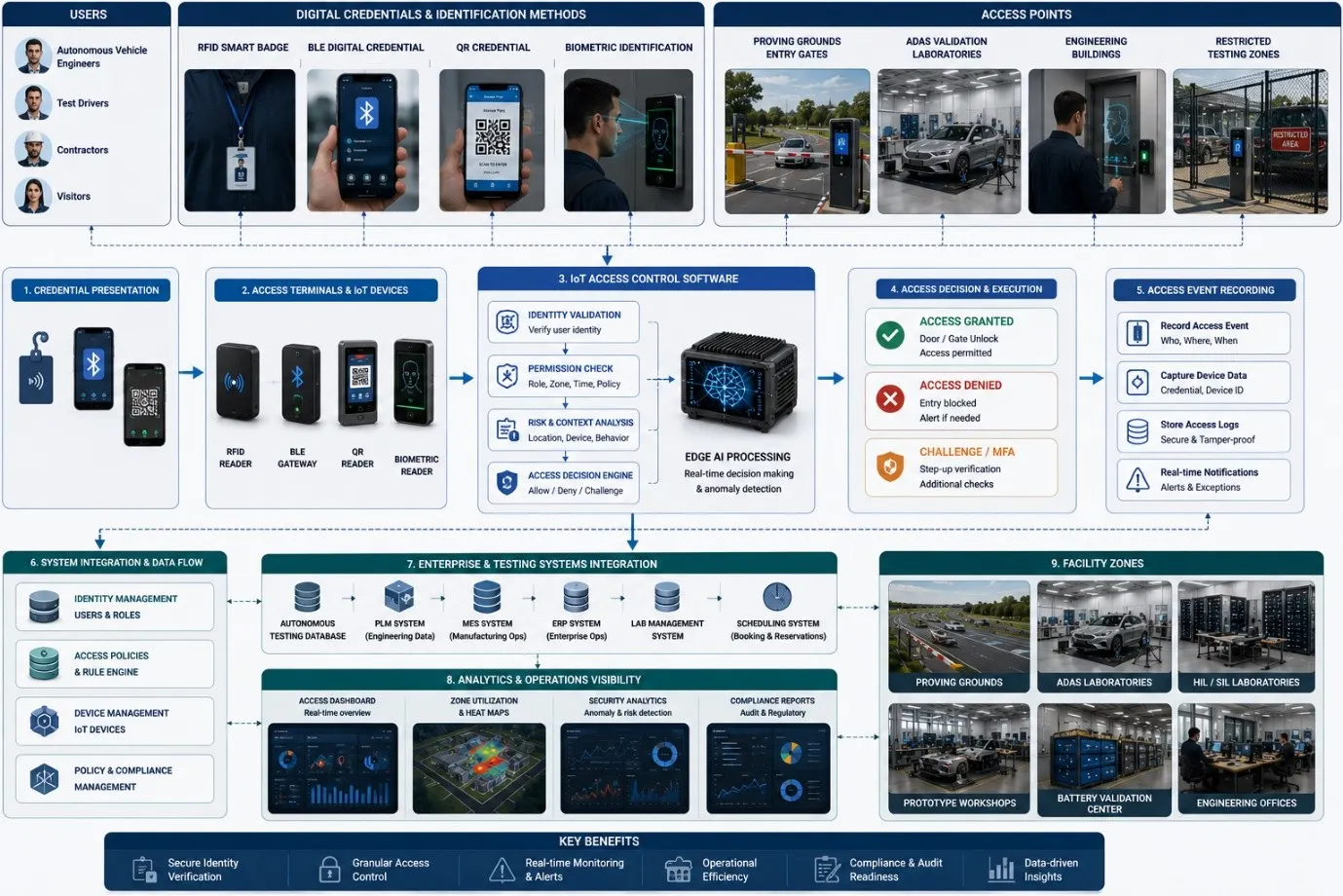
Validation access software enables automotive engineering organizations to manage digital identities, authorization rules, and access records across proving grounds, autonomous vehicle laboratories, prototype development facilities, and testing campuses.
The software connects identification technologies such as RFID credentials, BLE-enabled badges, QR-based access credentials, biometric readers, and smart access terminals to provide controlled entry management for different testing zones.
AIoT-enabled access management helps organizations verify:
- Who is entering a specific autonomous vehicle testing area
- Whether personnel have appropriate validation permissions
- When engineering teams access restricted facilities
- Which contractors or visitors are authorized for testing activities
- How access events relate to vehicle validation programs
Access control software is especially important for autonomous vehicle development because testing facilities frequently contain confidential prototype vehicles, proprietary ADAS systems, autonomous driving algorithms, and advanced engineering equipment.
AIoT Access Control Workflow for Autonomous Vehicle Testing Facilities
Digital Test Credential Software
Digital test credential software provides identity management capabilities for personnel involved in autonomous vehicle testing operations.
The software allows organizations to create and manage digital credentials for:
- Autonomous test drivers
- Validation engineers
- ADAS specialists
- Calibration technicians
- Engineering contractors
- Authorized visitors
Applications include:
- Digital identity verification
- Testing zone authorization
- Credential lifecycle management
- Access history tracking
- Integration with RFID and BLE identification systems
Digital credential management improves control over sensitive testing areas where vehicle prototypes, autonomous driving software, and engineering data require protection.
Proving Ground Access Software
Autonomous proving grounds often cover large outdoor areas containing multiple vehicle testing routes, simulation zones, preparation areas, and engineering support facilities.
Proving ground access software provides visibility into personnel authorization and movement across these complex testing environments.
Key applications include:
- Autonomous test driver authorization
- Validation engineer access management
- Test route area permissions
- Contractor access verification
- Visitor access monitoring
Integration with RFID, BLE, UWB, and GPS-based identification technologies enables organizations to support both outdoor and indoor testing requirements.
GPS-based solutions can support large-scale vehicle and personnel visibility across outdoor validation areas, while UWB and BLE technologies can provide more precise positioning within controlled testing locations.
ADAS Validation Laboratory Access Software
ADAS validation laboratories require controlled access because they contain specialized equipment, prototype systems, and confidential development resources.
ADAS laboratory access software supports:
- Engineer authentication
- Laboratory zone permissions
- Equipment area authorization
- Visitor management
- Validation activity records
The software helps automotive organizations maintain controlled environments for testing:
- Adaptive cruise control systems
- Lane assistance technologies
- Automated parking systems
- Vehicle perception systems
- Autonomous driving functions
Validation Visitor Access Software
Autonomous vehicle testing programs frequently involve suppliers, research organizations, certification personnel, and engineering partners.
Validation visitor access software helps organizations manage temporary access while protecting sensitive vehicle development activities.
Capabilities include:
- Visitor identity registration
- Temporary credential assignment
- Restricted area permissions
- Digital visitor records
- Access activity reporting
This supports collaboration while maintaining control over prototype vehicle and validation environments.
Test Contractor Authorization Software
External contractors often support autonomous vehicle testing through specialized activities such as vehicle preparation, calibration, equipment maintenance, and validation support.
Test contractor authorization software enables organizations to:
- Verify contractor identities
- Assign temporary permissions
- Control access duration
- Maintain contractor activity records
- Support compliance documentation
This capability improves coordination when multiple engineering organizations participate in autonomous vehicle validation programs.
Prototype Asset Tracking Software for Autonomous Vehicle Development
Prototype vehicles and engineering assets represent critical resources throughout autonomous vehicle development cycles. Poor asset visibility can delay validation schedules, reduce engineering efficiency, and increase operational costs.
Prototype asset tracking software provides digital identification and location visibility for:
- Prototype autonomous vehicles
- ADAS test equipment
- Calibration tools
- Diagnostic equipment
- Engineering components
- Mobile validation resources
The software uses RFID identification, BLE asset tracking, UWB positioning, and GPS fleet tracking technologies to connect physical assets with digital records.
For autonomous vehicle testing organizations, this enables faster asset discovery, improved utilization, and better coordination between engineering teams.
Prototype Vehicle Tracking Software
Prototype vehicle tracking software enables automotive organizations to monitor the location, assignment, and availability of development vehicles used for autonomous driving validation.
Applications include:
- Prototype vehicle identification
- Autonomous test fleet management
- Vehicle assignment tracking
- Validation vehicle availability
- Engineering usage records
Different tracking technologies support different testing conditions:
- GPS tracking software supports outdoor proving grounds and fleet operations
- UWB vehicle positioning supports high-accuracy indoor environments
- BLE identification supports facility-level asset visibility
- RFID identification supports vehicle recognition and inventory records
ADAS Test Equipment Tracking Software
ADAS validation requires specialized equipment including:
- Calibration systems
- Diagnostic tools
- Measurement equipment
- Vehicle interface devices
- Engineering test instruments
ADAS test equipment tracking software helps engineering teams locate and manage these resources throughout testing operations.
Capabilities include:
- Equipment identification
- Tool availability tracking
- Assignment management
- Engineering asset utilization analysis
- Calibration resource coordination
RFID and BLE asset tracking solutions reduce time spent searching for shared engineering equipment and improve resource availability.
RFID Prototype Asset Tracking Software
RFID prototype asset tracking software provides digital identification for components, tools, and engineering resources used in autonomous vehicle development.
Applications include:
- Prototype component identification
- Calibration equipment tracking
- Engineering tool management
- Asset lifecycle records
- Validation resource coordination
RFID technology is particularly useful for automotive development environments because it allows rapid identification of multiple tagged assets during engineering operations.
BLE Validation Asset Tracking Software
BLE validation asset tracking software supports location visibility for mobile assets used throughout autonomous vehicle testing facilities.
Applications include:
- Calibration tool location tracking
- Portable equipment management
- Shared engineering resource visibility
- Multi-location validation support
- Asset availability improvement
BLE-based asset identification solutions are useful when engineering teams frequently move equipment between laboratories, proving grounds, and prototype preparation areas.
UWB High-Accuracy Asset Positioning Software
UWB asset positioning software provides high-precision location capabilities for critical engineering resources.
Applications include:
- Indoor prototype vehicle positioning
- Laboratory equipment tracking
- High-value validation asset management
- Precision location within testing zones
UWB is especially valuable in environments where centimeter-level or near-real-time positioning accuracy is required.
Validation Inventory Software for Autonomous Vehicle Testing Operations
Autonomous vehicle testing requires accurate management of engineering inventory, including prototype components, ECUs, battery packs, replacement parts, and validation equipment.
Validation inventory software provides digital visibility into inventory location, availability, and allocation status by combining identification technologies with inventory management workflows.
The software helps organizations reduce validation delays caused by unavailable components and improves coordination between engineering teams, prototype programs, and testing operations.
Key applications include:
- Prototype parts inventory management
- Autonomous ECU inventory tracking
- Battery validation inventory control
- Engineering equipment availability management
- RFID-based inventory identification
Prototype Parts Inventory Software
Prototype parts inventory software supports tracking of vehicle components used during autonomous driving development.
Applications include:
- Prototype component identification
- Engineering parts availability tracking
- Replacement part management
- Test preparation coordination
- Component location visibility
RFID identification software allows organizations to associate physical automotive components with digital inventory records.
Autonomous ECU Inventory Software
Autonomous electronic control unit (ECU) inventory software supports management of computing hardware used in ADAS and autonomous driving systems.
The software helps organizations track:
- ECU hardware versions
- Development allocation
- Test program assignments
- Storage locations
- Engineering availability
Accurate ECU inventory tracking is important because autonomous vehicle programs often involve multiple hardware configurations and software validation cycles.
Battery Validation Inventory Software
Battery validation programs require careful tracking of battery packs, modules, and related engineering resources.
Battery validation inventory software supports:
- Battery pack identification
- Test allocation tracking
- Storage location visibility
- Engineering availability management
- Validation resource planning
RFID and BLE identification technologies help teams maintain accurate battery-related inventory records during vehicle testing programs.
Validation Equipment Inventory Software
Validation equipment inventory software supports management of specialized resources used across autonomous vehicle testing environments.
Applications include:
- Test instrument tracking
- Calibration equipment availability
- Engineering tool management
- Laboratory resource allocation
- Multi-site inventory visibility
This improves operational coordination when multiple validation programs share engineering resources.
AIoT Integration for Autonomous Vehicle Testing Software Operations
Autonomous vehicle development requires coordination between physical testing activities and digital engineering systems. IoT software provides the connection layer that organizes identification, location, access, asset, and inventory information generated throughout autonomous vehicle validation programs.
AIoT-enabled autonomous vehicle testing software combines AI and IoT technologies with industrial software systems to improve operational visibility across proving grounds, ADAS laboratories, prototype facilities, and validation centers.
The software can integrate information from:
- RFID identification systems for vehicles, components, and engineering assets
- BLE location solutions for workforce and equipment visibility
- UWB positioning systems for high-accuracy validation environments
- GPS tracking software for autonomous test fleets
- Digital access systems for controlled testing areas
These integrations help automotive engineering organizations connect physical resources with digital workflows used for autonomous driving validation.
Validation MES Integration
Validation Manufacturing Execution System (MES) integration connects identification and location information with engineering production and validation workflows.
Applications include:
- Prototype vehicle preparation tracking
- Validation resource coordination
- Engineering workflow visibility
- Test process documentation support
- Resource allocation improvement
Integration between IoT software and validation MES systems helps organizations maintain better alignment between prototype development activities and testing operations.
Prototype PLM Integration
Product Lifecycle Management (PLM) integration supports coordination between prototype vehicle configurations, engineering assets, and validation activities.
Applications include:
- Prototype configuration management
- Engineering change coordination
- Vehicle development record association
- Component identification tracking
- Validation history support
PLM integration helps connect physical prototype resources with engineering development information.
Engineering ERP Integration
Enterprise Resource Planning (ERP) integration enables coordination between autonomous vehicle testing resources and business systems.
Applications include:
- Engineering inventory management
- Equipment resource planning
- Component availability visibility
- Procurement coordination
- Asset lifecycle management
ERP connectivity supports better planning for complex autonomous vehicle development programs involving multiple engineering teams.
ADAS Laboratory Systems Integration
ADAS laboratories require integration between test equipment, access systems, engineering databases, and validation workflows.
IoT software integration supports:
- ADAS test equipment identification
- Laboratory resource visibility
- Validation personnel coordination
- Test area access management
- Engineering data synchronization
This helps organizations manage increasingly complex ADAS validation activities.
Autonomous Fleet Systems Integration
Autonomous fleet validation requires coordination between vehicles, tracking systems, and engineering operations.
Integration capabilities include:
- Autonomous vehicle location information
- Fleet assignment records
- Test vehicle availability
- Validation activity coordination
- Vehicle utilization analysis
GPS fleet tracking software combined with IoT identification solutions provides improved visibility across autonomous vehicle test programs.
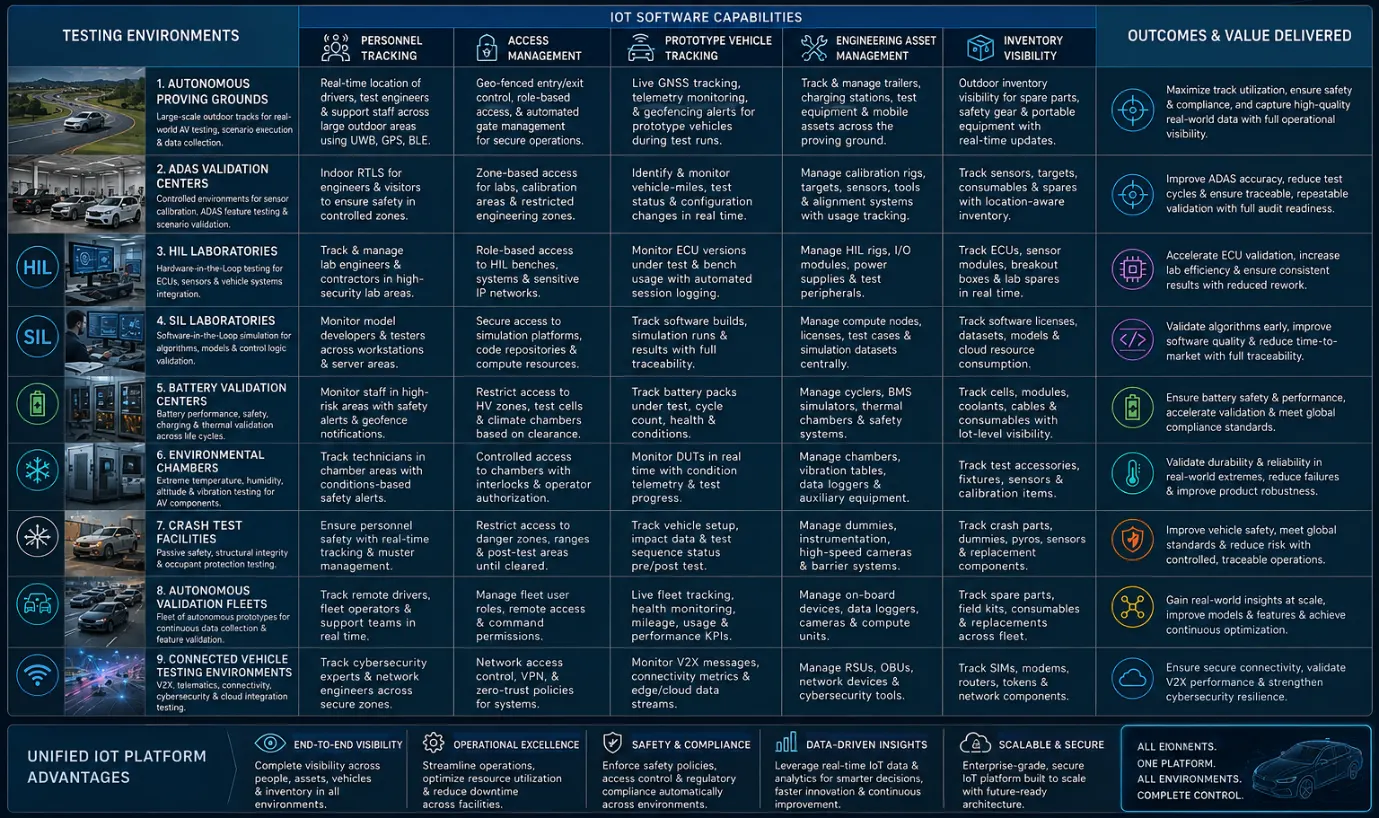
Autonomous Vehicle Testing Environments and IoT Software Capabilities Comparison Matrix
Why AVehicle AI for Autonomous Vehicle Testing IoT Software
AVehicle AI combines automotive engineering requirements with industrial IoT software capabilities designed for autonomous vehicle development and validation environments.
The solution approach is based on practical IoT experience from GAO, which has served thousands of IoT customers and completed thousands of IoT projects over two decades. AVehicle AI applies this experience to autonomous vehicle testing applications through dedicated research and development, quality assurance processes, and technical expertise provided remotely or onsite.
Supported by professionals including Ph.D. experts from leading universities, AVehicle AI has experience supporting:
- Fortune 500 companies
- Advanced research organizations
- Leading engineering firms
- Prestigious universities
- U.S. and Canadian government agencies
This experience helps address real-world autonomous vehicle testing requirements, including:
- Prototype vehicle identification challenges
- Large-scale proving ground visibility
- ADAS laboratory access management
- Engineering asset coordination
- Validation inventory tracking
- Multi-location testing operations
Future-Ready IoT Software for Autonomous Vehicle Validation
Autonomous vehicle testing continues to evolve as automotive organizations manage larger validation fleets, increasing software complexity, more prototype configurations, and distributed engineering operations.
AIoT-enabled IoT software helps organizations connect physical testing environments with digital engineering workflows through identification and location technologies.
By combining:
- RFID identification software
- BLE location solutions
- UWB positioning technology
- GPS fleet tracking software
- Industrial IoT integration
automotive engineering teams can improve:
- Test workforce visibility
- Prototype vehicle tracking
- Engineering asset utilization
- Validation inventory coordination
- Facility access management
- Operational traceability
AVehicle AI provides IoT software solutions designed for autonomous vehicle systems and testing operations, helping engineering teams manage critical identification and location information throughout the autonomous driving validation lifecycle.
Request Autonomous Vehicle Testing IoT Software Consultation
Autonomous vehicle development organizations require reliable software solutions to manage personnel, prototype vehicles, engineering assets, access permissions, and validation resources.
AVehicle AI supports automotive engineering teams evaluating AIoT-enabled IoT software solutions for:
- Autonomous proving grounds
- ADAS validation centers
- Prototype vehicle programs
- Vehicle calibration laboratories
- HIL and SIL testing environments
- Connected vehicle validation operations
Contact AVehicle AI to discuss IoT software solutions for autonomous vehicle systems and testing environments.
Contact AVehicle AI