
AIoT Applications Across Autonomous Vehicle Testing and Validation Environments
Autonomous Vehicle Systems & Testing requires complex validation activities across proving grounds, ADAS laboratories, simulation facilities, vehicle calibration centers, battery validation facilities, and autonomous test fleets. Automotive engineering organizations must coordinate prototype vehicles, validation engineers, test drivers, contractors, calibration equipment, autonomous driving software builds, and engineering components throughout the vehicle development lifecycle.
AIoT solutions help autonomous vehicle testing organizations improve operational visibility by connecting physical testing activities with digital engineering workflows. Using AI and IoT technologies such as RFID identification, BLE tracking, UWB positioning, GNSS vehicle tracking, and connected access systems, automotive teams can improve identification accuracy, location visibility, asset utilization, inventory control, and engineering traceability.
AVehicle AI focuses on AIoT applications designed specifically for autonomous vehicle validation environments where accurate identification and location information are essential for safe and efficient testing.
Autonomous Vehicle Testing Applications Overview
Autonomous vehicle development requires thousands of validation activities before autonomous driving systems and ADAS functions can be deployed commercially.
Testing programs commonly include:
- Autonomous driving scenario validation
- Advanced Driver Assistance Systems (ADAS) testing
- Vehicle software verification
- Electronic control unit (ECU) validation
- Autonomous vehicle calibration
- Battery system testing
- Environmental durability testing
- Prototype fleet validation
- Hardware-In-The-Loop (HIL) testing
- Software-In-The-Loop (SIL) testing
These activities involve large numbers of physical resources, including:
- Prototype autonomous vehicles
- Test vehicles equipped with ADAS functions
- Engineering vehicles
- Calibration tools
- Diagnostic equipment
- Battery modules and packs
- Validation components
- Test engineers and drivers
- Laboratory resources
Traditional manual tracking methods often create challenges when organizations need real-time visibility into vehicle locations, equipment availability, personnel movement, and prototype configuration status.
AIoT solutions provide connected identification and location capabilities that help automotive engineering teams manage complex testing environments.
AI and IoT combines artificial intelligence with IoT devices, connected identification technologies, industrial systems, and engineering software. AIoT solutions may incorporate Industrial AI, Edge AI, machine learning, and Physical AI concepts where appropriate for autonomous applications.
Within autonomous vehicle testing, AIoT enables organizations to better understand:
- Where prototype vehicles are located
- Which validation engineers are assigned to testing activities
- Where critical equipment is available
- Which components belong to specific vehicle configurations
- Which testing resources are being utilized
- How validation workflows are progressing
AIoT-Enabled Autonomous Vehicle Testing Environment Architecture Overview
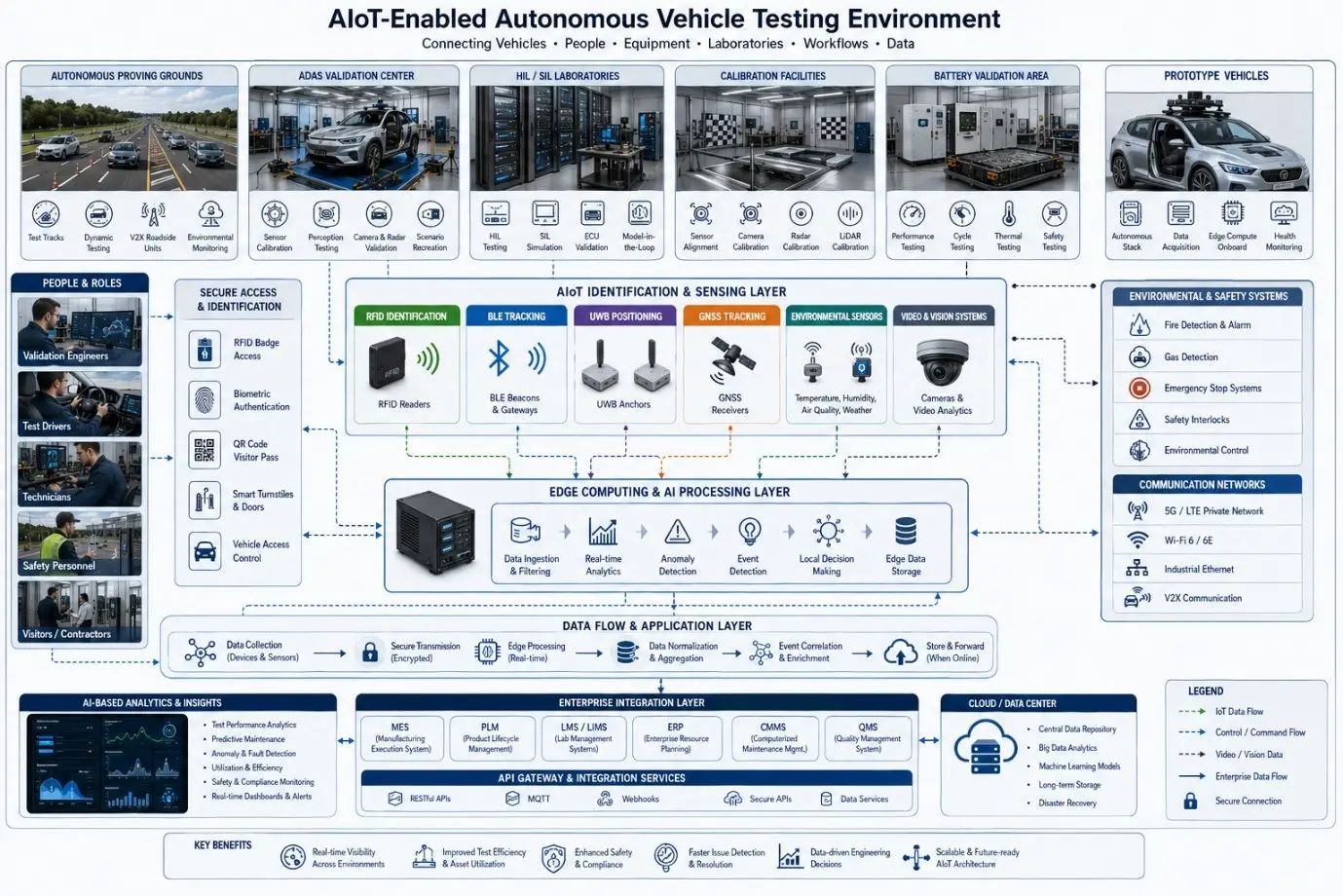
AIoT Identification and Location Solutions for Autonomous Vehicle Validation
Autonomous vehicle testing environments require precise identification and location visibility because validation activities involve high-value prototype vehicles, safety-critical components, and specialized engineering resources.
AIoT solutions support autonomous vehicle validation by combining connected identification technologies with AI-based software analysis.
Key application areas include:
- Autonomous test workforce location analytics
- Prototype autonomous vehicle tracking
- ADAS test equipment identification
- Validation asset management
- Restricted testing area access control
- Prototype component traceability
- Engineering inventory visibility
- Autonomous fleet utilization analysis
The primary technologies supporting these applications include RFID, BLE, UWB, and GNSS.
RFID Identification for Autonomous Vehicle Testing Assets
RFID technology provides digital identification capabilities for physical assets used throughout autonomous vehicle development.
Common RFID applications include:
- Prototype vehicle component identification
- Autonomous ECU tracking
- Battery module identification
- Calibration equipment management
- Validation inventory control
- Engineering sample tracking
RFID helps automotive organizations maintain accurate associations between physical components and engineering records.
For example, an autonomous vehicle validation team can identify which ECU, battery module, or prototype component is installed on a specific test vehicle and associate that information with validation activities.
This improves prototype configuration management and supports engineering change traceability during vehicle development.
BLE Tracking for Validation Workforce and Mobile Equipment
Bluetooth Low Energy (BLE) identification solutions support location visibility for personnel and mobile resources operating throughout autonomous testing facilities.
BLE applications include:
- Validation engineer location analytics
- Test driver identification
- Contractor tracking
- Emergency workforce accountability
- Mobile calibration equipment tracking
- Laboratory resource visibility
BLE is commonly used in environments such as:
- ADAS validation laboratories
- Vehicle calibration centers
- Engineering workshops
- Prototype preparation areas
By providing location information for authorized personnel and mobile assets, BLE solutions help improve coordination across complex validation operations.
UWB Positioning for High-Accuracy Autonomous Testing Environments
Ultra-Wideband (UWB) positioning technology supports high-accuracy location requirements where precise positioning is necessary.
Typical UWB applications include:
- Prototype autonomous vehicle positioning
- Indoor validation equipment tracking
- ADAS laboratory asset location
- Calibration tool management
- Controlled testing zone visibility
UWB is particularly valuable in environments where engineering teams require more precise location information than conventional positioning methods can provide.
Examples include vehicle preparation areas, controlled test facilities, and specialized validation laboratories.
GNSS Tracking for Autonomous Validation Fleets
Global Navigation Satellite System (GNSS) tracking supports outdoor autonomous vehicle testing programs where vehicles operate across proving grounds and extended validation routes.
GNSS applications include:
- Autonomous test vehicle location tracking
- Validation fleet utilization analysis
- Test route visibility
- Vehicle deployment monitoring
- Outdoor prototype fleet management
GNSS information combined with AI-based software helps engineering teams analyze vehicle usage patterns and improve validation planning.
Autonomous Proving Grounds
Autonomous proving grounds are critical testing environments where automotive organizations validate autonomous driving functions, ADAS performance, vehicle dynamics, and safety scenarios before public deployment.
These facilities may include:
- Highway simulation tracks
- Urban driving environments
- Intersection testing zones
- Parking validation areas
- ADAS scenario fields
- Vehicle preparation facilities
- Engineering support buildings
Managing proving grounds requires accurate visibility into:
- Prototype vehicle locations
- Test driver activities
- Validation engineer assignments
- Test equipment availability
- Restricted area access
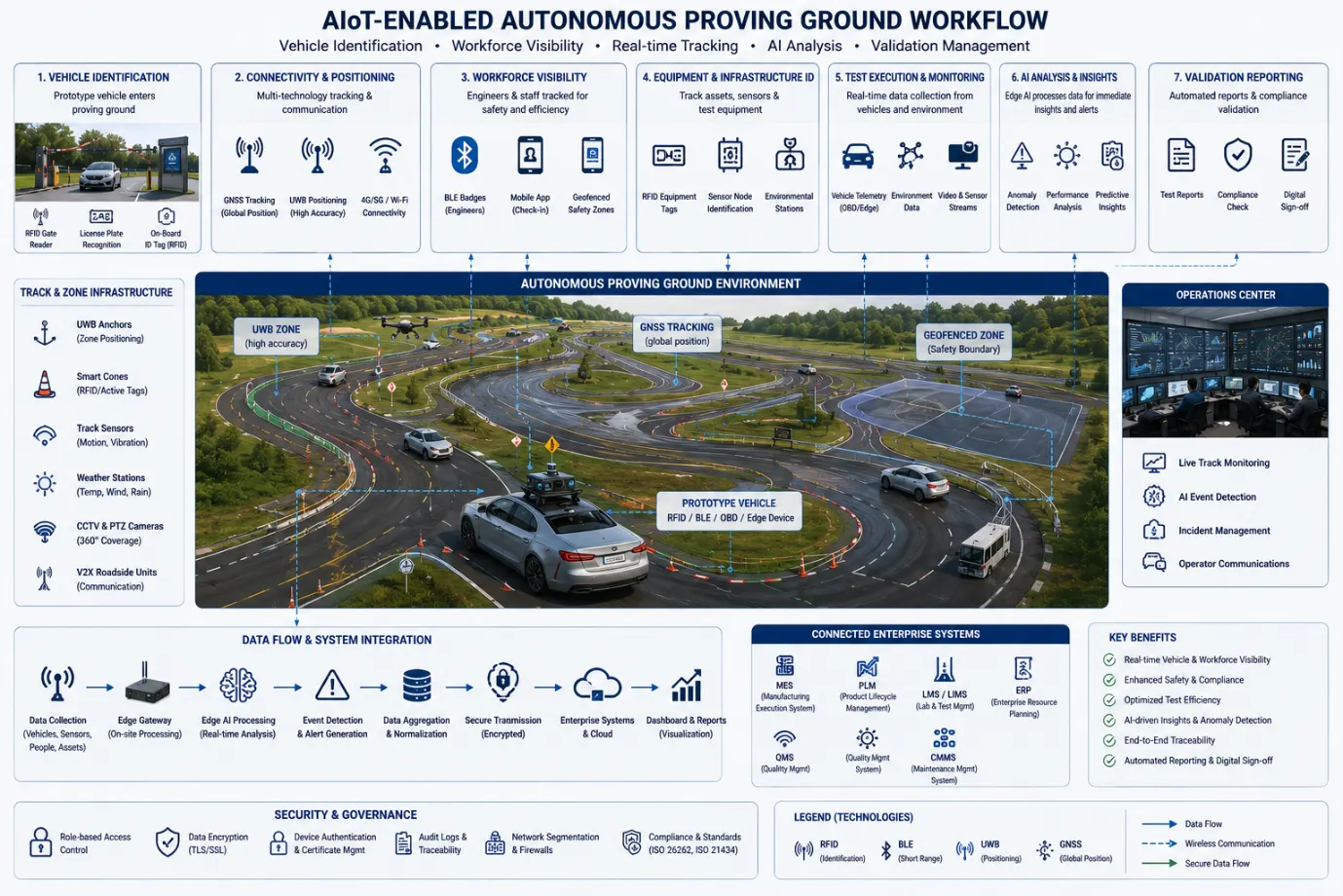
AIoT solutions support autonomous proving grounds through:
- Prototype autonomous vehicle tracking
- GNSS-based fleet visibility
- UWB vehicle positioning
- BLE workforce tracking
- RFID equipment identification
- Digital access authorization
Outdoor proving grounds commonly use GNSS tracking for vehicle movement visibility, while controlled areas may use BLE or UWB technologies for more detailed location information.
AI-based software can analyze validation activities, vehicle utilization patterns, and resource availability to support more efficient autonomous testing operations.
AIoT Autonomous Proving Ground Workflow for Vehicle Validation and Engineering Operations
ADAS Validation Centers
ADAS validation centers test advanced driver assistance functions before integration into production vehicles.
Testing activities include:
- Adaptive cruise control validation
- Lane assistance testing
- Automated parking verification
- Collision avoidance evaluation
- Driver monitoring system validation
- Vehicle perception testing
- ADAS software verification
These facilities require controlled access, accurate asset identification, and reliable validation records.
AIoT applications support ADAS validation centers through:
- Validation engineer access management
- Prototype vehicle identification
- ADAS equipment tracking
- Calibration asset visibility
- Test contractor authorization
- Engineering workflow coordination
RFID identification helps associate components and equipment with specific ADAS validation programs. BLE and UWB technologies support location visibility for mobile equipment and personnel within laboratory environments.
Secure access solutions help ensure that only authorized personnel enter restricted validation areas containing sensitive autonomous vehicle development resources.
Vehicle Calibration Laboratories
Vehicle calibration laboratories are essential environments for autonomous vehicle development where automotive engineers validate vehicle behavior, electronic control systems, autonomous driving functions, and ADAS performance.
Calibration activities ensure that hardware components, embedded software, vehicle controllers, and autonomous driving algorithms operate according to engineering specifications.
Common vehicle calibration activities include:
- ADAS parameter calibration
- Electronic Control Unit (ECU) validation
- Vehicle dynamics testing
- Powertrain calibration
- Steering and braking system validation
- Autonomous driving function optimization
- Vehicle communication verification
These laboratories contain high-value prototype vehicles, diagnostic equipment, calibration instruments, engineering tools, and specialized validation resources.
Maintaining accurate identification and location visibility of these resources is important because calibration teams frequently move equipment between multiple test areas.
AIoT applications support vehicle calibration laboratories through:
- Prototype vehicle identification
- Calibration equipment tracking
- Validation engineer location analytics
- Diagnostic tool management
- Test component traceability
- Laboratory access control
RFID identification helps engineering teams associate calibration tools, prototype components, and diagnostic equipment with specific validation programs.
BLE tracking supports visibility of mobile calibration assets that move between vehicle bays, engineering rooms, and test areas.
UWB positioning provides higher location accuracy for controlled laboratory environments where precise equipment and vehicle positioning is required.
AI-based software can analyze equipment utilization, resource availability, and calibration workflow information to improve coordination between engineering teams.
Hardware-In-The-Loop (HIL) Laboratories
Hardware-In-The-Loop laboratories are critical validation environments used by automotive engineering teams to test electronic control units, autonomous driving controllers, and vehicle hardware components under controlled simulation conditions.
HIL testing allows engineers to evaluate vehicle systems before complete vehicle deployment by connecting physical hardware with simulated driving scenarios.
Common HIL validation activities include:
- Autonomous driving controller testing
- ADAS ECU validation
- Vehicle communication verification
- Safety function testing
- Power management validation
- Embedded software verification
HIL laboratories contain complex testing resources including:
- ECU test units
- Simulation equipment
- Prototype hardware components
- Test benches
- Engineering workstations
- Calibration equipment
AIoT solutions improve HIL laboratory operations by providing visibility into physical resources supporting validation activities.
Applications include:
- ECU identification and traceability
- Test equipment location visibility
- Validation engineer access management
- Prototype component tracking
- Laboratory asset utilization analysis
RFID identification helps maintain accurate records of ECU units, prototype modules, and test components throughout validation cycles.
BLE identification supports tracking of mobile equipment used across multiple HIL testing stations.
Access control solutions help protect restricted HIL environments where confidential autonomous vehicle software and hardware testing occurs.
AI-based software can connect identification information with validation records to improve operational visibility and reduce delays caused by unavailable or misplaced resources.
Software-In-The-Loop (SIL) Laboratories
Software-In-The-Loop laboratories validate autonomous vehicle software functions through simulation-based testing before deployment into physical vehicles.
SIL environments are widely used for:
- Autonomous driving algorithm testing
- Virtual vehicle simulation
- ADAS software verification
- Scenario-based validation
- Software build testing
- Regression testing
Although SIL testing primarily focuses on software validation, physical engineering operations still require effective management of personnel, equipment, access permissions, and development resources.
AIoT solutions support SIL environments through:
- Engineering personnel identification
- Restricted laboratory access control
- Test equipment identification
- Software validation workflow traceability
- Engineering resource management
Connected identification systems help organizations associate validation activities with authorized engineering personnel and approved testing resources.
For example, access management solutions can ensure that only authorized engineers enter software validation areas containing confidential autonomous driving development resources.
AI-based software can analyze validation workflow information and support better coordination between software engineering teams, simulation engineers, and vehicle testing groups.
Battery Validation Centers
Battery validation centers support electric and autonomous vehicle development by testing battery packs, energy storage systems, charging performance, thermal behavior, and safety requirements.
Modern autonomous vehicles increasingly depend on advanced electric vehicle systems, making battery validation an important part of vehicle testing programs.
Battery validation operations include:
- Battery pack testing
- Battery module verification
- Charging system validation
- Thermal performance testing
- Energy management evaluation
- Battery safety testing
These facilities manage high-value prototype assets requiring accurate identification and traceability.
AIoT applications support battery validation centers through:
- Battery pack identification
- Prototype component traceability
- Validation equipment tracking
- Restricted area access management
- Battery inventory visibility
- Engineering workflow coordination
RFID identification enables battery packs, modules, and prototype components to be associated with specific validation records.
BLE tracking supports location visibility for mobile battery testing equipment and engineering resources.
UWB positioning can support precise tracking within controlled battery testing areas where accurate equipment location is important.
AI-based software can analyze asset movement, validation activities, and resource availability to improve battery testing operations.
Environmental Vehicle Test Chambers
Environmental vehicle test chambers validate autonomous vehicles and components under controlled operating conditions.
These facilities simulate challenging environments to evaluate vehicle reliability and system performance.
Environmental testing applications include:
- Cold-weather vehicle testing
- High-temperature validation
- Climate chamber testing
- Durability evaluation
- Component reliability testing
- Vehicle system verification
These facilities require coordination of:
- Prototype vehicles
- Engineering teams
- Test equipment
- Calibration resources
- Validation schedules
AIoT solutions help environmental test facilities improve operational visibility through:
- Vehicle identification
- Equipment tracking
- Personnel access control
- Validation resource management
- Test asset traceability
RFID identification helps associate vehicles and components with environmental testing records.
BLE and UWB technologies support location visibility inside controlled test environments.
AI-based analysis helps engineering teams understand equipment utilization, testing progress, and resource allocation.
Autonomous Validation Fleets
Autonomous validation fleets consist of prototype vehicles used for autonomous driving development, ADAS testing, and real-world validation programs.
Fleet operations may include:
- Closed-course proving ground testing
- Public-road validation programs
- Autonomous driving scenario testing
- Software release verification
- Vehicle configuration validation
Managing autonomous validation fleets requires visibility into:
- Vehicle location
- Vehicle assignment
- Test activity
- Prototype configuration
- Engineering ownership
- Fleet availability
AIoT solutions support autonomous validation fleets through:
- GNSS vehicle tracking
- Prototype vehicle identification
- Fleet utilization analytics
- Validation asset management
- Configuration traceability
- Engineering access control
GNSS tracking supports outdoor vehicle location visibility across proving grounds and extended testing routes.
RFID identification supports vehicle configuration management by linking physical vehicles and components with engineering records.
BLE and UWB technologies support controlled environments such as vehicle preparation areas and autonomous testing facilities.
AI-based software can analyze validation fleet information to improve vehicle utilization, scheduling, and engineering decision-making.
AIoT Applications Across Autonomous Vehicle Testing Environments
Autonomous vehicle testing involves interconnected operations across laboratories, proving grounds, and fleet validation programs.
AIoT solutions provide visibility across:
- Personnel and validation teams
- Prototype autonomous vehicles
- ADAS testing equipment
- Calibration resources
- Battery validation assets
- Engineering components
- Testing workflows
By combining AI software with RFID, BLE, UWB, GNSS, and connected access technologies, automotive organizations can improve operational accuracy and strengthen control over autonomous vehicle validation activities.
AIoT Integration with Autonomous Vehicle Engineering Systems
Autonomous vehicle testing requires coordination between physical validation activities and multiple automotive engineering software systems. Prototype vehicles, test equipment, engineering personnel, and validation workflows must remain connected throughout the vehicle development lifecycle.
AIoT solutions help automotive organizations connect physical identification and location information with existing engineering systems, improving visibility across autonomous vehicle validation operations.
Common integration areas include:
- Product Lifecycle Management (PLM) systems
- Manufacturing Execution Systems (MES)
- Enterprise Resource Planning (ERP) systems
- Autonomous fleet management systems
- Laboratory management systems
- Validation management software
- Engineering data management systems
AI and IoT identification and location solutions provide additional operational information that complements existing automotive engineering applications.
Examples include:
- Linking prototype vehicle identification data with validation records
- Associating autonomous vehicle components with engineering configurations
- Connecting equipment locations with laboratory workflows
- Synchronizing asset information with inventory systems
- Supporting validation evidence traceability
- Improving visibility of engineering resource utilization
These integrations help reduce manual tracking processes and provide engineering teams with more accurate information about physical testing activities.
Validation Data Synchronization for Autonomous Vehicle Testing
Autonomous vehicle validation generates large amounts of engineering information from multiple testing environments.
Organizations must coordinate information from:
- Autonomous proving grounds
- ADAS validation centers
- HIL laboratories
- SIL laboratories
- Calibration facilities
- Battery testing centers
- Environmental test chambers
- Autonomous validation fleets
AIoT solutions support validation data synchronization by connecting identification and location information with engineering workflows.
Applications include:
- Prototype vehicle status synchronization
- RFID-based component information exchange
- BLE workforce activity synchronization
- UWB location data integration
- GNSS fleet location synchronization
- Digital validation record updates
For example, when a prototype autonomous vehicle enters a validation area, identification information can be associated with the related engineering program, test campaign, configuration record, and responsible validation team.
This improves traceability throughout autonomous vehicle development.
Secure Access Management for Autonomous Vehicle Testing Facilities
Autonomous vehicle testing environments often contain confidential vehicle designs, proprietary software, prototype hardware, and safety-critical validation activities.
Controlled access is required for facilities including:
- ADAS validation laboratories
- Autonomous vehicle software testing rooms
- Prototype preparation areas
- Battery validation facilities
- HIL testing laboratories
- Engineering workshops
AIoT-enabled access solutions improve facility control through:
- Digital test credentials
- RFID access identification
- BLE-enabled personnel identification
- Smart access terminals
- Validation contractor authorization
- Visitor access management
These solutions help organizations verify that authorized personnel are accessing appropriate testing areas.
Examples include:
- Restricting access to autonomous driving software validation rooms
- Managing contractor access during prototype testing
- Tracking authorized personnel entering battery validation areas
- Maintaining access records for engineering audits
AI-based software can analyze access information to support operational reporting and improve accountability within autonomous vehicle testing facilities.
AIoT Support for Autonomous Vehicle Testing Safety and Operational Efficiency
Safety and operational efficiency are critical requirements across autonomous vehicle validation environments.
Testing facilities must manage:
- Moving prototype vehicles
- Restricted engineering areas
- High-value equipment
- Complex validation schedules
- Multiple engineering teams
- External testing contractors
AIoT identification and location solutions support safer operations by improving visibility into physical resources.
Key applications include:
- Validation workforce location analytics
- Emergency personnel accountability
- Prototype vehicle identification
- Test equipment visibility
- Restricted zone access control
- Engineering asset traceability
Improved visibility allows automotive organizations to better coordinate testing activities while maintaining operational discipline.
AIoT solutions support engineering teams by providing accurate information about physical assets involved in autonomous vehicle development.
AVehicle AI Experience in AIoT-Enabled Autonomous Vehicle Testing Solutions
AVehicle AI is created within Aperture Venture Studio, with support from GAO.
Building on two decades of IoT experience, GAO has supported thousands of IoT customers and successfully completed thousands of IoT projects across industrial and technology environments.
AVehicle AI applies practical IoT experience, engineering knowledge, and real-world deployment lessons to develop AI and IoT solutions for autonomous vehicle systems and testing applications.
The company has made significant investments in research and development supported by:
- Quality assurance processes
- Experienced engineering specialists
- Remote and onsite technical support
- Advanced IoT research capabilities
AVehicle AI is supported by Ph.D. professionals from leading universities and works with experienced technical experts and strategic partners.
Over the years, related IoT capabilities have supported:
- Fortune 500 companies
- Leading research and development organizations
- Prestigious universities
- U.S. and Canadian government agencies
This experience supports the development of reliable AIoT solutions for automotive organizations requiring accurate identification, location visibility, access management, prototype tracking, and validation traceability.
Enterprise Benefits of AIoT Applications for Autonomous Vehicle Testing
AIoT solutions provide measurable operational improvements across autonomous vehicle validation environments.
Key benefits include:
- Improved prototype vehicle visibility
- Faster identification of engineering assets
- Better management of validation workforce activities
- Enhanced access control for restricted facilities
- Improved prototype component traceability
- More accurate inventory information
- Better utilization of testing equipment
- Reduced manual tracking requirements
- Improved coordination between engineering teams
- Stronger validation workflow visibility
These capabilities help automotive organizations manage increasingly complex autonomous vehicle development programs.
AIoT does not replace existing automotive engineering systems. Instead, it provides additional identification and location capabilities that connect physical testing operations with digital engineering workflows.
Explore AIoT Applications for Autonomous Vehicle Systems & Testing
Autonomous vehicle development requires accurate coordination between vehicles, engineering teams, facilities, equipment, and validation workflows.
AVehicle AI provides AI and IoT identification and location solutions supporting:
- Autonomous proving grounds
- ADAS validation centers
- Vehicle calibration laboratories
- Hardware-In-The-Loop testing facilities
- Software-In-The-Loop laboratories
- Battery validation centers
- Environmental vehicle test chambers
- Autonomous validation fleets
By combining AI software with RFID, BLE, UWB, GNSS, and connected identification technologies, automotive organizations can improve operational visibility and strengthen control across autonomous vehicle testing programs.
Contact AVehicle AI for Autonomous Vehicle Testing AIoT Solutions
Automotive organizations developing autonomous vehicles require reliable visibility across complex validation environments.
AVehicle AI helps engineering teams evaluate AIoT solutions for:
- Autonomous test workforce tracking
- Prototype vehicle identification
- Validation facility access management
- ADAS equipment tracking
- Calibration asset management
- Prototype inventory visibility
- Engineering traceability
- Autonomous validation fleet operations
Contact AVehicle AI to explore AI and IoT solutions designed for autonomous vehicle systems and testing environments.
Contact AVehicle AI